At 2:00 a.m., the phone rings, a pump motor has tripped, production is down, and every lost hour is expensive. You arrive, run a few checks, and find the motor is burned out. The worst part is that the failure usually started weeks earlier, with small signs that no one chased down.
That pattern is common because induction motors are tough, not indestructible. They run pumps, fans, compressors, conveyors, and countless other loads, and they consume a huge share of industrial electricity worldwide. When induction motors fail, the cause is often heat, dirt, poor power, bad lubrication, or a mechanical problem upstream.
If you know where to look, you can catch most of these problems before they turn into a rewind or a replacement.
Table of Contents
Why induction motors fail so often in industrial service
Induction motors live hard lives. They start under load, sit in heat, breathe dust, and often run for long shifts without a break. That is why reliability depends less on the motor’s nameplate and more on maintenance habits, operating conditions, and how quickly a small symptom gets taken seriously.
For a broader look at why these machines are so common, and what they need to stay healthy, see these common maintenance needs for induction motors.
The hidden cost of a single motor trip
A failed motor rarely stays a motor problem. One trip can stop a line, starve another machine, miss a shipment, and force a rushed repair during the worst possible shift. Then the bill grows, overtime labor, emergency parts, and lost production.
That pattern shows up in motor maintenance literature too, because the real cost is usually downtime, not copper and steel alone.
The warning signs usually show up early
Motors usually speak before they die. You might see rising vibration, hotter bearing housings, nuisance thermal trips, a slight current increase, or a drop in insulation resistance after a long idle period.
A motor that runs hotter, louder, or rougher than it did last month is already giving you a warning.
Good programs catch that drift early. A practical motor failure prevention program starts with baseline readings, then compares future readings against them.
The five main reasons induction motors fail and how to stop them
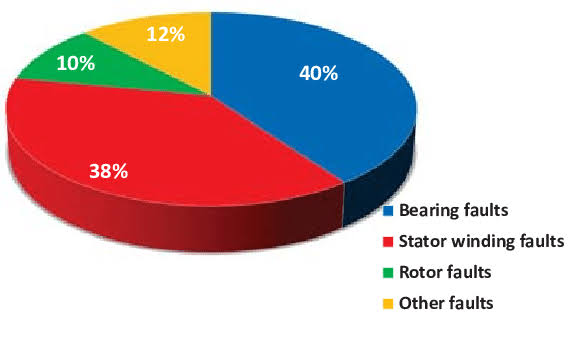
The usual causes are well known. In the EPRI preventive maintenance guide, the same themes keep showing up, bearings, insulation, heat, contamination, power quality, and load. Failures may look sudden on the day of the trip, but the damage often builds slowly.
Bearing damage starts with grease, dirt, and stray current
Bearing failure is one of the top reasons induction motors fail. Bearings carry the rotor shaft and let it spin with low friction. When they go bad, the first clues are often vibration, noise, and temperature rise.
Poor lubrication causes many of these failures. Too little grease leaves metal surfaces unprotected, but too much grease can also churn, overheat, and damage the bearing. Dust, moisture, and chemicals make things worse fast. In VFD-driven motors, stray shaft current can also pass through the bearing and pit the metal over time.
The fix is simple, but it has to be consistent. Follow the maker’s lubrication interval and grease quantity, not shop habit. Add routine vibration checks, because they catch bearing trouble early. On VFD-fed motors, insulated bearings or shaft-grounding rings help stop electrical damage before it starts.
Overheating slowly eats the winding insulation
Heat is the enemy that keeps working after the shift ends. A common rule used in motor insulation life says that for every 10 C rise above the rated winding temperature, insulation life is cut in half.
That extra heat can come from overload, blocked cooling vents, high room temperature, or too many starts and stops. Each restart dumps more heat into the winding, and if the motor never cools properly, the insulation ages faster. Over time, a healthy motor turns into a winding fault waiting to happen.
A thermal overload trip is a warning, not a nuisance to reset.
Clean the cooling paths, check that the fan and vents are clear, and verify that the motor is sized correctly for the job. On important assets, winding thermistors or RTDs give you early notice before heat becomes damage.
Voltage problems can hurt a healthy motor
A motor can be mechanically sound and still fail because the supply is poor. Voltage imbalance is one of the most damaging cases. Even a small imbalance across three phases can push winding temperature up hard because the current becomes uneven.
Overvoltage and undervoltage also matter. Most motors are built to run within plus or minus 10 percent of nameplate voltage. Outside that band, the motor draws current differently, loses efficiency, and runs hotter. Then there are spikes and transients from switching events, capacitor banks, or lightning. One sharp event can puncture insulation and create an instant fault.
The answer starts with measurement. Check all three phases and log the values instead of relying on one quick reading. If several motors on one feeder fail early, look upstream for load imbalance or other power quality trouble. On critical circuits, surge protection and power quality analysis are worth the effort.
Contamination and moisture turn a tough motor into a fragile one
Many motors fail because the plant environment gets inside the frame. Dust, oil mist, and chemical vapor can clog cooling passages and coat winding surfaces. Once that layer builds up, the motor runs hotter and the insulation has a better path for tracking and breakdown.
Moisture is even worse. Idle motors are especially exposed because condensation can form inside the housing while the machine sits cold. Then the next start becomes the moment of failure, not because the motor was weak that day, but because the insulation resistance had already fallen too far.
Use the right enclosure for the location, and for many outdoor industrial jobs, IP55 is a sensible minimum. Idle motors often need anti-condensation heaters. Before restarting a spare or standby unit that has been sitting, do insulation testing for electric motors so moisture problems show up on a meter, not during an emergency start.
Mechanical overload and misalignment wear everything out
Sometimes the motor is not the root cause at all. The driven machine is. Misalignment between the motor and the load creates extra bearing force, vibration, and seal wear. Over time, that stress shortens bearing life and can damage the shaft or coupling.
Mechanical overload does the same kind of harm from a different angle. A jammed conveyor, a blocked pump, or a driven bearing that starts to seize will force the motor to pull more current and run hotter. If a cooling tower fan coupling wears out or a rotor becomes unbalanced, the motor may fail again and again while the real problem stays in place.
Laser alignment beats eyeballing every time. Inspect couplings during shutdowns, and watch for sustained current increases in normal operation. If the same motor fails twice, stop treating it as bad luck and review the entire machine train.
Partial discharge is the hidden risk in VFD and medium-voltage systems
Partial discharge is not a full short circuit. It is a series of tiny electrical sparks inside the insulation system. Each event is small, but repeated stress can hollow out insulation over many operating hours.
Why VFD switching can create extra insulation stress
In standard 415 V or 480 V motors running on clean supply, partial discharge is usually not the first concern. VFDs change that picture because they switch fast and produce steep-front voltage pulses. At the motor terminals, those pulses can create spikes far above the nominal supply, sometimes approaching twice the incoming voltage.
That extra stress can start PD activity in places where insulation is already weak. The motor may keep running for a long time, but the damage keeps accumulating inside the winding.
When to monitor for partial discharge
Medium-voltage motors, especially above 3.3 kV, deserve closer attention. On those machines, routine PD monitoring helps you trend insulation condition before a hard failure lands you in outage mode.
IEEE 1434 and IEC 60034-27 are common references for PD testing on rotating machines. Online monitoring with capacitive couplers is one way to trend changes over time. If you work with larger assets, these medium voltage motor fault protection strategies fit well with insulation monitoring and event review.
Keep the trip from becoming a burnout
Most induction motor failures trace back to a small set of causes, bearing damage, overheating, bad voltage, contamination or moisture, and mechanical overload or misalignment. In newer VFD-driven and medium-voltage systems, partial discharge adds another layer of insulation stress that can’t be ignored.
The main lesson is simple: most motor failures are preventable. Pay attention to the early clues, investigate repeat trips, and fix the real cause instead of swapping parts. That is how you keep a 2:00 a.m. phone call from turning into a burned motor and a dead production line.