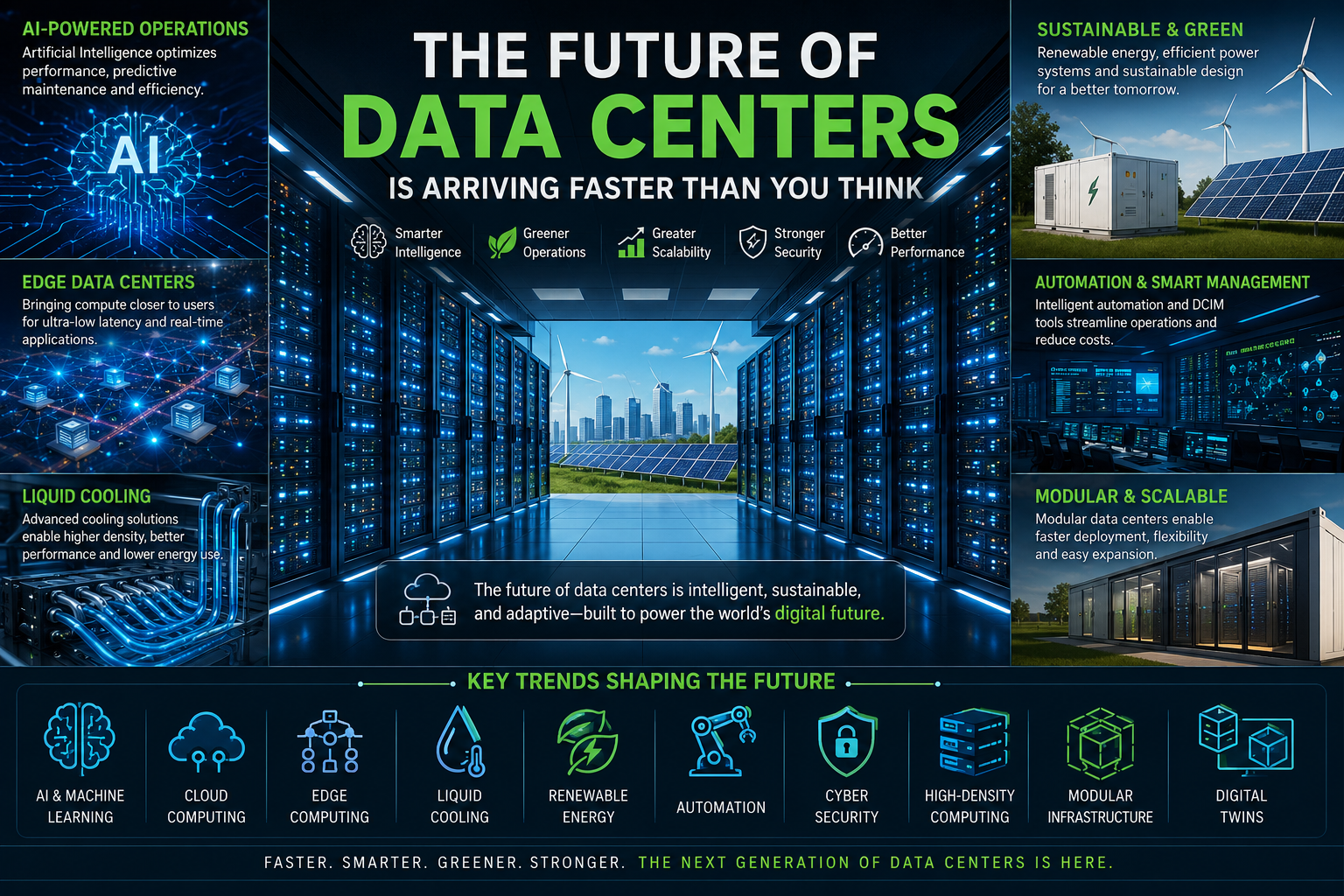
The future of data centers is evolving at an unprecedented pace. As artificial intelligence (AI), cloud computing, 5G, edge computing, and the Internet of Things (IoT) continue to grow, the demand for faster, smarter, and more energy-efficient data centers is reaching new heights.
Modern data centers are no longer just buildings filled with servers. They are becoming intelligent digital infrastructure capable of self-monitoring, predictive maintenance, automated resource allocation, and sustainable operations.
Industry analysts predict that global investments in data center infrastructure will continue to grow rapidly throughout 2026 and beyond, driven by AI workloads, enterprise digital transformation, and the expansion of hyperscale cloud providers.
In this article, we’ll explore the biggest technologies shaping the next generation of data centers and what businesses should expect over the coming years.
Table of Contents
Why Data Centers Matter More Than Ever
Nearly every digital service depends on data centers.
From streaming platforms and online banking to industrial automation, healthcare, electric vehicles, and smart cities, data centers power the modern digital economy.
Growing technologies include:
- Artificial Intelligence
- Machine Learning
- Cloud Computing
- Edge Computing
- Autonomous Vehicles
- Smart Manufacturing
- Digital Twins
- Industrial IoT
- 5G Networks
- High Performance Computing (HPC)
Without next-generation infrastructure, these technologies simply cannot scale.
AI Is Transforming Data Centers
Artificial Intelligence is creating one of the biggest shifts in data center history.
Traditional enterprise applications required moderate computing power.
Modern AI models demand:
- Thousands of GPUs
- Massive memory bandwidth
- Ultra-low latency networking
- High-density server racks
- Advanced cooling systems
AI is not only consuming more computing resources—it is also helping optimize data center operations.
AI-powered management systems can:
- Predict equipment failures
- Optimize cooling automatically
- Reduce energy consumption
- Detect cybersecurity threats
- Balance server workloads
- Improve resource utilization
This creates smarter, more autonomous facilities.
Edge Data Centers Will Expand Rapidly
Cloud computing remains essential, but users increasingly expect real-time responses.
Applications such as:
- Autonomous vehicles
- Smart factories
- Remote healthcare
- Industrial robotics
- AR/VR
- Smart cities
cannot tolerate long network delays.
This is where edge data centers become essential.
Instead of sending all data to centralized cloud facilities, edge data centers process information closer to users, reducing latency while improving reliability.
Expect thousands of new micro data centers to be deployed worldwide over the next decade.
Liquid Cooling Is Becoming the New Standard
AI servers generate enormous amounts of heat.
Traditional air cooling is reaching its practical limits.
Modern facilities are rapidly adopting:
- Direct-to-chip liquid cooling
- Immersion cooling
- Rear-door heat exchangers
- Hybrid cooling systems
Benefits include:
- Lower electricity usage
- Higher rack density
- Better GPU performance
- Reduced cooling costs
- Improved hardware lifespan
Liquid cooling will become increasingly common as AI infrastructure expands.
Sustainability Is No Longer Optional
Energy consumption has become one of the biggest challenges facing data centers.
Operators are investing heavily in sustainable technologies, including:
- Solar power
- Wind energy
- Battery energy storage systems
- Smart power management
- Waste heat recovery
- High-efficiency UPS systems
- Water-saving cooling technologies
Many organizations are also setting ambitious carbon-neutral and net-zero goals.
Future data centers will prioritize both performance and environmental responsibility.
Automation Is Redefining Operations
Manual management is becoming increasingly impractical as facilities grow larger and more complex.
Automation technologies now handle:
- Server provisioning
- Capacity planning
- Infrastructure monitoring
- Predictive maintenance
- Power optimization
- Security monitoring
- Incident response
Data Center Infrastructure Management (DCIM) software, combined with AI, enables operators to monitor thousands of assets from a single dashboard.
This reduces operational costs while improving uptime.
Modular Data Centers Are Gaining Momentum
Construction timelines for traditional facilities can stretch across several years.
Modular data centers offer a faster alternative.
Advantages include:
- Faster deployment
- Lower construction costs
- Scalability
- Easier maintenance
- Improved energy efficiency
- Flexible expansion
Many enterprises now deploy prefabricated modular data centers for manufacturing plants, telecom networks, and remote industrial sites.
Cybersecurity Will Become Even More Critical
As digital infrastructure expands, cyber threats continue to evolve.
Future data centers must defend against:
- Ransomware
- Distributed Denial-of-Service (DDoS) attacks
- Insider threats
- Supply chain vulnerabilities
- AI-driven cyberattacks
Security strategies increasingly include:
- Zero Trust Architecture
- AI-powered threat detection
- Multi-factor authentication
- Continuous monitoring
- Secure hardware roots of trust
- Network segmentation
Cyber resilience is now a core requirement for modern infrastructure.
Renewable Energy Will Drive the Next Generation
Major cloud providers are investing billions in renewable energy projects.
Future facilities are expected to rely more on:
- Solar farms
- Wind farms
- Green hydrogen
- Small modular nuclear reactors (SMRs)
- Battery storage
- Smart energy grids
The goal is to reduce emissions while ensuring a reliable power supply for energy-intensive AI workloads.
Digital Twins Are Improving Data Center Management
Digital twin technology creates a virtual model of physical infrastructure.
Operators can simulate:
- Power distribution
- Cooling performance
- Equipment failures
- Capacity expansion
- Energy optimization
This enables informed decision-making before implementing changes in the physical environment.
High-Density Computing Is the Future
AI clusters are increasing rack power densities dramatically.
Traditional racks typically consumed:
- 5–10 kW per rack
Modern AI deployments often require:
- 50–120+ kW per rack
Supporting these higher densities demands:
- Advanced cooling
- High-capacity power distribution
- Intelligent monitoring
- Redundant electrical systems
Facilities that cannot adapt risk falling behind.
The Rise of Autonomous Data Centers
One of the most exciting developments is the autonomous data center.
Powered by AI and automation, these facilities can:
- Monitor themselves
- Predict failures
- Optimize energy use
- Schedule maintenance
- Detect anomalies
- Allocate computing resources dynamically
Human operators remain essential, but AI increasingly handles routine operational tasks.
Key Trends Shaping the Future of Data Centers
| Trend | Impact |
|---|---|
| Artificial Intelligence | Intelligent operations and AI workload support |
| Edge Computing | Lower latency and faster processing |
| Liquid Cooling | Improved efficiency for high-density servers |
| Renewable Energy | Reduced carbon footprint |
| Automation | Lower operational costs and greater reliability |
| Digital Twins | Better planning and predictive maintenance |
| Modular Infrastructure | Faster deployment and scalability |
| Cybersecurity | Stronger protection against evolving threats |
| High-Density Racks | Support for advanced AI infrastructure |
| Smart Power Management | Improved energy efficiency and resilience |
Challenges Ahead
Despite rapid innovation, the industry faces several significant challenges:
- Rising energy costs
- Limited power grid capacity
- Skilled workforce shortages
- Cooling infrastructure requirements
- Hardware supply constraints
- Regulatory compliance
- Increasing cybersecurity risks
Organizations that address these challenges proactively will be better positioned to support future digital demands.
Preparing Your Business for the Future
Businesses planning new infrastructure should consider:
- Designing for AI-ready workloads
- Investing in scalable modular architectures
- Implementing intelligent monitoring systems
- Prioritizing energy efficiency
- Strengthening cybersecurity frameworks
- Evaluating liquid cooling options
- Integrating renewable energy where feasible
Future-ready planning today can reduce long-term costs and improve operational resilience.
The future of data centers is arriving much faster than many organizations anticipated. AI, edge computing, automation, sustainable energy, and intelligent infrastructure are reshaping how digital services are delivered around the world.
Organizations that embrace these technologies will benefit from improved performance, lower operating costs, greater resilience, and the flexibility to support rapidly evolving workloads.
Whether you’re an IT professional, data center manager, industrial automation engineer, or business leader, understanding these trends is essential for staying competitive in the digital era.
As demand for AI, cloud services, and connected devices accelerates, the next generation of data centers will become smarter, greener, and more autonomous than ever before.
Frequently Asked Questions (FAQ)
What is the future of data centers?
The future of data centers focuses on AI-driven automation, edge computing, liquid cooling, renewable energy, and intelligent infrastructure that delivers greater efficiency, scalability, and sustainability.
Why are AI workloads changing data centers?
AI applications require powerful GPUs, higher rack densities, faster networking, and advanced cooling systems, prompting significant infrastructure upgrades.
What is an edge data center?
An edge data center is a smaller facility located closer to end users or devices, enabling faster data processing and lower latency for real-time applications.
Why is liquid cooling becoming popular?
Liquid cooling dissipates heat more efficiently than traditional air cooling, making it ideal for high-performance AI and GPU servers while reducing energy consumption.
How are data centers becoming more sustainable?
Operators are adopting renewable energy, efficient cooling technologies, intelligent power management, and carbon-reduction strategies to lower environmental impact.