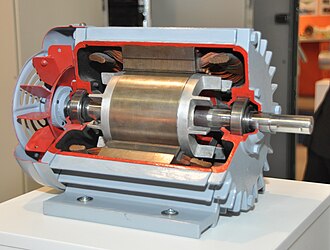
An induction motor turns without any direct electrical connection to its rotor. That is what makes it feel strange at first, especially if you’ve seen a DC motor where brushes and a commutator feed current straight into the moving part.
Yet this simple machine drives fans, pumps, conveyors, and compressors across industry. The working principle of induction motors comes down to a clean chain: a moving magnetic field induces rotor voltage, that voltage drives rotor current, and that current produces force and torque. Once you add slip to the picture, the mystery disappears.
The pieces fit together fast once the basics are clear.
Table of Contents
What makes the working principle of induction motors so different?
The induction motor is the workhorse of industry because its layout is simple and tough. In the common squirrel-cage design, the stator stays still, the rotor sits inside it, and the rotor has no direct electrical connection. That single fact separates it from a DC motor and sets up the whole story.
Why the rotor gets power without wires
When AC energizes the stator windings, the stator creates a magnetic field. In a three-phase motor, that field rotates. As it sweeps past the rotor bars, it cuts through them and induces a voltage. Because the bars are shorted together by end rings, current can flow through the rotor without any external wire touching it.
That is why the motor is called an induction motor. The rotor current is induced, not supplied directly. Many textbooks describe the machine as a rotating transformer, because power reaches the rotor through magnetic action across the air gap. working principle of induction motors
How an induction motor compares with a DC motor
In a DC motor, current reaches the rotating armature through brushes and a commutator. Those parts make the current path easy to picture because the electrical connection goes right to the moving member.
An induction motor works another way. Its rotor is usually a cage of metal bars joined by end rings, so the electrical path exists inside the rotor itself. The stator creates the field, the field induces rotor current, and the rotor responds.
This side-by-side view makes the difference clear.
| Feature | DC motor | Squirrel-cage induction motor |
|---|---|---|
| Rotor supply | Direct electrical connection | Induced in the rotor |
| Brushes and commutator | Present in classic designs | Not used |
| Rotor construction | Wound armature | Bars shorted by end rings |
| Motion source | Current and magnetic field through commutation | Current induced by the stator’s rotating field |
Because of that simple cage and the lack of rubbing electrical contacts, it is easy to see why induction motors are used in industry so widely.
Faraday’s law starts the motion
The first half of motor action is electromagnetic induction. Without it, the rotor would sit still because no voltage would exist inside its conductors.
What relative motion really means
Start with one conductor and a magnetic field. If the magnet moves past the conductor, the magnetic flux linking that conductor changes. Put a voltmeter across the conductor and you would read a voltage, even though no supply wire feeds it.
The same thing happens if the conductor moves through the magnetic field instead. What matters is relative motion between the conductor and the field. The motor does not care whether you picture the field moving, the conductor moving, or both moving. It only cares that the field cuts the conductor.
Why induced voltage grows when speed increases
Faraday’s law says the induced voltage depends on how fast the magnetic flux changes. Faster motion means more flux cutting in the same amount of time, so the induced voltage rises.
For a straight conductor, a simple expression is E = B L V. Here, E is the induced voltage, B is the magnetic flux density, L is the conductor length inside the field, and V is the relative speed between the conductor and the magnetic field. You do not need the equation to follow the motor, but it tells the story neatly: more field, more active conductor length, or more speed gives more induced voltage.
Why this same idea shows up in transformers too
The same law appears in a transformer. There, changing magnetic flux induces voltage in another winding even though the windings are not connected electrically. A motor adds motion and torque to that picture, but the induction part is familiar.
A plain-language companion explanation appears in AC induction motors explained. The core idea is the same in both machines: changing magnetic flux creates voltage.
How rotating magnetic fields create torque in an induction motor
Induced voltage alone does not make a useful motor. The rotor also needs current and force, and the motor needs that force to act in a circle instead of a straight line. That is the job of the rotating magnetic field.
Why three-phase AC is the secret to continuous rotation
A plain DC supply does not create this natural rotating field in the stator because its polarity stays constant. Three-phase AC does. Feed three-phase current into properly placed stator windings, and the magnetic field rotates around the stator.
That rotation makes continuous motor action possible. A single conductor in a magnetic field may only get pushed one way. A motor needs a field that keeps moving around the air gap, so the rotor keeps seeing fresh flux cutting and keeps developing torque.
Stator, rotor, and synchronous speed in plain words
The stationary outer part of the motor is the stator. It has a solid frame with slots that hold the windings. When three-phase AC energizes those windings, the stator produces the rotating magnetic field.
Inside the stator sits the rotor, the part attached to the shaft. In a squirrel-cage motor, many rotor conductors are arranged around the circumference and shorted together at both ends by end rings. That circular arrangement lets the whole rotor respond as the field sweeps around it.
The speed of the rotating magnetic field is called synchronous speed.
Synchronous speed is the speed of the magnetic field, not the actual speed of the rotor.
That point matters because people often confuse field speed with shaft speed. In an induction motor, those two speeds are never exactly the same during normal operation.
How induced current turns into mechanical force
Once the rotor conductors sit inside the rotating field, the working principle of induction motors follows a short sequence.
- The rotating magnetic field cuts the rotor conductors, so a voltage is induced in them.
- The rotor bars are shorted by end rings, so that induced voltage drives current.
- A current-carrying conductor inside a magnetic field feels Lorentz force.
- Because the conductors are arranged around the rotor, those forces combine into torque.
The rotor then turns in the same direction as the rotating magnetic field. Because the field rotates around the stator, the rotor does not move sideways. It spins around its own axis.
This is the complete motor action. Faraday’s law starts the current. Lorentz force turns that current into mechanical force. Together, they convert electrical energy into rotation at the shaft.
What slip is, and why the motor cannot run at synchronous speed
One detail keeps the motor from chasing the magnetic field all the way up to synchronous speed. That detail is slip, and it is why an induction motor is also called an asynchronous motor.
Why the rotor always lags a little
Slip is the difference between synchronous speed and rotor speed. At standstill, the rotating field cuts the rotor bars strongly because the rotor is not moving yet. As a result, rotor voltage and rotor current are high, and torque starts to build.
Then the rotor accelerates. As its speed rises, the relative motion between the rotor and the rotating field gets smaller. That means less flux cutting, less induced voltage, and less rotor current than at start. The motor settles at a speed below synchronous speed where it can still produce the torque that the load needs.
If the rotor ever reached synchronous speed, relative motion would fall to zero, induced rotor voltage would drop to zero, and torque would also drop to zero.
That is the whole reason the rotor never catches the rotating field in a normal induction motor.
How changing phase order changes motor direction
The rotor follows the direction of the rotating magnetic field. So if you reverse the field, you reverse the rotor.
In a three-phase induction motor, swapping any two supply phases reverses the phase order. That reverses the rotating magnetic field, and the motor spins the other way.
Why slip matters in real machines
Slip is not a defect. It is the condition that keeps induction alive inside the rotor. A motor needs that small speed difference to keep inducing current and producing torque.
This also explains why motor speed changes slightly with load. When load rises, the rotor slows a bit, slip increases, and the motor can develop more torque. When load falls, the rotor speed moves closer to synchronous speed, slip shrinks, and the required rotor current drops. That simple balance explains starting behavior, load handling, and the basic reason motor speed is never exactly equal to field speed.
Key takeaways every beginner should remember
By this point, the mystery is much smaller than it looked at the start. The rotor turns without a direct supply because the stator’s rotating magnetic field induces voltage in the rotor bars. Since those bars are shorted together, current flows. Once current flows inside a magnetic field, force appears, and that force becomes torque.
Keep these points in view:
- The stator creates the rotating magnetic field.
- The rotor current is induced, not supplied through wires.
- The rotor stays below synchronous speed because slip is needed for torque.
That is why the motor is simple, rugged, and so common in plant service. Once these basics are clear, later topics such as direction control, starting behavior, speed control, and troubleshooting make far more sense.
Why the rotor keeps turning
The strange part of an induction motor is also the elegant part. A rotor with no direct electrical supply can still turn because the stator creates a moving magnetic field, and that field induces the rotor current it needs.
Hold on to three ideas: induction creates rotor voltage, rotor current in a magnetic field creates torque, and slip keeps the process alive. Once you can picture those steps, the working principle of induction motors stops feeling abstract and starts looking like a clean, repeatable machine.
That picture is enough to carry you into deeper topics such as motor construction, starting methods, and speed control.