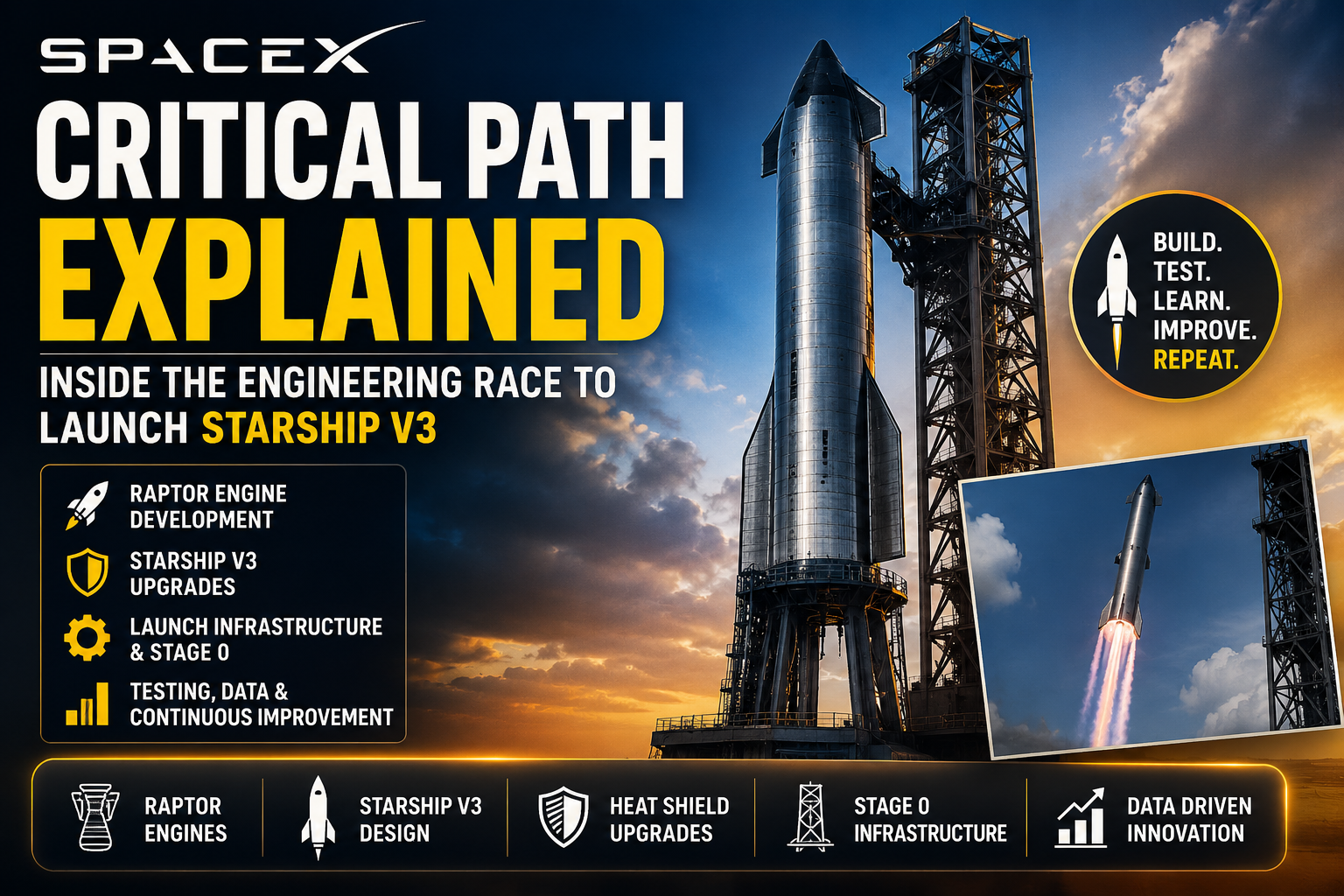
The race to make humanity a multi-planetary species has entered a new phase. With the development of Starship Version 3 (V3), SpaceX is pushing the limits of rocket engineering, manufacturing, and rapid testing. The company’s latest documentary, Critical Path, provides a rare behind-the-scenes look at the enormous effort required to prepare the world’s most powerful launch system for its next milestone.
But what exactly does “Critical Path” mean, and why is it so important to the future of Starship? Here’s everything you need to know.
Table of Contents
What Is SpaceX Critical Path?
In project management, the critical path refers to the sequence of essential tasks that determine the minimum time required to complete a project. If any task on this path is delayed, the entire project timeline moves back.
For SpaceX, the critical path represents the engineering, manufacturing, testing, and launch preparation activities that must be completed before Starship V3 can safely lift off.
Unlike traditional aerospace programs that can take years between launches, SpaceX follows an iterative development model. Engineers continuously build, test, analyze failures, improve designs, and fly again. This fast-paced workflow makes identifying and managing the critical path essential to maintaining rapid progress.
Why Starship V3 Matters
Starship V3 is expected to be the most advanced version of SpaceX’s fully reusable launch system. Building on lessons learned from previous flight tests, the new version aims to improve reliability, payload capacity, and operational efficiency.
Key goals include:
- Higher launch reliability
- Improved Raptor engine performance
- Enhanced heat shield durability
- Faster booster recovery
- Better fuel transfer capabilities
- Increased payload capacity for future missions
These upgrades are crucial for supporting future lunar missions under NASA’s Artemis program and, eventually, human missions to Mars.
Engineering Challenges on the Critical Path
Developing the world’s largest reusable rocket involves far more than assembling hardware. Every major system must work together perfectly.
1. Raptor Engine Development
The Raptor engine is one of the most advanced methane-fueled rocket engines ever built. Each Starship launch depends on dozens of Raptors operating simultaneously.
Engineers continue refining:
- Engine reliability
- Combustion stability
- Manufacturing speed
- Thrust performance
- Reusability
Even minor improvements can significantly increase mission success.
2. Starship Vehicle Manufacturing
SpaceX manufactures Starship using stainless steel, allowing rapid production and easier repairs compared to traditional aerospace materials.
Starship V3 introduces improvements in:
- Structural design
- Weight optimization
- Fuel tank construction
- Internal plumbing
- Payload integration
The company continues refining production methods to support high launch frequency.
3. Heat Shield Improvements
Returning from orbit exposes Starship to extreme temperatures exceeding 1,400°C during atmospheric reentry.
SpaceX engineers are improving:
- Thermal protection tiles
- Tile attachment systems
- Inspection procedures
- Maintenance efficiency
A more reliable heat shield is essential for achieving full rocket reusability.
4. Stage 0 Launch Infrastructure
The launch tower, often called Stage 0, plays a vital role in Starship operations.
Its responsibilities include:
- Fuel loading
- Vehicle stabilization
- Booster capture
- Launch support
- Ground communications
Every launch also validates improvements to the launch site itself.
5. Software and Flight Control
Modern rockets rely heavily on software.
Starship uses sophisticated onboard computers to manage:
- Navigation
- Guidance
- Engine control
- Flight safety
- Autonomous landing
SpaceX updates these systems after every flight using real-world test data.
Why SpaceX Builds So Fast
Traditional aerospace companies often spend years designing a rocket before testing it.
SpaceX follows a different philosophy:
Build. Test. Learn. Improve. Repeat.
Instead of avoiding failures entirely, the company treats every test as valuable engineering data. This iterative approach has dramatically accelerated Starship development and helped identify issues much earlier in the design process.
The Importance of Rapid Testing
Every Starship flight test provides critical information about:
- Engine performance
- Structural integrity
- Heat shield behavior
- Stage separation
- Orbital operations
- Recovery techniques
Data collected from each mission feeds directly into the next design iteration, enabling faster improvements and reducing long-term development time.
Preparing for Future Moon and Mars Missions
Starship is designed to support a wide range of future missions, including:
- Lunar landings for NASA’s Artemis program
- Satellite deployment
- Deep-space cargo transport
- Space station resupply
- Human missions to Mars
- Large-scale commercial spaceflight
Achieving these goals depends on making Starship a reliable, rapidly reusable transportation system.
Why the “Critical Path” Documentary Matters
The Critical Path documentary offers a rare glimpse into the daily work of SpaceX engineers, technicians, and manufacturing teams. Rather than focusing only on dramatic launches, it highlights the countless engineering decisions, manufacturing improvements, and system-level challenges that determine whether Starship is ready for flight.
It also showcases how collaboration across propulsion, structures, software, and ground systems is essential for meeting ambitious development timelines.
The Future of Starship V3
As SpaceX continues refining Starship V3, each test flight brings the company closer to its long-term vision of affordable, reusable space transportation. Success will not come from a single breakthrough but from thousands of engineering improvements made across every part of the vehicle and its supporting infrastructure.
If Starship achieves its full potential, it could transform access to space by dramatically lowering launch costs, enabling larger payloads, and opening the door to sustained exploration of the Moon, Mars, and beyond.
Final Thoughts
The SpaceX Critical Path is more than a project management concept—it represents the coordinated effort required to develop one of the most ambitious aerospace projects ever attempted. From advanced Raptor engines and improved heat shields to launch infrastructure and autonomous flight software, every milestone moves Starship V3 closer to operational reality.
As SpaceX continues its rapid development strategy, the lessons learned from each test flight will shape the future of reusable spaceflight and help pave the way for humanity’s next era of exploration.
Frequently Asked Questions (FAQ)
What is the SpaceX Critical Path?
The SpaceX Critical Path is the sequence of engineering, manufacturing, testing, and launch preparation activities that must be completed before Starship V3 is ready for flight.
What is Starship V3?
Starship V3 is the next-generation version of SpaceX’s fully reusable rocket system, featuring improvements in performance, reliability, and reusability.
Why is Starship important?
Starship is designed to support missions to the Moon, Mars, and beyond while also enabling satellite launches, cargo transport, and future commercial space travel.
What powers Starship?
Starship is powered by SpaceX’s methane-fueled Raptor engines, which are designed for high performance and rapid reuse.