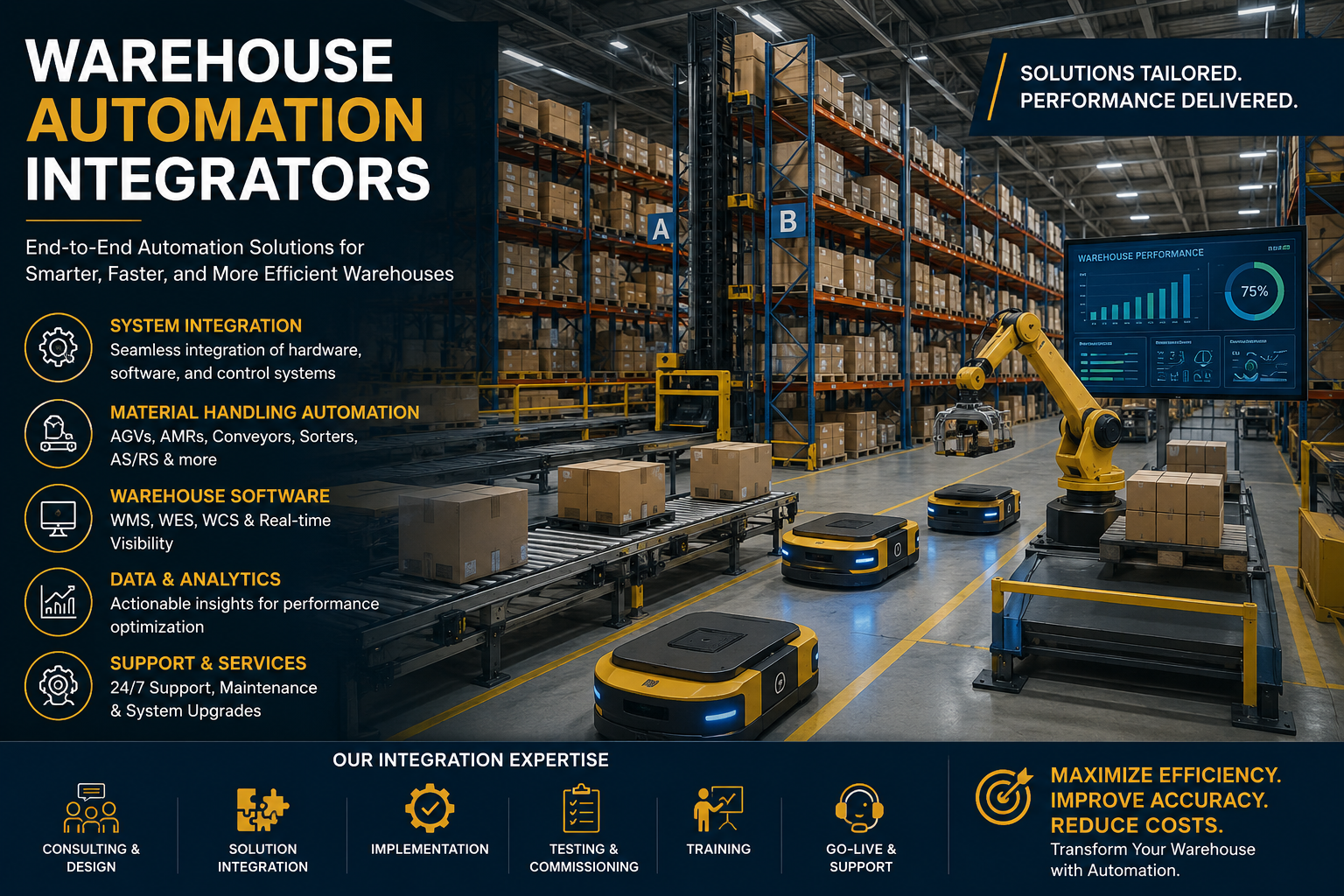
A warehouse can have fast robots and expensive conveyors, yet still miss shipping cutoffs if the systems don’t work as one. Rising order volume, thin labor pools, and tighter delivery promises put that problem in plain view.
Warehouse automation integrators turn separate machines, software platforms, and operating rules into one coordinated material-handling system. The right partner helps you choose the technology mix, manage the build, and keep it working after launch.
Table of Contents
What warehouse automation integrators actually do
An integrator begins with your operating targets, not a catalog of equipment. It studies order profiles, labor constraints, inventory flow, building limits, and customer service commitments. Then it designs a system that can meet those conditions.
The work often includes process mapping, layout design, equipment selection, controls engineering, software connections, installation, commissioning, training, and ongoing support. A robot maker sells robots. A conveyor supplier sells conveyor. An integrator takes responsibility for how each piece performs within the larger operation.
How integrators connect hardware, software, and people
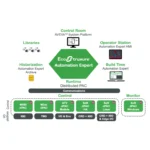
The warehouse management system (WMS) holds inventory and order data. A warehouse execution system (WES) prioritizes work, while a warehouse control system (WCS) directs conveyors, sorters, sensors, and other equipment. Robot fleet software assigns missions, traffic routes, and charging tasks.
Without clear handoffs, systems can act like musicians playing different songs. An integrator builds the interfaces, exception rules, and control logic that keep tasks moving in the right sequence. Platforms such as Swisslog’s WMS, WES, and WCS software show how these software layers can sit together.
Good design also accounts for people. Operators need clear prompts, maintenance teams need safe access, and supervisors need useful alarms instead of a screen full of noise.
When a full-service partner makes more sense
A single vendor can be enough for a contained project, such as adding a few AMRs to transport totes across a stable picking area. It can also work when your internal engineering and IT teams already manage controls, software, and deployment.
However, a multi-system project needs a single point of ownership. If you are combining AS/RS, pick stations, sortation, packing automation, and WMS integration, gaps between vendor scopes become costly. A full-service partner can own the performance model and coordinate tradeoffs before they turn into change orders.
The main systems warehouse automation integrators deliver
Automation isn’t one product. The best combination depends on throughput, SKU dimensions, inventory depth, order patterns, labor availability, ceiling height, and plans for growth.
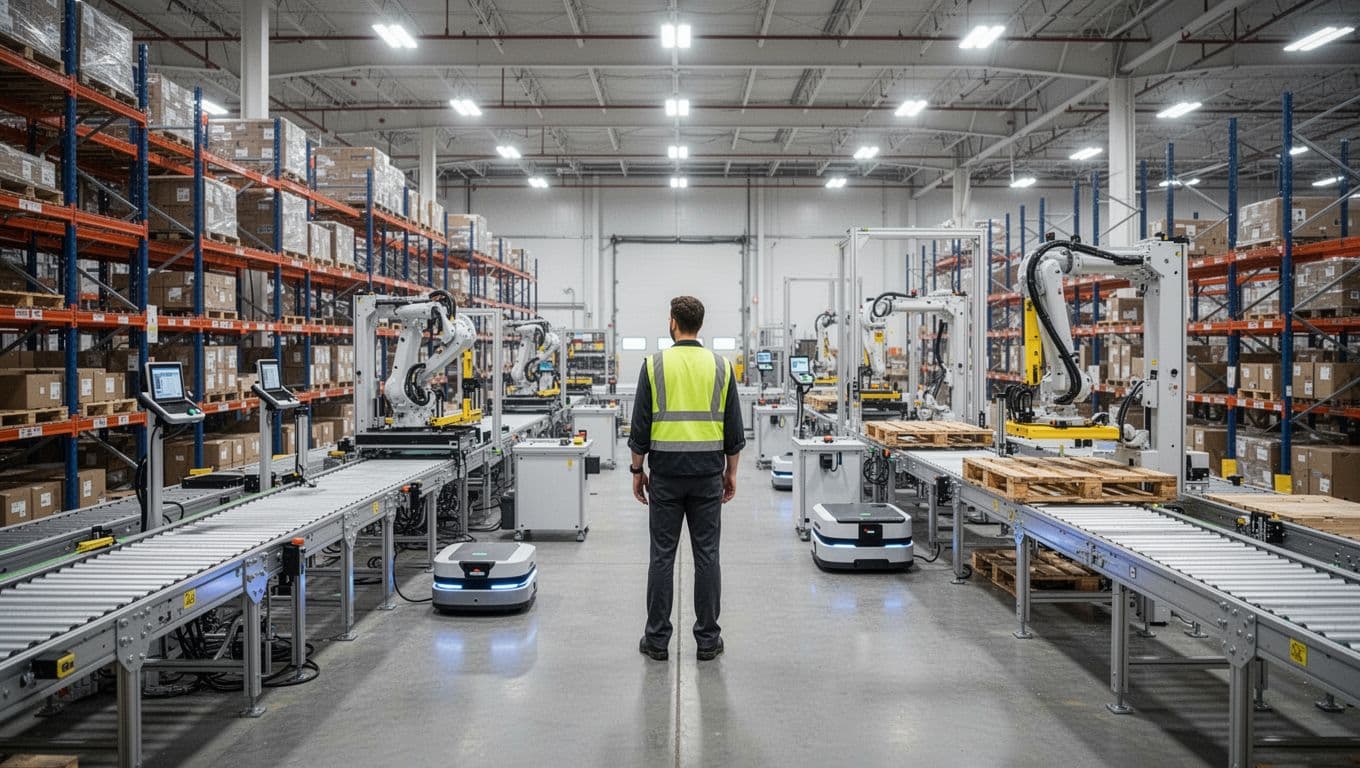
AS/RS and shuttle systems for dense storage
Automated storage and retrieval systems store and retrieve pallets, cases, cartons, or totes through cranes, shuttles, lifts, and software controls. They work well where floor space is scarce or inventory must sit in dense, highly organized storage.
Shuttle systems can buffer fast-moving inventory near picking or shipping. Yet the gains come with a demanding planning process. Building tolerances, fire protection, slab conditions, inventory profiles, and software connections all matter. Review AS/RS integration requirements before construction before committing to a fixed storage design.
AMRs and goods-to-person picking for flexible throughput
Autonomous mobile robots (AMRs) reduce walking by carrying inventory, carts, or shelves through changing warehouse layouts. They suit operations with fluctuating volumes, frequent SKU changes, and long travel paths.
Goods-to-person systems take that idea further by bringing products to fixed workstations. Pickers stay in a smaller area, which can improve consistency and reduce fatigue. Still, station ergonomics, replenishment speed, and exception handling set the real capacity.
For a broader view of the choices, compare these warehouse automation technologies against your actual material flow, not a trade-show demonstration.
Conveyors, sortation, and robotics for high-volume flow
Conveyors and sorters move cartons, parcels, and totes between receiving, picking, packing, and shipping. They are strongest where routes are repeatable and volume stays high enough to justify fixed infrastructure.
Robotic picking and palletizing can take over repetitive physical work. Product weight, carton condition, shape variation, required speed, and picking accuracy determine whether a robot is practical.
A sorter can meet its rated speed and still miss shipping cutoffs if induction, label quality, packing, or trailer loading restricts the flow.
Leading warehouse automation integrators and technology providers
No provider is best for every facility. Buyers often shortlist global full-service firms such as Bastian Solutions, Dematic, Honeywell Intelligrated, Fortna, SSI Schaefer, Swisslog, Vanderlande, and KNAPP. These companies commonly work across larger material-handling programs and multi-site deployments.
Technology-led providers include Exotec, GreyOrange, and Addverb. Their systems may fit a focused automation need, then connect into a broader architecture led by an integrator. Regional firms such as enVista, Kuecker Pulse Integration, Hy-Tek Intralogistics, St. Onge Company, and VARGO can also offer strong project execution.
A global warehouse automation company overview can help build an initial market map. Then narrow the list using current references, local support coverage, and experience with your product type.
What to look for in a global or full-stack integrator
Large deployments benefit from simulation tools, controls engineers, software teams, procurement strength, and lifecycle service. A provider with multi-site rollout experience can also apply lessons across a network.
Scale alone doesn’t make a company the right choice. A smaller operation may receive better attention from a specialist that understands its building, labor market, and fulfillment model.
Why local and regional integrators can be a strong choice
Regional teams may respond faster and communicate more directly during construction and go-live. They often know local contractors, permitting practices, and facility conditions that affect schedules.
Still, check financial stability, technical depth, spare-parts access, and after-hours support. Ask for customers with comparable throughput, product mix, and operating hours, then speak with those references directly.
Choose an integrator with clean data and clear ownership
The quality of your input shapes the quality of the design. Before requesting proposals, collect enough operating data to show how work moves during normal and peak periods.
Start with warehouse data and a business case
Prepare order lines per hour, daily peaks, SKU dimensions, inventory levels, pick rates, labor cost, error rates, storage constraints, service targets, and expected growth. Include problem data as well, such as overtime patterns, congested zones, and recurring safety incidents.
Clean data prevents expensive overbuilding. It also exposes whether a process change, slotting fix, or automation-ready inventory system can solve part of the problem before equipment enters the building.
Compare proposals by integration depth and support
Ask each bidder who owns the design, controls, WMS and WES connections, installation, commissioning, training, cybersecurity, maintenance, upgrades, and troubleshooting. Clarify API support, simulation methods, uptime assumptions, project milestones, warranty terms, and change-order rules.
A low equipment price can hide a thin integration scope. If the proposal excludes key interfaces or site work, the apparent savings may vanish after the contract is signed.
Control automation costs and prove ROI
Cost varies more than most buyers expect. A modest AMR pilot may cost far less than a full distribution-center rebuild. Large warehouse automation projects can range from roughly $5 million to more than $500 million when they include land, building work, fixed material handling, software, and network-wide deployment.
There is no universal price or payback period. High-speed sortation, deep AS/RS structures, controls, WMS integration, and long-term support can change the total sharply. Treat every vendor estimate as a site-specific business case.
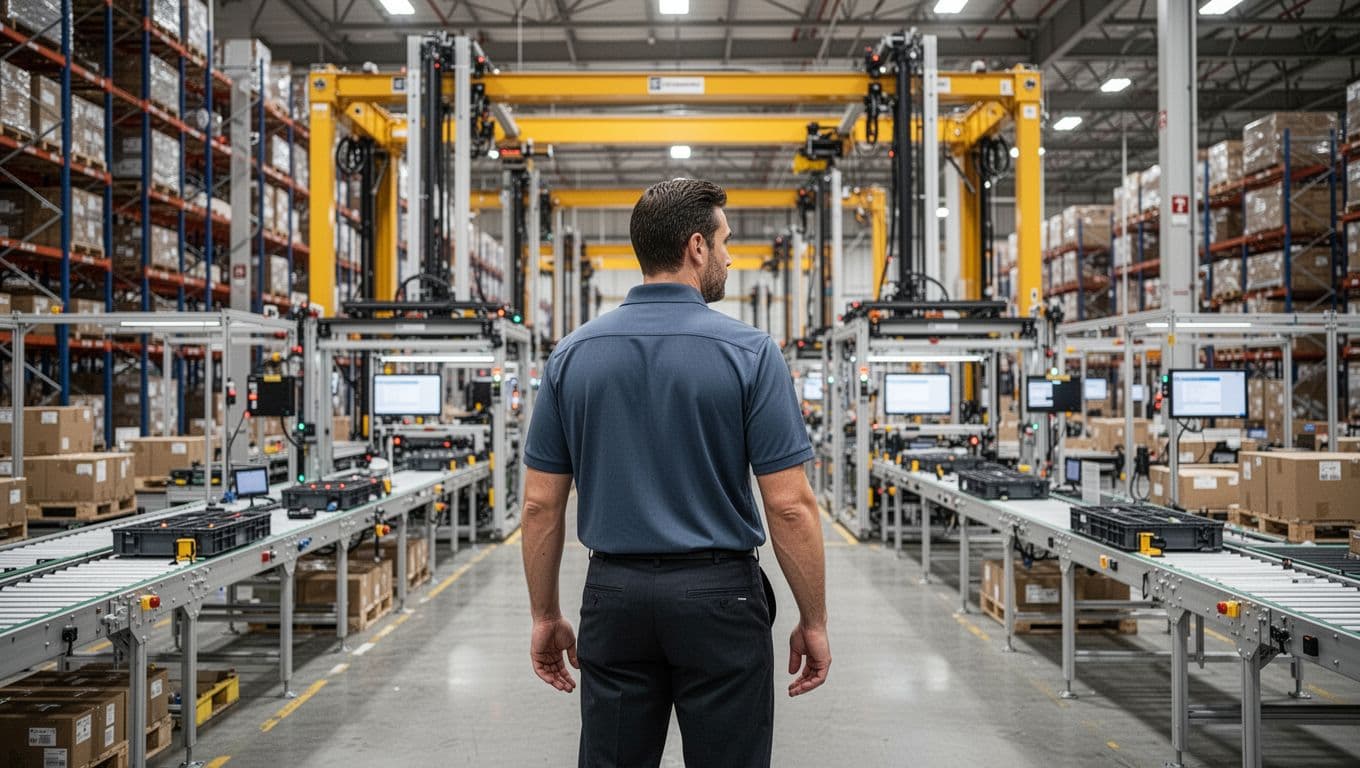
Measure ROI with more than labor savings
Labor savings matter, but they rarely tell the whole story. Track throughput, storage density, order accuracy, labor hours per order, picking time, uptime, overtime, safety incidents, inventory visibility, and expansion capacity.
A system can justify itself by processing more orders within the same footprint or by protecting service during peak season. It may also reduce chargebacks and mis-ships that never appear on a labor report.
Compare total cost of ownership, including software subscriptions, parts, support, energy, replacement cycles, and internal staffing. A smaller first phase can produce real operating data before a larger commitment.
What warehouse automation implementation looks like
A successful launch depends on operations, IT, maintenance, safety, and frontline workers. Machines don’t remove the need for disciplined process ownership. They make weak process decisions visible faster.
Discovery, concept design, and simulation
The integrator maps material flow, storage, labor steps, building columns, docks, utilities, and safety zones. It then creates layouts and models likely operating conditions.
Simulation should test peak demand, SKU variation, replenishment delays, blocked lanes, maintenance downtime, and future growth. A design that only works under average volume is a plan for congestion.
Build, integrate, test, and train
Next come equipment fabrication or sourcing, controls configuration, software setup, installation, safety validation, and site acceptance testing. Test real cartons, real labels, real order profiles, and real exception cases.
Phased commissioning usually lowers risk because teams can correct issues before the entire facility depends on the new system. Training should cover operators, supervisors, maintenance technicians, and IT support.
Go-live support and continuous optimization
After launch, the integrator should monitor performance, stock critical spare parts, resolve defects, and review operating data with the site team. Software updates and process changes need the same care as the original installation.
Automation is a long-term operating partnership. The strongest providers stay engaged when inventory shifts, volumes rise, or new customer requirements change the work.
Conclusion
The best warehouse automation integrator understands the work already happening on your floor. It recommends the right technology mix, connects systems cleanly, communicates risks early, and supports the site after go-live.
Gather your operating data, define success metrics, and request proposals from several qualified providers. Compare the total business value, not the lowest upfront bid.