A modern plant runs on a constant conversation. Sensors report pressure and speed, controllers make split-second decisions, software records the outcome, and operators step in when the process needs judgment.
Industrial automation and control systems bring those parts together so equipment can produce safely, consistently, and with less manual adjustment. The technology reaches far beyond robots, as industrial automation trends now connect factory machines, utility systems, remote assets, and plant data.
Getting the architecture right starts with knowing what each part does and where it belongs.
Table of Contents
What industrial automation and control systems include
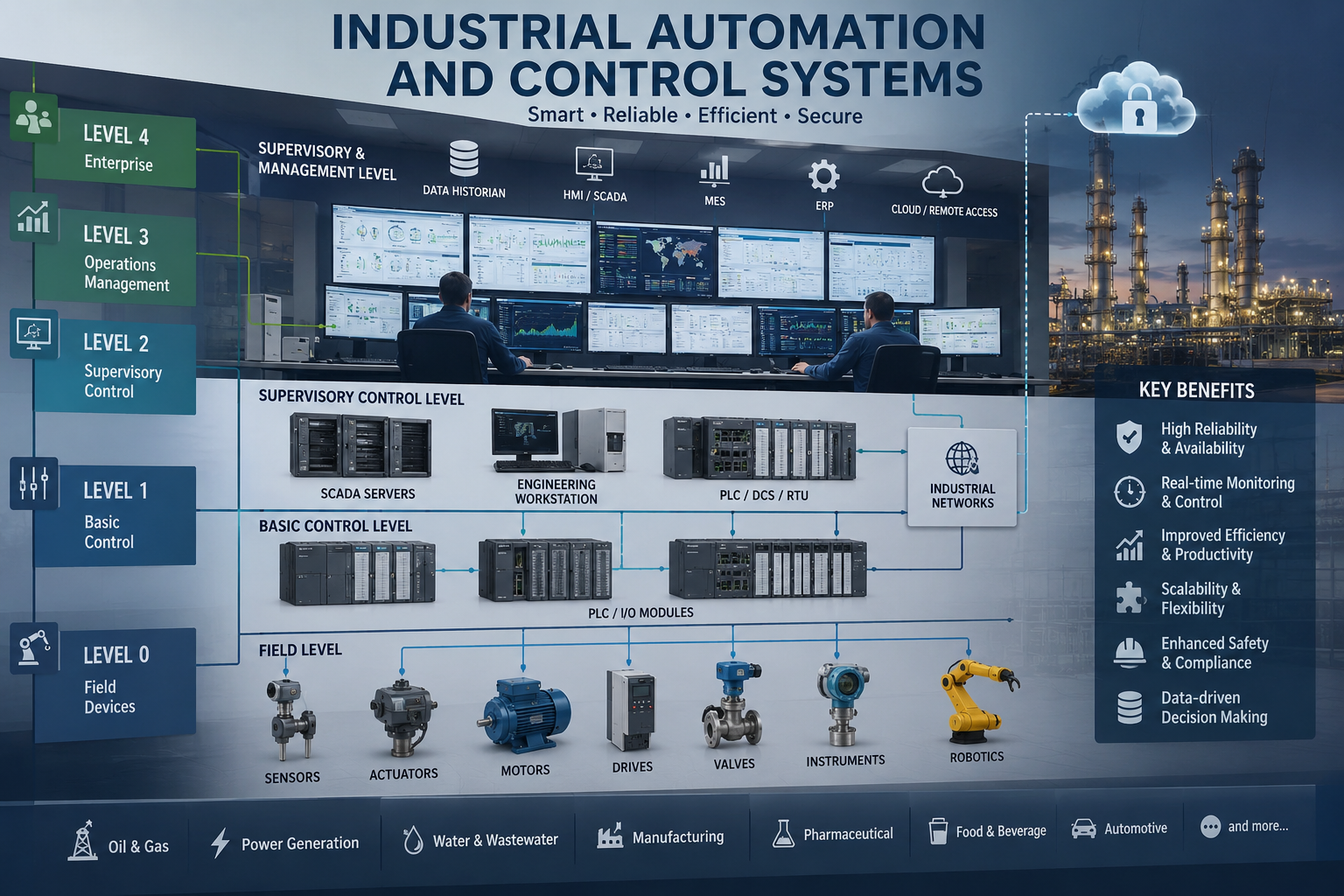
Industrial automation and control systems, often called IACS, combine field hardware, control software, industrial networks, operating procedures, safety functions, and cybersecurity controls. Together, they measure a physical process, compare it with a desired condition, and command equipment to respond.
Discrete automation handles individual items and repeatable sequences. It runs packaging machines, automotive welding cells, electronic assembly lines, and conveyor systems. Process automation controls flowing or changing materials, such as steam, water, chemicals, grain, fuel, or medicine batches.
The same principles support machines, production lines, water treatment plants, electrical systems, pipelines, and other remote infrastructure.
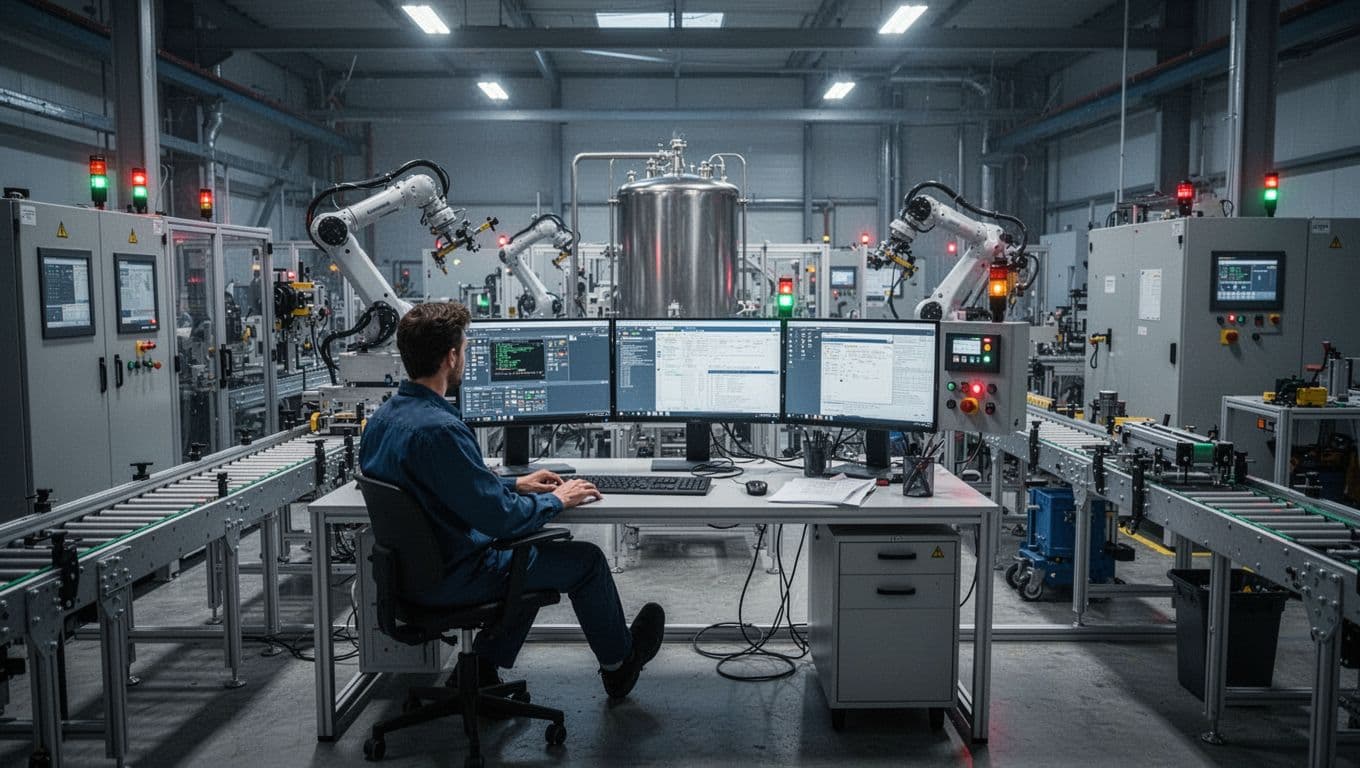
PLCs, DCS, and SCADA: The main control platforms
A programmable logic controller, or PLC, runs fast machine logic. It can sequence a packaging line, stop a motor on a fault, coordinate a robot cell, or control motion on a conveyor. PLCs are common in equipment that must respond predictably in milliseconds.
A distributed control system, or DCS, manages many process loops across a plant. Chemical, power, oil and gas, pharmaceutical, cement, and food facilities use DCS platforms for continuous and batch operations.
SCADA, short for supervisory control and data acquisition, sits higher in the stack. It gathers data, presents alarms, stores history, and gives staff visibility over remote pumps, substations, pipelines, or multiple facilities.
HMIs, sensors, actuators, and industrial networks
Sensors detect temperature, pressure, level, flow, position, vibration, and speed. Controllers interpret those signals, then send commands to actuators such as valves, motors, variable-frequency drives, cylinders, and robots.
The HMI is the operator’s working window. It displays process values, alarm conditions, setpoints, and approved manual controls. Good screens show the important state of the process without burying an operator in color or noise.
Industrial Ethernet, remote I/O, and specialized field networks carry signals between these devices. Many facilities must also bridge older serial equipment with modern platforms, which makes a clear PLC, DCS, and SCADA comparison useful during upgrades.
How control systems work together on the plant floor
The control path is simple in principle. A field device takes a measurement. The controller compares it with a target, applies logic or a control loop, and sends an output to equipment that changes the process.
For example, a PLC may manage an individual filler, labeler, and palletizer. Meanwhile, a DCS can regulate the temperature, pressure, and flow loops around a larger production process. SCADA gives supervisors and maintenance teams a broader view.
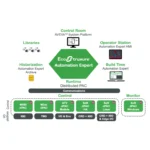
Remote I/O reduces long cable runs by placing signal modules near equipment. Engineering workstations configure logic and graphics. Historians preserve time-stamped production data, while recipe systems manage repeatable batch instructions.
A simple example of closed-loop control
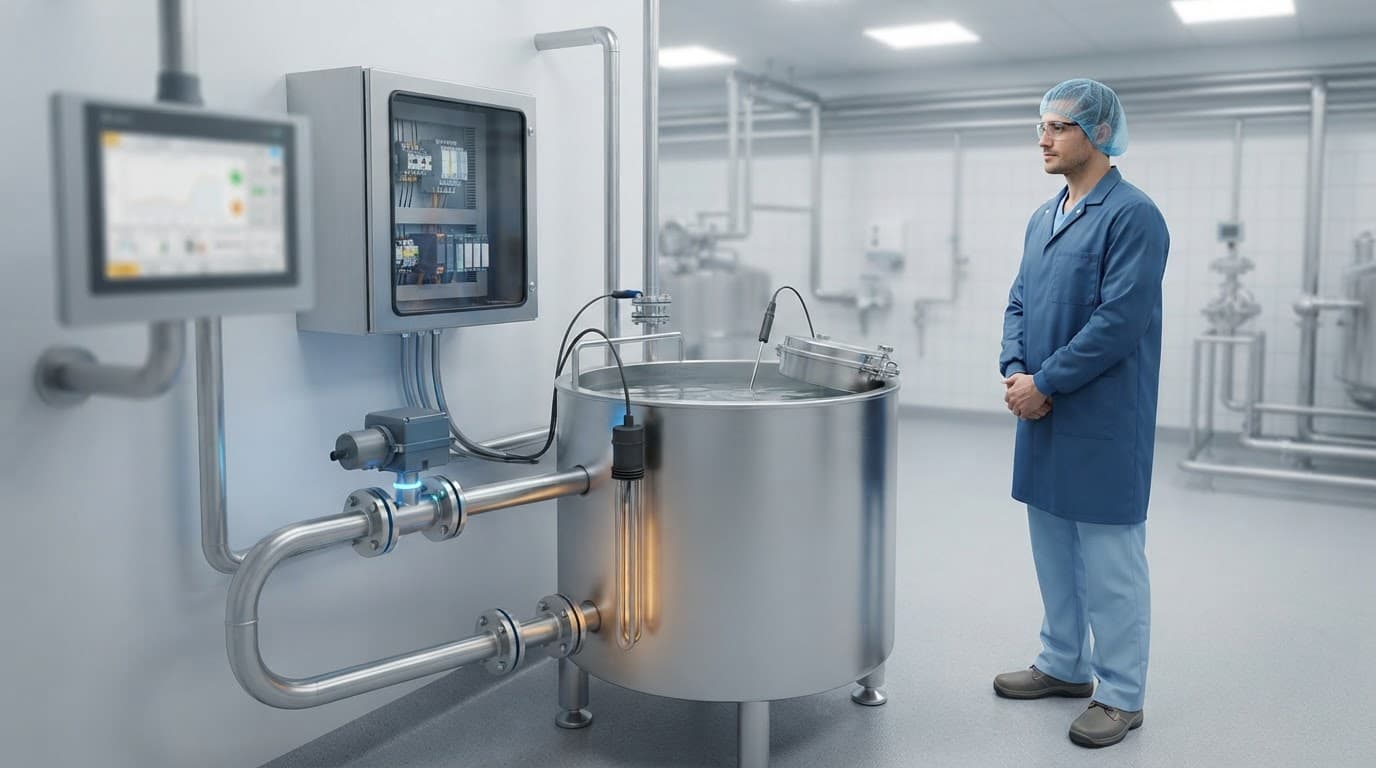
Consider a heated tank that must hold a product at 160 degrees Fahrenheit. A temperature sensor sends its reading to the controller. If the liquid cools below the setpoint, the controller opens a steam valve or increases heater output.
As the temperature rises, the controller reduces that output. The operator sees the measured temperature, setpoint, alarm state, and valve position on the HMI.
Feedback prevents the process from drifting as raw materials, ambient conditions, and demand change. It also reduces the need for constant manual adjustments.
Where industrial automation is used
Discrete manufacturers use automation in automotive assembly, electronics, packaging, warehousing, and material handling. The focus is often cycle time, part tracking, machine availability, and repeatable motion.
Process industries include refining, chemicals, food and beverage, pharmaceuticals, metals, cement, and power generation. Here, stable control of heat, pressure, flow, and chemistry protects both quality and equipment.
Water and wastewater facilities, rail systems, electric substations, and pipelines depend heavily on SCADA and reliable communication. In those environments, a lost signal can matter as much as a stopped machine.
The business value of industrial automation and control systems
Well-designed automation creates useful operational results. Diagnostics, alarms, remote monitoring, and event history can shorten fault isolation time. A maintenance technician can see whether a motor tripped, a sensor failed, or a process limit was crossed before opening a panel.
Repeatable logic also helps teams hold quality targets. Consistent fill levels, accurate batch temperatures, and controlled machine motion can reduce scrap and rework. Production data makes the discussion more concrete because teams can track downtime, cycle time, scrap rate, energy use, and alarm response time.
Still, technology alone doesn’t deliver these gains. Reliable instruments, preventive maintenance, trained operators, and sensible performance measures determine whether the system helps or frustrates the people running it.
Safety, reliability, and better energy use
Interlocks stop equipment when unsafe conditions appear. Emergency shutdown functions, machine guarding, safety relays, and safety PLCs add layers of protection around people and assets.
Basic process control and independent safety functions have different jobs. A normal controller may regulate pressure, while a separate safety system shuts down the process if pressure reaches a dangerous limit.
Automation can also reduce wasted energy. Properly controlled drives match motor speed to demand, while tighter temperature, pressure, and flow control can limit excess heating, pumping, and compressed-air use.
A faster control loop does not replace a safety function. Safety systems need clear design, independent testing, and disciplined maintenance.
The limits and tradeoffs to plan for
Automation projects carry real costs before the first product moves. Engineering, installation downtime, old equipment, software licenses, difficult integrations, and shortages of skilled controls staff can stretch schedules.
Poor design creates its own problems. Operators may face floods of low-value alarms, networks may become fragile, and a plant can become too dependent on one supplier or undocumented custom code.
Industrial automation and control systems work best when teams define the operating problem before selecting hardware. A new controller can’t fix unreliable instruments or unclear procedures.
Building a secure, cost-effective system
Start with a process study and asset inventory. Identify what must be controlled, what safety risks exist, which equipment can remain, and what business measure should improve. Then define the scope in practical terms, including production windows and acceptable outage time.
Project cost depends on I/O count, instrumentation, safety requirements, redundancy, network design, software licenses, engineering, commissioning, training, spare parts, and service agreements. A public listing around Rs. 25,000 may describe a basic control panel, not a complete plant-grade automation system.
Cybersecurity standards and risks to address
ISA/IEC 62443 is the central cybersecurity framework for IACS. The ISA/IEC 62443 standards series covers security programs, risk assessment, zones and conduits, technical system requirements, secure products, and lifecycle management.
Common threats include ransomware, flat networks, weak passwords, exposed remote access, unmanaged vendor connections, insecure engineering laptops, and aging PLCs that can’t receive routine patches. NIST’s guide to industrial control systems security also recognizes SCADA and other operational technology as environments with unique availability and safety needs.
Security changes require testing because a production controller cannot be patched like an office laptop. Practical industrial automation cybersecurity starts with asset visibility, segmented networks, controlled remote access, backups, and rehearsed recovery procedures.
Choosing providers and commissioning the work
Major suppliers include Siemens, Rockwell Automation, Schneider Electric, ABB, Mitsubishi Electric, Emerson, Honeywell, Omron, and Delta. None is automatically the best choice. The right platform fits the application, existing equipment, engineering skills, and local support.
Questions to ask a vendor or integrator
Compare providers against the conditions your plant will face after startup:
- Ask for experience in your industry and proof of work on similar control problems.
- Confirm PLC, DCS, SCADA, safety, and cybersecurity capabilities before signing a scope.
- Check support for open protocols and integration with existing instruments, drives, and business systems.
- Review local service coverage, spare-part availability, response times, training, and long-term lifecycle plans.
- Require current drawings, source code access, backups, and clear ownership of project documentation.
Vendor lock-in can become expensive years later. Open interfaces and a documented support plan give the plant more room to change.
Testing and handover protect the investment
A sound project includes design reviews, loop checks, Factory Acceptance Testing (FAT), Site Acceptance Testing (SAT), and Site Integration Testing (SIT) when systems connect across a facility. Each stage catches a different kind of error before it reaches live production.
Operators need hands-on training for alarms, manual operation, and abnormal conditions. Teams should also test backups, cybersecurity controls, interlocks, and fail-safe behavior.
Updated electrical drawings, network maps, alarm lists, and source code protect the plant after the integrator leaves. Rockwell’s IEC 62443 security guide reinforces the need to treat operational technology security as an ongoing program.
What is changing in industrial automation today
Plants increasingly connect PLCs, SCADA, historians, manufacturing execution systems, IIoT platforms, and edge computers. That connection can make production data easier to share, provided each layer has clear ownership and security boundaries.
OPC UA supports structured machine-to-machine data exchange. MQTT can move lightweight messages efficiently between systems. A careful MQTT versus OPC UA guide can help teams match the protocol to the job rather than treating either as a default answer.
AI now appears in anomaly detection, predictive maintenance, vision inspection, and process optimization. However, clean historical data and human review still matter. AI in industrial automation should support established control logic, not bypass safety interlocks or operating limits.
Legacy modernization remains a daily concern. The strongest projects replace the highest-risk, least-supportable components first while protecting production schedules.
Conclusion
Effective automation is more than a PLC, SCADA package, or robot. Industrial automation and control systems depend on trustworthy measurements, sound control logic, capable operators, safety practices, reliable networks, and long-term support.
Begin with a well-defined business and safety goal. Apply ISA/IEC 62443 principles, test every stage, and select technology that fits the process instead of chasing features.
Improve one process with measurable results, then scale the approach that proves itself on the plant floor.