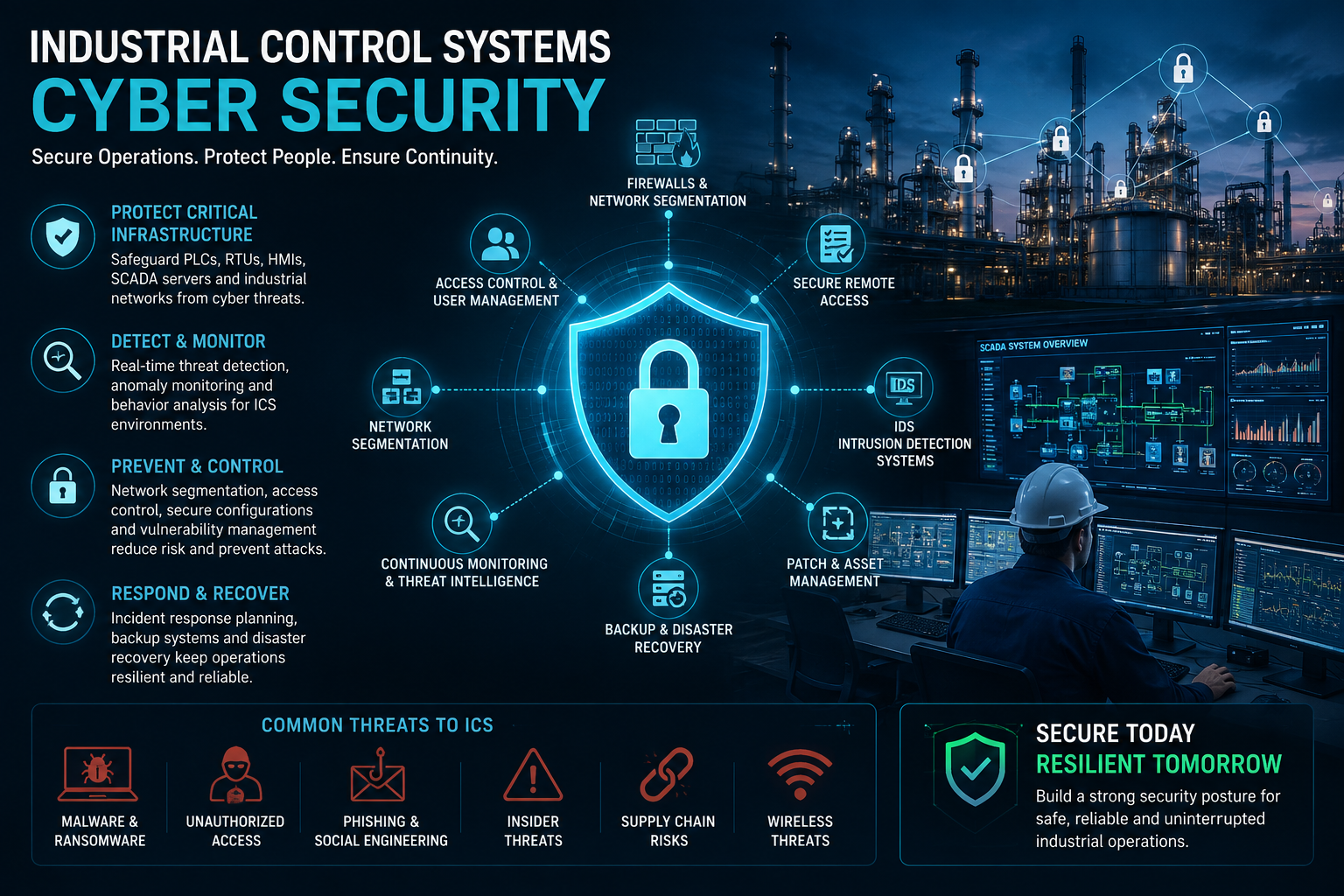
A modern plant runs on more than steel, motors, and pipes. PLCs, operator screens, sensors, and industrial networks direct the work, so a cyberattack can interrupt production, damage equipment, threaten safety, and erode public trust.
Industrial control systems cyber security protects the technology that turns digital commands into physical action. Plant leaders, engineers, IT teams, and security staff need safeguards that respect uptime while reducing real attack paths.
Table of Contents
What industrial control systems cyber security protects
Industrial control systems, or ICS, are the hardware and software that monitor or control physical processes. Operational technology, or OT, is the broader category that includes those systems and the networks around them.
A PLC may open a valve or regulate a conveyor. SCADA software gives operators a wide view of remote sites. Distributed control systems manage complex processes such as chemical production, while HMIs display alarms and process status. Sensors, safety controllers, drives, and industrial switches complete the chain.
Energy facilities, water utilities, factories, and transportation networks all depend on this equipment. For a practical breakdown of PLC, DCS, and SCADA differences, compare each system’s role before assigning security controls.
How IT and OT security priorities differ
IT security often favors rapid patching, device isolation, and data protection. In OT, an abrupt reboot or blocked connection can interrupt a process that must remain stable.
Safety, availability, and predictable timing often come first. Therefore, operations and engineering teams must test patches and firewall changes before placing them in a live environment. A security action that protects a database may create a hazardous condition on a running line.
Why legacy systems create new exposure
Many plants still use unsupported operating systems, controllers with limited authentication, and protocols designed for reliability rather than encryption. Some devices can’t run endpoint security software without affecting performance.
Flat networks make that problem worse. A compromised office computer, unmanaged remote tool, or direct IT-to-OT connection can give an attacker a path toward the plant floor.
The biggest cyber threats facing industrial networks
Attackers rarely begin by targeting a controller. More often, they compromise email, steal a password, exploit remote access, or enter through a supplier connection. Then they move through reachable systems until they find engineering workstations, HMIs, or control servers.
The damage can extend well beyond stolen files. Altered setpoints, unavailable operator screens, corrupted logic, and halted production can leave a site with a long, careful recovery.
Vendor remote access and lateral movement
Persistent VPNs, shared vendor accounts, and remote desktop tools create convenient paths into OT. If a contractor only needs one PLC, that account shouldn’t also reach every HMI and server.
Use named accounts, time-limited approval, and recorded sessions. Secure remote access for industrial control systems limits each connection to the equipment required for the task.
Command tampering and weak OT communications
Unauthorized logic updates can alter how a machine behaves. Attackers may also manipulate commands, install unverified firmware, or exploit traffic that lacks strong authentication.
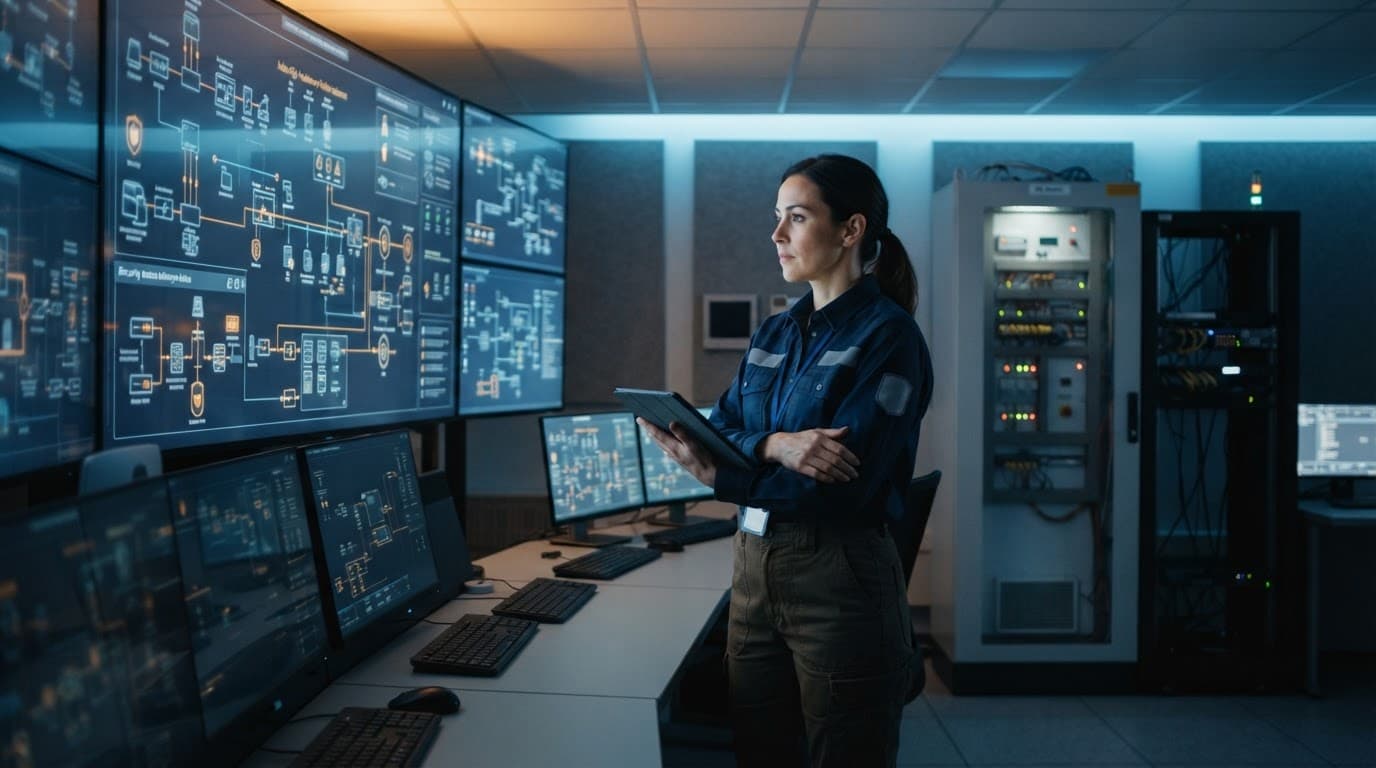
Defenders should monitor for unexpected controller downloads, configuration changes, unusual engineering workstation activity, and new connections across control zones. Protecting industrial control systems cyber security means guarding commands as carefully as data.
A plant can remain online while its control logic has changed. Availability alone doesn’t prove the process is safe.
Frameworks turn policy into plant-level decisions
A framework gives teams a common map instead of a pile of disconnected products. NIST SP 800-82 Rev. 3, published in September 2023, addresses OT architectures, threats, vulnerabilities, risk management, and safeguards tailored to operational environments.
CISA’s OT principles place safety and continuity beside cybersecurity. ISA/IEC 62443 adds the useful concepts of zones and conduits, while NIST’s revision announcement describes the broader shift from ICS-only guidance to OT security. MITRE ATT&CK for ICS also helps teams map adversary behavior to detection coverage.
Using zones, conduits, and an industrial DMZ
Zones group systems with similar security needs. For example, business IT, plant operations, safety systems, and controller networks should have separate boundaries.
Conduits define and restrict the traffic allowed between zones. An industrial DMZ acts as a controlled buffer between business and plant networks. Segmentation offers stronger protection than trusting an assumed air gap, especially when remote support or production data crosses the boundary.
Turning frameworks into a risk-based plan
Start with the process that could cause the greatest safety, environmental, or production impact. Next, identify every asset, connection, vendor dependency, and recovery requirement around it.
NIST supports tailored controls for low, moderate, and high-impact OT systems. That approach prevents a low-risk historian from receiving the same treatment as a safety-critical controller.
Practical controls that strengthen industrial cyber security
Industrial control systems cyber security improves fastest when teams first understand what is connected. Passive monitoring can inventory PLCs, HMIs, servers, network paths, and unexpected assets without sending disruptive scans into fragile equipment.
Control access without blocking necessary work
Put multi-factor authentication at jump hosts and other controlled entry points. Then use least privilege, named accounts, approval workflows, and session recording for employees and vendors.
Older controllers may not support modern identity controls. In that case, protect them through the systems that sit in front of them, including jump hosts, firewalls, and segmented network paths.
Protect stable workstations and configurations
Application allowlisting can restrict what runs on engineering workstations and HMIs. Keep protected, offline backups of PLC logic, HMI settings, switch configurations, and server images.
Test restoration copies before an incident. Use signed or authenticated industrial communications where equipment supports them, but validate compatibility and timing before deployment.
How to respond without stopping the plant
An OT incident response team needs operations, engineering, safety, security, legal staff, leadership, and key vendors. Their first goal is safe containment, not immediate disconnection.
Confirm the event, protect people and processes, restrict approved network segments, disable risky remote access, and preserve logs. Then validate controller logic and configurations before restoring systems in stages.
Prepare and recover with OT-specific playbooks
Maintain separate playbooks for ransomware, compromised remote access, unauthorized logic changes, lost visibility, and suspicious control traffic. Include manual operating steps, emergency contacts, safe shutdown criteria, recovery priorities, and tabletop exercises.
After recovery, remove persistence, verify HMI settings and PLC logic, test process safety, and watch closely for recurring activity. The review should update vendor rules, access controls, and the response plan.
Build protection one connection at a time
Strong industrial control systems cyber security comes from layered defenses, not one product or an assumed air gap. Map the environment, remove unnecessary IT-to-OT paths, segment critical systems, govern remote access, and protect the configurations that run the process.
Begin with the highest-risk connection or safety-sensitive process. Each tested improvement makes the plant harder to disrupt and easier to recover.