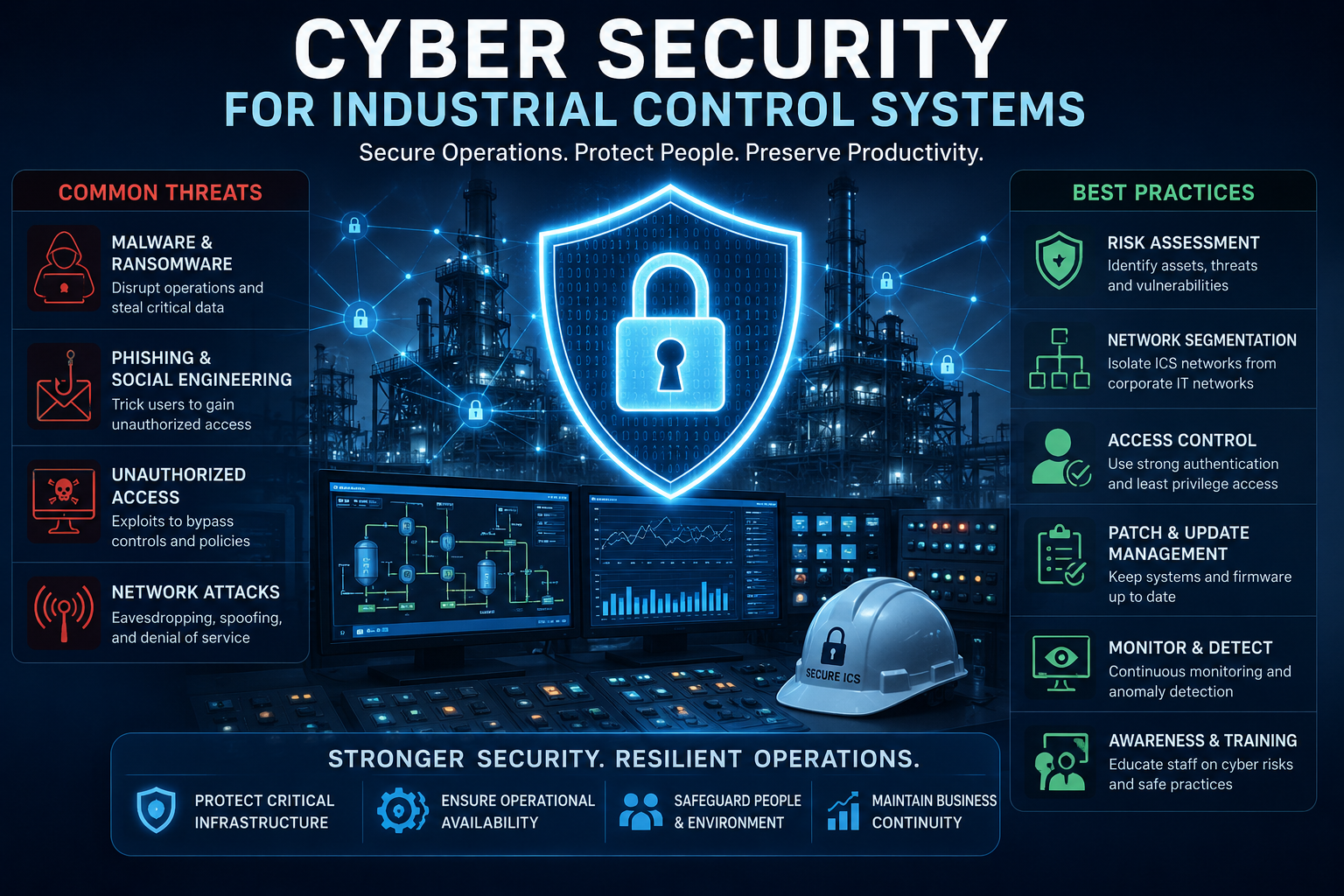
A ransomware attack can stop a factory line long before anyone touches a PLC. When operators lose access to production data, engineering workstations, or remote support, a safe shutdown may be the only responsible choice.
Cyber security for industrial control systems protects more than files and passwords. It protects people near moving equipment, costly machinery, steady output, and the reliable process signals that operators trust. The work starts with visibility, then moves through segmentation, access control, monitoring, patching, and practiced response.
Table of Contents
What Industrial Control Systems Security Protects
Industrial control systems, or ICS, run physical processes. They open valves, regulate pressure, move conveyors, manage electrical distribution, and control thousands of small decisions that keep a plant operating.
Operational technology, often shortened to OT, is the wider category. It includes the systems, networks, devices, and software that interact with a physical process. A SCADA platform can supervise distant sites. A distributed control system, or DCS, manages continuous processes such as refining or chemical production. PLCs control machines, while HMIs give operators a window into the process.
Engineering workstations program equipment. Historians retain process data. Safety-instrumented systems can place a process into a safe state when pressure, temperature, or other conditions cross a limit.
IT security often puts confidentiality first. In OT, availability, timing, and safety often come first because a delayed command or incorrect value can affect the real world. CISA’s principles for OT cyber security recognize this operational reality.
The Main Cyber Threats Facing OT Environments
Ransomware, stolen credentials, phishing, weak passwords, and exposed remote-access tools can all create an entry point. Malware may enter through a business network, a vendor connection, an engineering laptop, or removable media.
Poor segmentation turns a small foothold into a plant-wide problem. An attacker who compromises an office account should not gain a route to an HMI, controller, or safety network. Yet broad firewall rules and shared administrator passwords still create those paths.
The damage isn’t limited to stolen information. A plant can lose visibility into a process, halt production, damage equipment, or force operators into manual control. Cyber security for industrial control systems must limit both unauthorized access and the ability to issue unsafe commands.
Why Legacy Devices Make Industrial Security Harder
Many plants run devices designed for 15 or 20 years of service. Some PLCs, sensors, and control servers use unsupported operating systems or protocols with little built-in authentication. Replacing them can require downtime, validation, and vendor involvement.
A patch may also disrupt a live process. For that reason, teams shouldn’t treat every missing update as a simple maintenance failure. They need compensating controls, such as network isolation, strict allowlists, hardened jump hosts, and close monitoring.
A vulnerable controller behind a tightly controlled network boundary may present less immediate risk than a fully patched controller exposed through an unmanaged remote-access path.
Cyber Security for Industrial Control Systems: A Practical Protection Plan
A useful security plan follows the plant’s actual risk, not a generic IT checklist. Security staff need operators, controls engineers, maintenance teams, vendors, and safety leaders at the table before changing network traffic or access rights.
Start by asking which assets could affect safety, environmental compliance, production quality, or sustained uptime. Then document how people and data reach those assets.

Build an Accurate OT Asset Inventory
An inventory should include PLCs, SCADA and DCS servers, HMIs, network switches, historians, safety systems, engineering laptops, cloud links, and remote-access paths. Unknown equipment creates unknown risk, especially when it sits in a forgotten panel or a contractor-managed network segment.
For each asset, record its owner, location, software version, protocol, Purdue model level, business role, criticality, and known vulnerabilities. Also document who can administer it and where its backups live.
CISA’s OT asset inventory guidance focuses on building a definitive view of architecture and assets. That view gives teams a credible starting point for every later decision.
Separate IT and OT With Zones, Conduits, and an Industrial DMZ
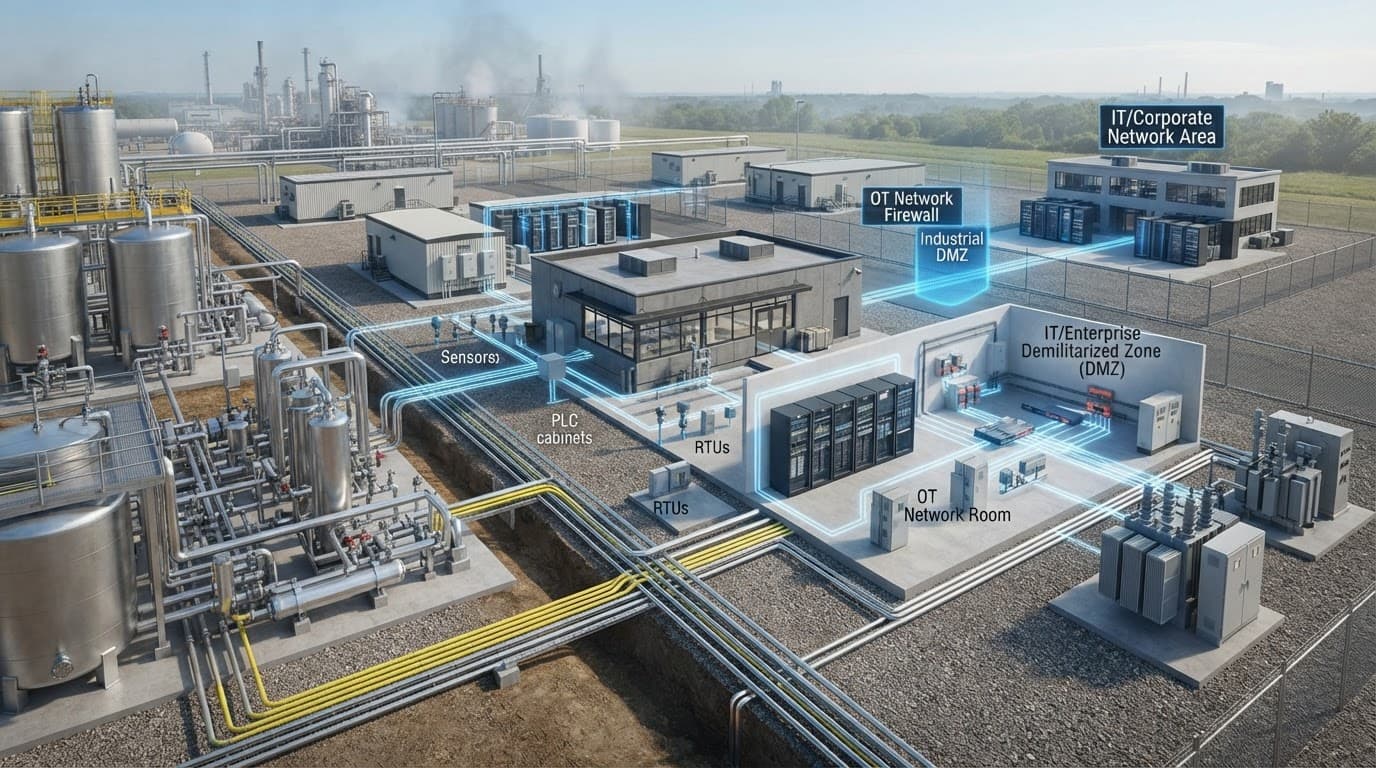
The Purdue model organizes systems by function. Physical processes and basic control sit near the bottom. Supervisory operations sit above them. An industrial DMZ separates plant operations from enterprise IT.
Each zone needs a clear purpose. Conduits between zones should permit only approved traffic, from known sources, to specific destinations. Deny-by-default firewall rules, jump hosts, proxy services, and one-way data flows can reduce unnecessary exposure.
Segmentation must also restrict east-west movement inside the plant. A compromised HMI should not freely reach every controller. Practical designs often combine VLANs and subnets for OT segmentation with tightly scoped firewall policies.
Control Remote Access and Privileged Accounts
Direct internet access to PLCs, HMIs, or control servers creates needless risk. Remote users should enter through an approved jump server protected by multifactor authentication, least-privilege permissions, and session logging.
Employees, contractors, equipment makers, and emergency support teams need different access rules. Vendor access should be time-limited and approved for a stated task. Review privileged accounts regularly, then remove old accounts and shared credentials.
A secure remote connection isn’t enough if it gives a user broad plant access. OT remote access security controls should restrict each session to the systems required for the work.
How to Monitor, Patch, and Harden OT Without Stopping Production
OT defenses must respect uptime and process limits. A tool that aggressively scans a sensitive network can cause more trouble than the threat it seeks. Therefore, every change needs testing, approval, a rollback plan, and operational coordination.
Use Passive Monitoring to Spot Unusual Behavior
Passive OT monitoring observes network traffic without sending disruptive probes. It can identify new devices, unexpected communications, failed authentications, unusual protocol commands, and connections across unauthorized zones.
First, establish a baseline for normal activity. A packaging line, boiler control system, and substation don’t communicate in the same patterns. Once teams understand normal behavior, anomalies become easier to investigate.
Centralized logs also help connect the dots between IT and OT events. A suspicious VPN login, followed by a new engineering-workstation connection, deserves attention before commands reach a controller.
Apply Risk-Based Patching and Compensating Controls
Rank patches by asset criticality, exploitability, exposure, and operational effect. A high-risk remote-access server may need fast action, while a control-system patch may wait for a scheduled maintenance window and vendor testing.
Test updates offline when possible. Keep verified backups, follow vendor guidance, and document exceptions with an owner and review date. If an asset can’t be patched safely, use isolation, application allowlisting, access restrictions, virtual patching where suitable, and stronger monitoring.
Cyber security for industrial control systems works best when maintenance decisions account for both cyber risk and process risk.
Standards That Guide an Industrial Cybersecurity Program
Frameworks give teams a repeatable way to set priorities, assign responsibilities, and check progress. They don’t replace site-specific engineering judgment. A wastewater facility, food plant, and power site have different safety constraints and failure modes.
NIST published the final SP 800-82 Revision 3 OT security guide in September 2023. It expands the earlier ICS focus to OT and addresses performance, reliability, and safety alongside security requirements. The earlier ICS security guidance in Revision 2 remains useful context for organizations modernizing older programs.
ISA/IEC 62443 is a globally recognized family of industrial automation security standards. Its ISA/IEC 62443 standards series addresses zones, conduits, system requirements, secure development, and supplier responsibilities.
How NIST SP 800-82 and ISA/IEC 62443 Work Together
NIST SP 800-82 helps leaders shape an OT security program around risk management and operational needs. ISA/IEC 62443 offers more detailed requirements for components, systems, processes, and supplier relationships.
A facility building its first program may begin with NIST’s risk-based structure. A team purchasing new equipment or writing vendor requirements may turn to IEC 62443 for deeper technical detail. Use both where they fit, then document decisions that match the site’s actual hazards and operating limits.
Prepare for an OT Cyberattack Before It Happens
Prevention reduces risk, but every facility also needs a response plan. The plan should identify who can isolate a system, approve a shutdown, contact the equipment vendor, inform leadership, and coordinate with emergency teams.
Write OT-specific playbooks for ransomware, compromised remote access, stolen credentials, malware on engineering workstations, and IT-to-OT lateral movement. Each playbook should distinguish actions security personnel can take alone from actions that require an operator or safety leader.
Test Recovery, Manual Operations, and Safe Shutdowns
Backups only matter when restoration works under plant conditions. Keep offline or immutable backups, current golden images, spare hardware, and tested restoration instructions. Document the recovery order because restoring a historian before a safety system may waste time during an emergency.
Manual fallback procedures also need regular review. Operators must know what they can safely control without normal digital visibility. Run tabletop exercises and controlled drills with operations, engineering, security, management, and third parties.
A response plan stored in a shared folder won’t help at 2 a.m. during a process upset. People need clear contacts, current instructions, and practice.
A Simple Order of Priorities for Small and Large Facilities
Teams don’t need to fix every gap at once. They should move in a deliberate order:
- Identify critical assets and map every remote path to them.
- Remove unnecessary internet exposure and secure privileged remote access.
- Build an industrial DMZ and limit traffic between OT zones.
- Monitor key systems, close high-risk gaps, and test backups.
- Practice response and recovery with the people who run the process.
Assign an owner, deadline, and risk-based outcome to each improvement. That discipline keeps cyber security for industrial control systems connected to real operational priorities.
Conclusion
Strong industrial security combines engineering judgment with controlled access, segmented networks, continuous visibility, careful maintenance, and tested response plans. It protects safety and uptime while reducing the chance that one stolen account can disrupt an entire operation.
Begin with a current asset inventory and the most exposed access paths. Clear visibility gives every other security decision a firm place to start.