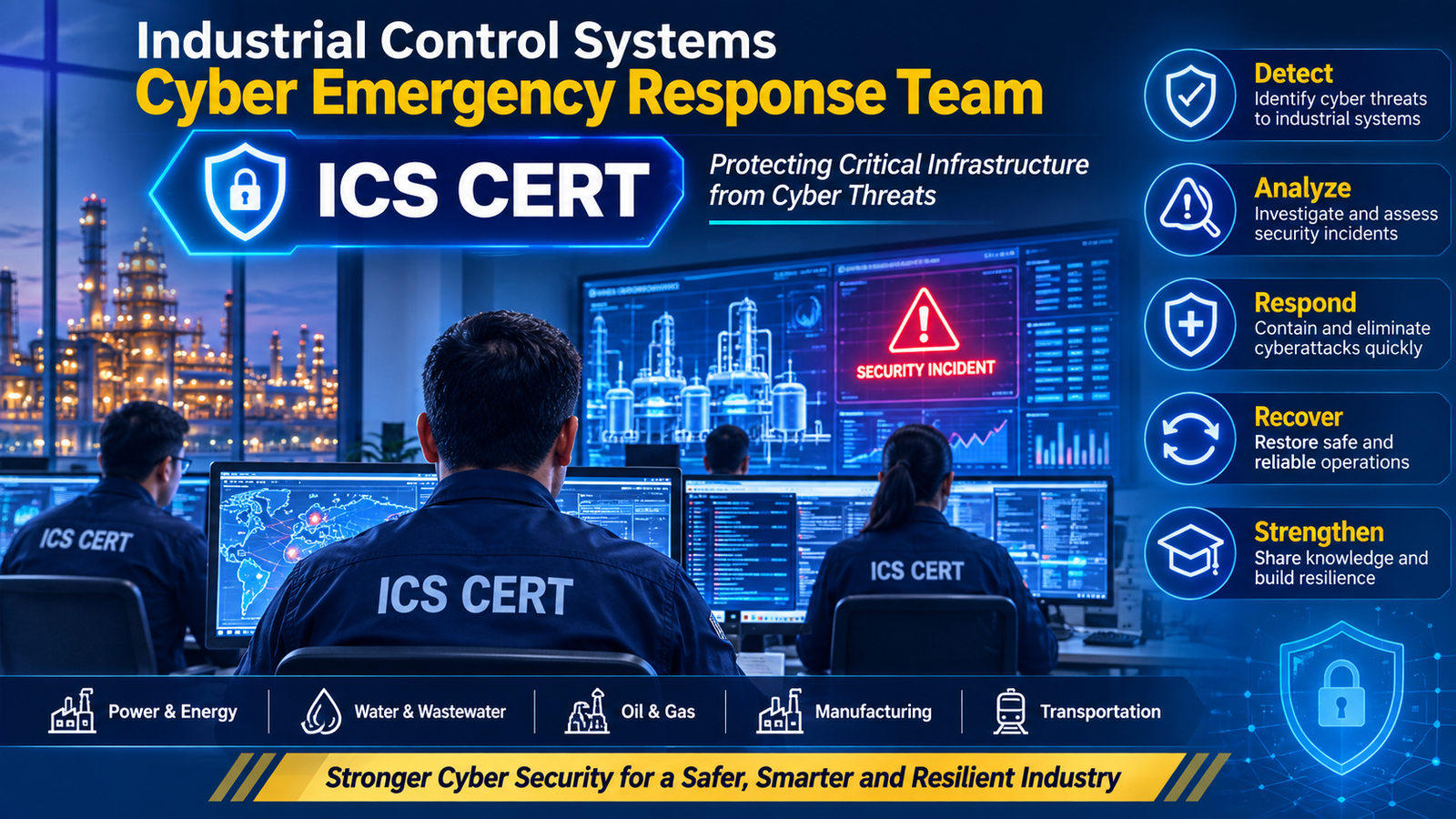
A search for an industrial control systems cyber emergency response team ics cert often starts with two different needs. One person wants a credential for an OT security career. Another needs help after a suspicious login, ransomware alert, or controller problem appears at a plant.
The name ICS-CERT still appears in old PDFs and training references, yet it isn’t a current standalone certification. Today, CISA provides public incident-response support and ICS training, while GIAC GICSP and ISA/IEC 62443 offer separate professional credential paths.
The distinction matters because a certificate can’t replace a practiced response plan when equipment, production, and safety are at stake.
Table of Contents
industrial control systems cyber emergency response team ics cert: what it is today
ICS-CERT was the former name associated with the U.S. government’s Industrial Control Systems Cyber Emergency Response Team. Its mission and public-facing resources now sit within the Cybersecurity and Infrastructure Security Agency, or CISA.
CISA publishes resources for critical infrastructure operators, government entities, and security teams working with operational technology. Its industrial control systems resources include vulnerability information, mitigations, and guidance for OT environments.
The broader work of protecting controllers, HMIs, SCADA servers, and plant networks also requires sound industrial automation cybersecurity practices. Cyber defense in a plant has to protect the physical process, not only the data.
ICS-CERT is a legacy name, not a current certification
An ICS-CERT search can lead to outdated pages because the label remained in use for years. That history creates understandable confusion, especially for people looking for an exam or credential to add to a resume.
An emergency response team is a service and coordination function. A professional certification is proof that an individual met an assessment standard. CISA doesn’t issue a standalone credential called “ICS-CERT.”
Look instead for current CISA training, Cybersecurity Advisories, ICS advisories, and incident-response services. Treat old references as historical context, not as an enrollment path.
What CISA does during an ICS or OT cyber incident
CISA can support cyber incident management, technical analysis, coordination, and root-cause investigation. Its available engagement types include remote assistance, advisory deployment, remote deployment, and on-site deployment.
That help is important, but it doesn’t replace the site’s own incident commander, operations leadership, safety procedures, or recovery decisions. Plant personnel know which process changes could create hazards.
CISA also publishes ICS vulnerability advisories that can help teams assess exposed products and prioritize mitigations.
How to respond to an industrial control systems cyber emergency
An OT incident response plan must account for consequences that ordinary IT response can miss. A disconnected workstation might be inconvenient in an office. The same action could interrupt operator visibility or a critical control workflow at a facility.
Safety, production continuity, legacy devices, and engineering change control all shape the response. Therefore, an operator shouldn’t shut down or reboot equipment without coordinating with the people responsible for the process.
Prepare before an ICS incident happens
Preparation starts with a usable asset inventory. Record PLCs, remote terminal units, HMIs, SCADA and DCS servers, engineering workstations, switches, remote-access tools, firmware, and software versions.
Keep current network diagrams, vendor contacts, emergency change procedures, and recovery priorities where responders can reach them during an outage. Backups need testing, and at least one recovery copy should remain offline or otherwise protected from a broad network compromise.
Use segmentation at IT and OT boundaries. Restrict vendor connections through monitored jump servers. Add MFA where systems support it, then use compensating controls where older equipment cannot.
A backup that has never been restored in a realistic test is only a recovery assumption.
Monitoring should cover ICS boundaries, important control-network segments, and high-value hosts. A plant can’t investigate activity it never records.
Detect, contain, and preserve evidence safely
First, validate the alert and appoint an incident lead. Then document the time, affected assets, observed behavior, severity, and actions taken. Preserve logs, firewall records, endpoint evidence, and engineering changes before cleaning systems.
Containment choices require operations input. Teams may disable compromised accounts, reset privileged passwords, block known malicious connections, close exposed ports, or remove a public-facing system from the network. However, isolation must not create a larger process or safety issue.
Bring together plant operations, safety leadership, legal counsel, IT, OT engineers, vendors, law enforcement when needed, and CISA. A single technical decision can affect production, contract obligations, and evidence handling.
Recover, learn, and improve the response plan
Recovery begins after the affected environment is understood. Remove malware, rebuild compromised hosts from trusted media, validate backups, and return systems to service in controlled stages.
Increase monitoring after restoration because an attacker may have left a second access path. Confirm the initial intrusion route, the affected identities, gaps in segmentation, and any unsafe assumptions about remote access.
CISA’s Cybersecurity Advisories publish threat behavior and indicators of compromise that can strengthen detection. Recovery isn’t complete until the team documents what happened and updates its response plan.
The best ICS cybersecurity training and certification paths
CISA training, GIAC GICSP, and the ISA/IEC 62443 program address different career needs. One offers accessible learning, one tests broad practitioner knowledge, and one builds standards-based expertise across the industrial automation lifecycle.
| Path | Best fit | What it provides |
|---|---|---|
| CISA ICS courses | Newcomers and plant teams | Free training and completion records |
| GIAC GICSP | OT security practitioners | Vendor-neutral, proctored certification |
| ISA/IEC 62443 | Designers, assessors, integrators | Stackable standards-focused certificates |
Choose based on the work you need to perform, not the familiarity of a search term.
CISA ICS training for a practical starting point
CISA offers introductory, intermediate, advanced, and evaluation-focused training. ICS 101 introduces control-system cybersecurity basics and the differences between IT and ICS. ICS 201 builds practical understanding, while ICS300 covers advanced ICS security concepts.
The ICS401L evaluation course uses CSET and a simulated ICS scenario. It is a three-day course, and ICS300 requires at least 80 percent on its final exam. Course delivery can change, so check the current CISA ICS training calendar before scheduling.
CISA courses have no tuition cost. Some provide CEUs and completion certificates. Those records show training completion, but they aren’t equivalent to a widely recognized professional certification.
GIAC GICSP for broad OT and ICS security skills
GIAC Global Industrial Cyber Security Professional, or GICSP, suits people who work between engineering, IT, and cybersecurity. It is a paid, proctored, vendor-neutral credential with a lifecycle view of industrial security.
The current GICSP exam has 82 questions, a three-hour limit, and a 71 percent passing score. Certification lasts four years and requires continuing professional education for renewal, unless the holder retakes the current exam.
Fees, delivery options, and renewal terms can change. Verify the current details directly with GIAC before setting a training budget.
ISA/IEC 62443 certificates for standards-based expertise
The ISA certificate route follows the ISA/IEC 62443 series for industrial automation and control systems. It starts with the IC32 Fundamentals Specialist certificate.
After that, candidates can earn IC33 Risk Assessment Specialist, IC34 Design Specialist, and IC37 Maintenance Specialist certificates. Completing all four earns the ISA/IEC 62443 Cybersecurity Expert designation.
This route fits control engineers, system integrators, asset owners, and consultants who design, assess, implement, or maintain IACS security programs. It rewards familiarity with the standards and the practical decisions behind them.
How to choose the right ICS emergency response credential
The right choice depends on the role you have now and the work you want next. CISA training makes sense when you need low-cost foundational knowledge or want to improve a site’s immediate readiness.
GICSP fits practitioners who want a formal, broad-based ICS and OT security certification. ISA/IEC 62443 fits standards-led work in design, risk assessment, implementation, and maintenance.
Hands-on experience still carries major weight. Employers look for people who understand PLCs, HMIs, SCADA, DCS platforms, industrial networking, logging, backups, access control, and plant operations.
Match the credential to your role and career goal
Control engineers and plant managers often benefit first from CISA 101 or 201 because the courses connect cybersecurity to operations. System integrators and cybersecurity consultants may gain more from the ISA/IEC 62443 progression.
SOC analysts, OT security analysts, and incident responders can use GICSP to demonstrate cross-functional knowledge. Experienced personnel may also pair it with deeper vendor or product training relevant to their facilities.
Before enrolling, compare employer job postings with your current experience. A credential has more value when it supports the work you can already discuss with confidence.
Avoid confusing training badges with professional certifications
Check the issuing organization and ask whether the program includes a proctored exam. Review prerequisites, practical exercises, continuing education requirements, renewal rules, employer recognition, delivery format, and total cost.
A completion badge can prove that you attended or finished a course. A certification usually requires formal assessment and maintenance over time. Older pages that present ICS-CERT as a current credential provider can send applicants in the wrong direction.
Turn training into a working site response plan
Training has more value when it changes how a facility prepares for the next incident. After a course or certification, update the asset inventory, call tree, escalation rules, and restoration procedures with the people who run the process.
Schedule tabletop exercises that force IT, OT, safety, and management teams to make decisions together. Include realistic problems such as a compromised vendor account, lost HMI visibility, or ransomware on an engineering workstation.
Use the results to close gaps. Improve remote-access controls, test backup restoration, refine firewall rules, and confirm which systems can be safely isolated. CISA’s ICS training program provides a practical starting point for that work.
Conclusion
There is no current standalone ICS-CERT credential to chase. CISA is the current public source for ICS incident-response support and free training, while GICSP and ISA/IEC 62443 offer formal paths with different career purposes.
Learn the CISA response phases, strengthen the site’s OT incident plan, and then choose a credential that fits your role. Prepared people and tested procedures matter most when a cyber alert reaches the control room.