At shift change, dust can hang in a busy plant like a pale fog, settling on beams, motors, and work surfaces long after the process stops. Industrial dust control systems protect workers, equipment, product quality, and visibility while reducing fire and explosion risks.
The right setup depends on the material and the process. It should capture dust where it starts, move it safely, and keep it from returning to the room. Practical decisions about collection, combustible-dust safety, maintenance, and cost come first.
Table of Contents
What industrial dust control systems do for a safer, cleaner plant
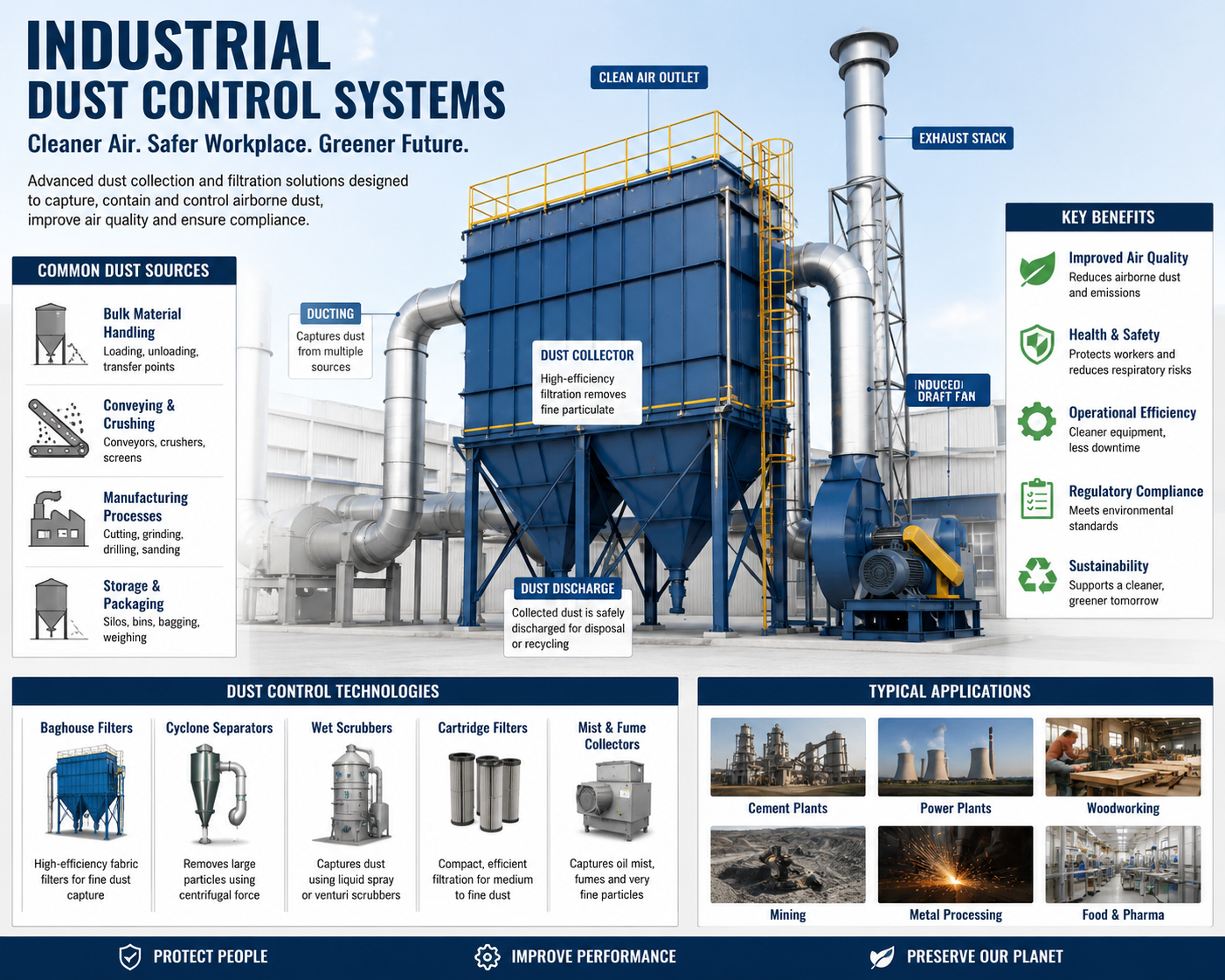
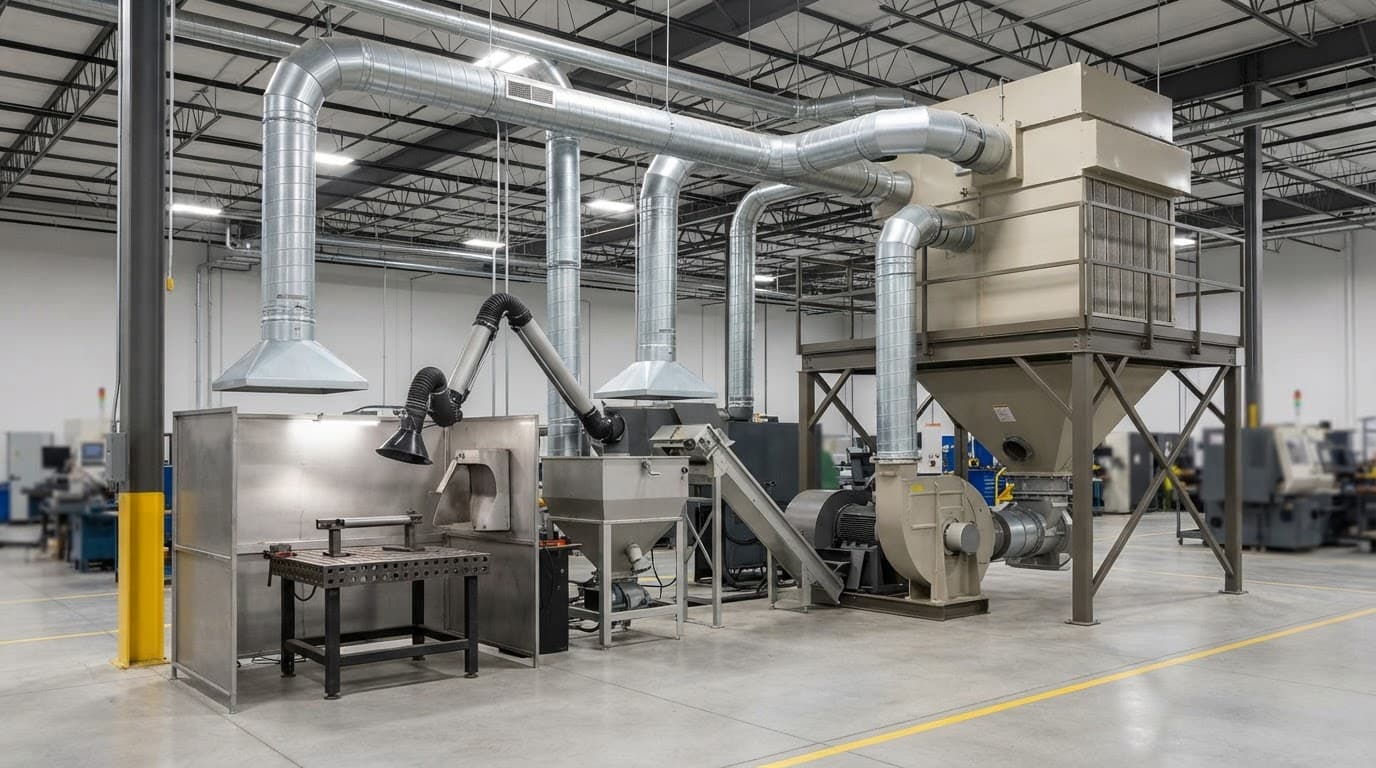
Industrial dust control systems pull contaminated air from a process through hoods, ductwork, fans, and filters. They then discharge or return cleaned air in a safe, code-compliant way.
Capturing dust near a saw, mixer, grinder, conveyor transfer, dump station, or sanding line beats trying to clean the whole building later. Once dust spreads, it reaches hard-to-see ledges and can enter bearings, electrical cabinets, and finished goods.
The main risks of airborne and settled dust
Dust exposure can irritate lungs, reduce indoor air quality, obscure walkways, wear down equipment, and contaminate products. Some materials also create a fire or deflagration hazard.
Particles around 420 microns or smaller may burn rapidly when suspended in air. However, size alone doesn’t establish the hazard. Material composition, moisture, concentration, ignition energy, confinement, and test data also matter. OSHA’s combustible-dust hazard communication guidance describes dust as a potential fire or deflagration hazard when dispersed in air.
Why source capture matters
Local exhaust ventilation uses a hood, enclosure, pickup point, duct, and fan to pull dust away before workers breathe it. Place the hood close to the release point and seal duct joints carefully.
A collector cannot compensate for a poorly located hood or an undersized fan. Leaks, open access doors, and weak airflow leave dust in the work area.
Select the right collector for the process
No single dust collector fits every plant. Dust type, particle size, temperature, moisture limits, production rate, floor space, and combustibility determine the best design.
Cartridge collectors for fine, dry dust
Cartridge collectors are compact dry-filtration units that often work well for fine dust and limited floor space. Pulse cleaning can extend filter life, and service access is often simpler than a large baghouse.
Still, sticky or damp material can blind filter media. Proper air-to-media ratios, cleaning cycles, and pressure monitoring prevent rapid loading.
Baghouses, scrubbers, and vacuum cleanup
Baghouses use fabric bags and often suit heavy dust loads or continuous processes. They need room for the housing, clean-side access, safe bag changes, and dust discharge equipment.
Wet scrubbers can handle dust alongside gases or odors where water is acceptable. They also bring water use, wastewater treatment, corrosion protection, and freeze planning. Misting may limit dust at transfer points, but it doesn’t replace capture or explosion planning.
Central vacuum systems and properly rated portable vacuums control fugitive dust during cleanup. Avoid dry sweeping or compressed-air blowdown when either could create a combustible cloud.
Size the system around real plant conditions
A process survey should map every dust-producing task, the material handled, worker locations, and future production changes. Then connect that information to capture hoods, duct runs, filtration, controls, and discharge methods.
Test dust before selecting equipment
Determine whether the material is combustible, toxic, corrosive, abrasive, oily, sticky, hygroscopic, or moisture-sensitive. Relevant inputs can include particle-size distribution, moisture, Kst, minimum ignition energy, and maximum pressure rise.
Metal, wood, grain, food, and chemical dusts can require different safeguards. A documented dust hazard analysis should guide the equipment specification, rather than assumptions based on a material’s appearance.
Match airflow to hoods and ductwork
Hood placement, pickup velocity, duct diameter, transport velocity, pressure loss, and fan selection must work as one system. Long duct runs, sharp elbows, poor balancing, and undersized fans can leave material inside ducts or at the source.
A high-quality collector with weak capture airflow still leaves the most hazardous dust where people and ignition sources are present.
Plan inspection doors, filter access, bin capacity, noise treatment, electrical supply, differential-pressure monitoring, and space for expansion. For control-side planning, industrial energy efficiency practices can help align collector run time with production demand.
Build combustible-dust safety into the design
Combustible-dust protection belongs in the initial design, not the final purchase order. OSHA inspections focus on housekeeping, equipment, and electrical hazards, as outlined in its Combustible Dust National Emphasis Program.
NFPA 654 remains a familiar reference for combustible particulate solids, while its content has been consolidated into NFPA 660. Depending on the process, teams may also apply NFPA 484 for combustible metals, NFPA 664 for wood processing, NFPA 68 for venting, NFPA 69 for prevention systems, and NFPA 499 for hazardous-location classification. A dust collector compliance guide can help frame questions for an engineering provider.
Venting, isolation, and housekeeping
A collector or connected process may need explosion venting, suppression, prevention, isolation, or an engineered combination. Safe vent discharge locations and isolation between connected equipment are essential. Test data and layout determine the protection method.
Settled dust on ledges, beams, ducts, and hidden spaces can fuel a secondary event. Use written inspection schedules and approved vacuum methods. Source capture remains the first line of defense, while industrial safety devices add protection around hazardous equipment.
Plan for ownership costs and routine maintenance
The collector is only part of the project cost. Hoods, ductwork, fans, electrical work, platforms, controls, discharge equipment, commissioning, training, and explosion protection can shape the final budget.
Lower-priced industrial dust control systems can cost more over time if filters load too quickly or access is poor. Review energy use, replacement filters, water and wastewater needs, housekeeping labor, Class II electrical requirements, and retrofit constraints.
Compare providers beyond the equipment quote
Ask manufacturers and providers about dust testing, engineering experience, code documentation, filtration performance, spare parts, warranties, commissioning, and local service. AIER Environmental, Golden Eagle Technologies, Nilfisk, Camfil APC, Acme Air Equipments, and Quickdraft are active names to research, but current support and capabilities vary by location.
Track pressure drop, airflow, filter condition, fan operation, bin levels, seals, duct buildup, relief devices, and visible leakage. Rising pressure drop often points to a loading, cleaning, airflow, or maintenance problem.
Conclusion
Effective industrial dust control systems start at the source and stay effective through proper airflow, sealed ductwork, suitable filtration, and disciplined maintenance. Combustible-dust hazards require testing and engineered protection before installation.
Document each dust-producing process, arrange a hazard assessment, and request a system design from a qualified industrial ventilation professional.