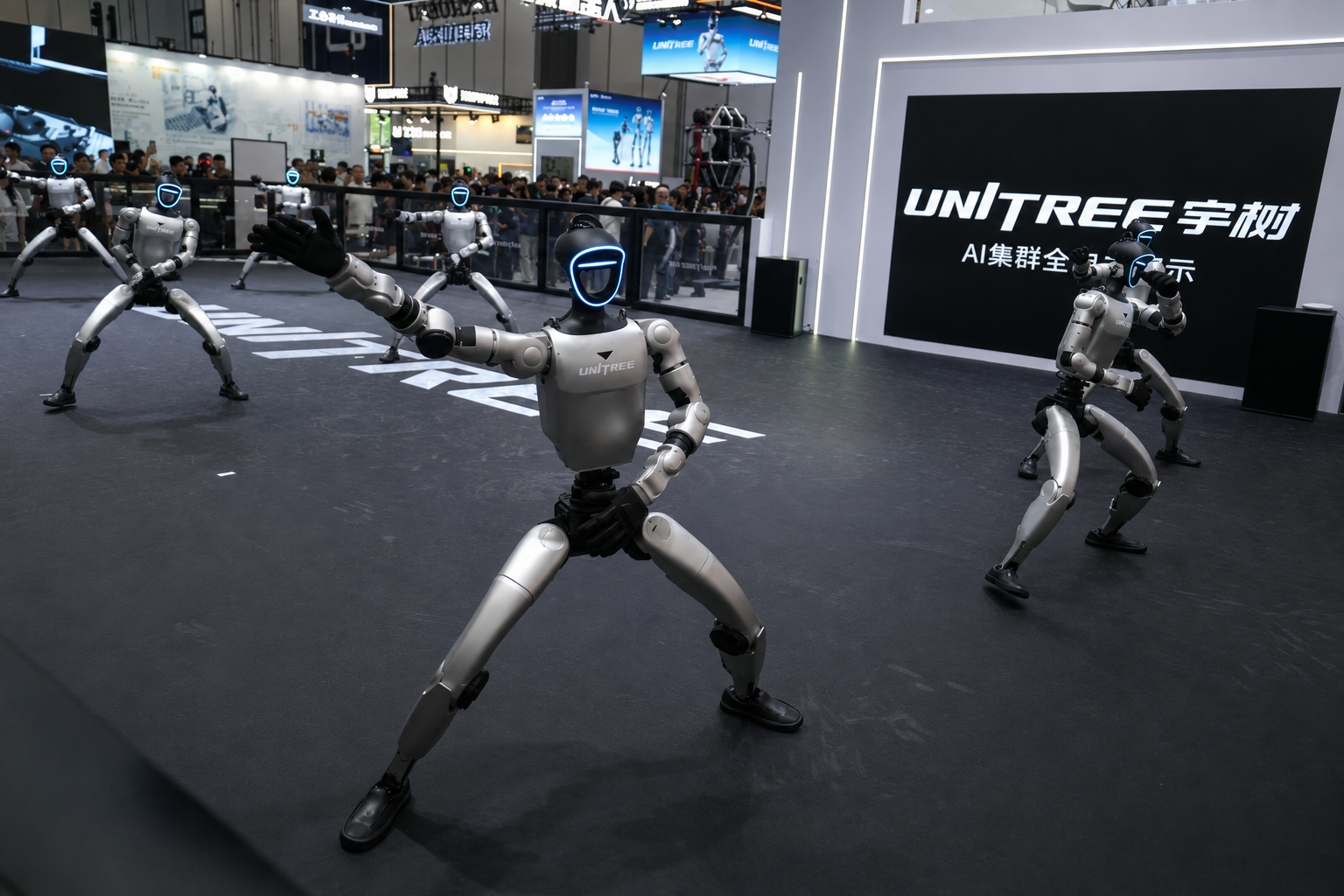
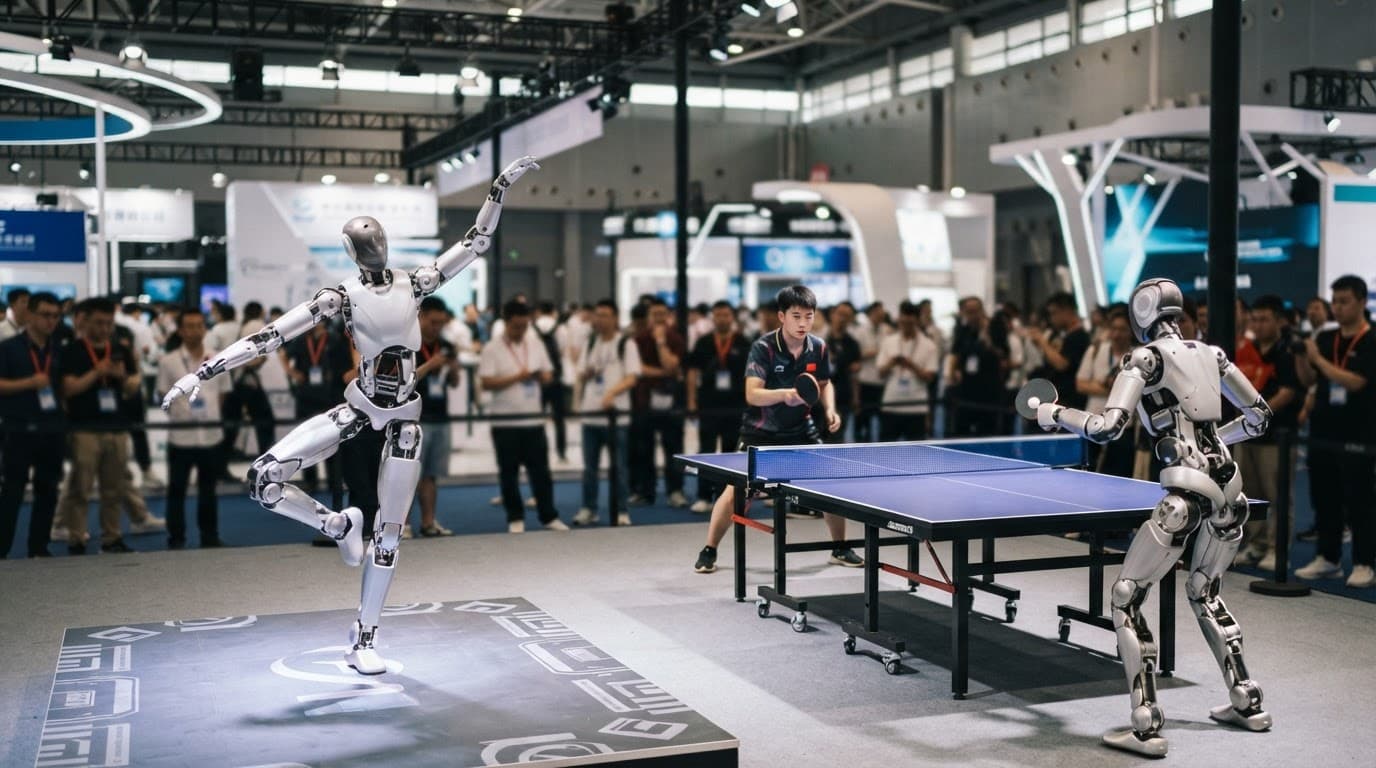
Under bright exhibition lights in China, humanoid robots danced, played ping pong, and drew crowds at the 2026 World Robot Conference. The Associated Press video captures a lively public display, but the bigger story sits behind the routines: China has built a wide network of robotics companies and component suppliers.
For anyone watching humanoid robots move with human-like timing, the hard question is whether a polished demo can become dependable everyday work. The conference offered signs of real progress, while also exposing the engineering and market hurdles still ahead.
Table of Contents
Humanoid Robots Show Off Skills at the Conference
Organizers said about 3,000 products would appear at the conference, placing humanoid robots alongside a much wider set of robotics technologies. The machines became a focal point because their bodies resemble ours, so even simple actions can feel familiar and surprising.
Dancing tests balance, coordinated joints, motion planning, and timing. Ping pong poses a different challenge. A robot must track a fast-moving ball, decide where to place its paddle, and respond to a human opponent in seconds.
Why Dancing and Ping Pong Matter
A dance routine can show whether a humanoid robot keeps its center of gravity while its arms, legs, and torso move together. Ping pong adds visual tracking and rapid arm control, which are harder to hide behind a preplanned sequence.
Still, conference demonstrations normally happen on clear floors with prepared equipment and narrow goals. Reuters’ report on the Beijing conference also framed the industry’s next challenge as turning attention into useful, repeatable adoption.
The Distance Between a Demo and Daily Work
A robot working in a warehouse, factory, hospital, or home must handle surprises. It may encounter an unfamiliar object, uneven ground, a person stepping into its path, or a software error at the wrong moment.
Battery life, safe physical contact, maintenance, and cost all matter. A machine that completes one impressive task on a stage hasn’t yet proven it can repeat useful work safely for hours.
A memorable performance shows a robot’s potential. Reliable work requires that same performance under changing conditions, day after day.
China’s Supplier Network Gives Robot Makers a Base
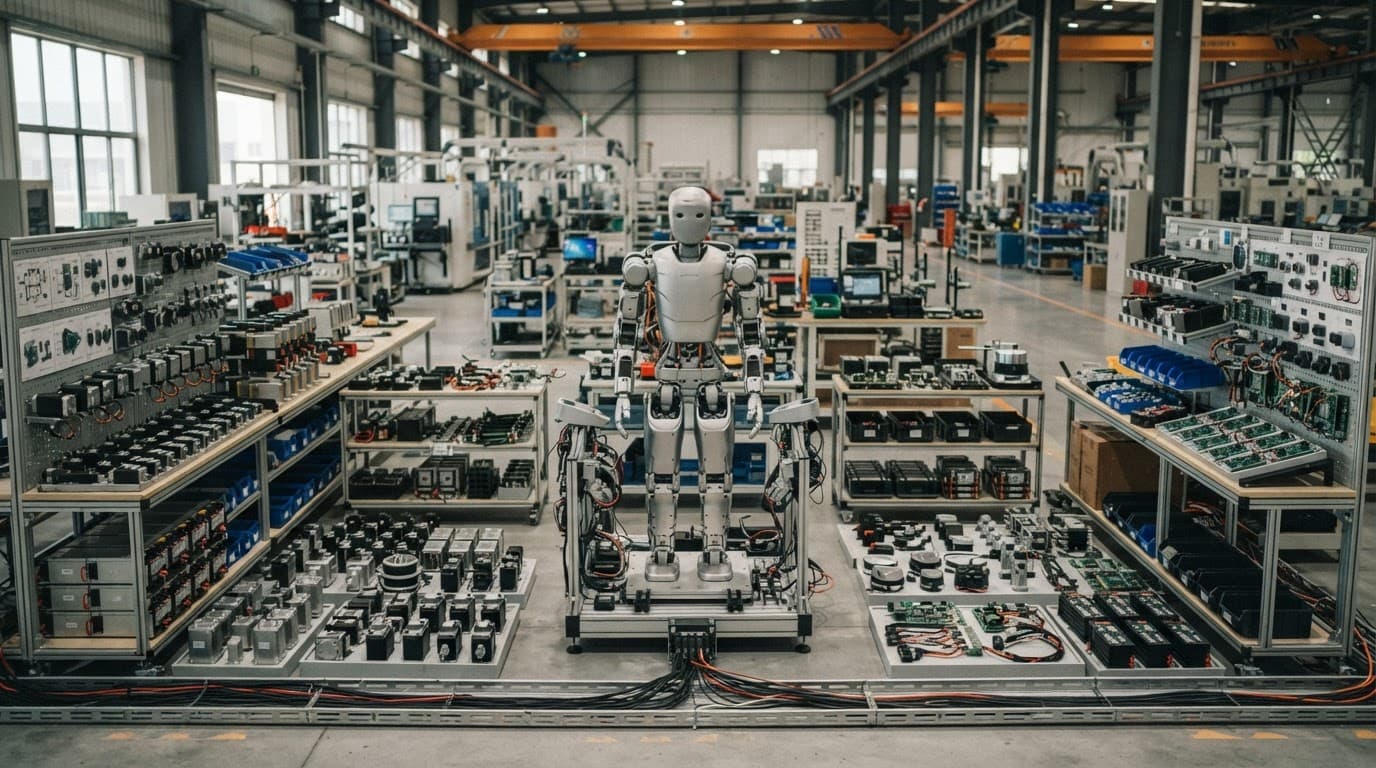
The video describes more than 500, and possibly over 1,000, Chinese companies involved in humanoid robots or their key components. That concentration gives manufacturers a large pool of potential partners close to where many robots are designed and assembled.
A broad local network can make it easier to test parts, compare suppliers, and source production batches. It doesn’t prove that every robot will be affordable or reliable, but it can shorten the distance between a prototype and a machine ready for repeated manufacturing.
Many Systems Must Work as One
Humanoid robots depend on actuators or motors for movement, sensors for sight and balance, batteries for power, onboard computers for control, and software that plans actions. Weakness in one part can limit the whole machine.
Strong motors won’t help a robot with poor balance. Sharp cameras can’t compensate for slow decision-making. This is why China’s supplier base matters as much as the finished robots on the show floor. It also fits into the broader growth of China’s AI-powered industrial robotics, where machine vision, automation, and connected production systems are becoming more common.
Nearby Suppliers Can Speed Up Development
When suppliers and robot makers operate near one another, teams can revise a motor, sensor, or controller without waiting on long-distance shipping. Faster repairs and closer cooperation may also help companies identify flaws earlier.
However, manufacturing scale can’t solve every problem. Software reliability, energy use, safety testing, and the training needed to operate and repair robots still demand sustained work.
U.S. Limits Could Shift Where Robots Are Sold
The video also points to a short-term commercial problem for Chinese companies: U.S. limits may prevent them from selling some products to American customers. Losing access to buyers means losing revenue streams, even when a company has the engineering capacity to make the product.
The video doesn’t identify a particular rule or product category, so the practical effect will vary by company. Yet the central concern is clear. Access to a major customer market can affect sales, partnerships, investment, and the ability to build an international support network.
Other Markets May Become More Important
Europe, Southeast Asia, and the wider EMEA region were identified as possible alternative markets. Those regions contain factories, logistics operations, research centers, and service businesses that may consider robotics, but they aren’t one market with one set of needs.
Adoption depends on local regulations, price, service support, and whether the robot performs a useful job. New customers elsewhere may soften the loss of U.S. sales, though they may not fully replace it.
Export Pressure Changes Competition
Trade barriers can push manufacturers to seek new partners, build domestic demand, adjust supply chains, or focus on products that fit different markets. Competition also affects component access, prices, safety standards, and how quickly useful machines reach customers.
For humanoid robots, market access is part of the product. A buyer needs repair options, software updates, spare parts, and a company that can provide support after delivery.
What the Conference Says About Humanoid Robots’ Future
The 2026 World Robot Conference showed a growing ecosystem, not a finished product category. More suppliers, thousands of displays, and public demonstrations point to active development. Yet everyday value will depend on less glamorous measures: safe movement, low downtime, manageable costs, and useful tasks.
Buyers should look beyond a clip of a robot dancing or returning a ping pong shot. A practical evaluation asks:
- What job is the robot built to do, and how often does it complete that job successfully?
- Can it operate outside a controlled demonstration, with people and changing conditions nearby?
- How long can it work before charging, and who handles repairs and software updates?
- What safety systems, human supervision, and data protections are in place?
Practical Work May Matter More Than Stage Skills
The next meaningful gains may appear in repetitive tasks such as moving supplies, inspecting items, sorting packages, or handling simple factory work. Those uses won’t draw the same applause as table tennis, but they could create clearer value if the robot works safely and consistently.
A robot designed for a factory may not fit a hospital, store, or home. That is why buyers need repeatable test results and evidence from real deployments, rather than relying only on a polished conference routine.
The Test Comes After the Applause
China’s 2026 World Robot Conference made humanoid robots more visible and showed growing capability in movement, balance, and coordination. Its large supplier network gives Chinese robot makers a meaningful foundation for building and refining machines.
Dancing and ping pong remain demonstrations, not proof that robots are ready for every workplace or household. U.S. sales limits may create pressure, while Europe, Southeast Asia, and other markets offer possible paths for growth. The next stage of humanoid robots will be measured by how safely, affordably, and reliably they help people beyond the conference floor.