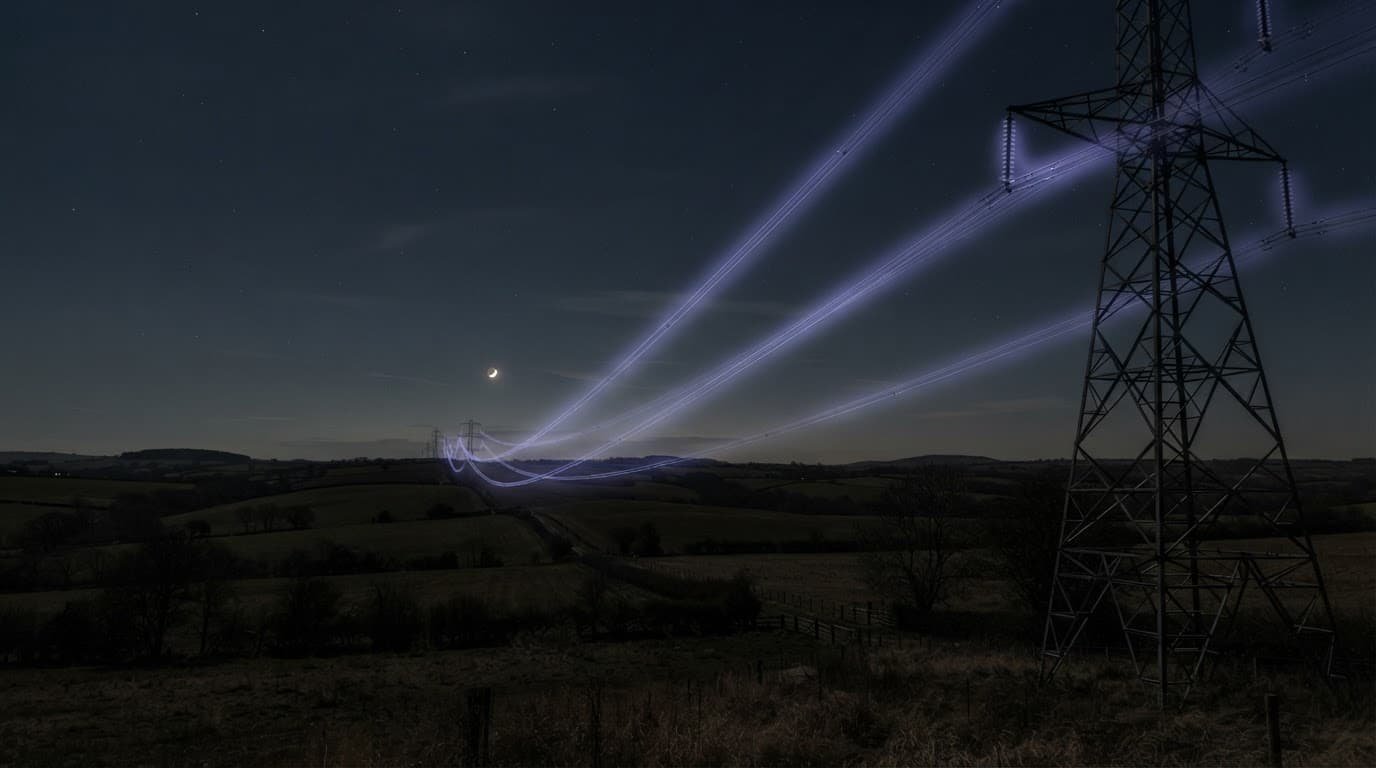
A faint violet halo around a transmission line can make an ordinary night scene look strange, especially when it comes with a soft hiss or crackle. That light is corona discharge, a localized ionization of air around energized high-voltage equipment.
Corona isn’t a full short circuit or an arc flash. Still, it wastes energy, creates electrical noise, and can speed up insulation aging when it persists. Its behavior also explains why extra-high-voltage lines often carry several conductors for each phase.
Table of Contents
What Causes the Violet Glow on High Voltage Lines?
Air normally insulates conductors from one another and from ground. However, it isn’t a perfect insulator. Small numbers of free electrons and ions are always present in the atmosphere.
When a conductor operates at very high voltage, it creates an electric field around itself. That field is strongest at the conductor surface and weakens with distance. If the surface field becomes intense enough, it accelerates nearby electrons until they collide with air molecules and knock more electrons free. This chain reaction ionizes a thin layer of air around the conductor.
That localized breakdown is corona discharge. The EPRI definition of corona discharge describes it as a partial breakdown of gaseous insulation caused by high electric stress.
Engineers call the point where ionization begins the critical disruptive voltage. A surface gradient of roughly 30 kV per centimeter is often used as a useful reference under standard conditions. Real systems don’t follow one fixed number, though, because weather, conductor shape, altitude, and contamination all change the result.
Corona is most often associated with extra-high-voltage equipment, commonly on systems around 245 kV and above. Lower-voltage lines can produce corona under unusual conditions, but the familiar violet glow on high voltage lines is far more likely where electric fields are severe.
How ionized air creates light, sound, and ozone
The violet-blue light comes mainly from excited nitrogen molecules releasing energy as photons. That glow is often easiest to see at night, although specialized instruments can detect corona in daylight.
Meanwhile, countless small discharges heat and disturb the surrounding air. Rapid microscopic expansions create the hissing or crackling sound heard near heavily energized lines and substations.
Corona also forms ozone. High-energy collisions split oxygen molecules, and free oxygen atoms can combine with other oxygen molecules to form O3. A spark creates a sudden, visible path through air. Corona is different because it consists of repeated, small discharges concentrated near a stressed surface.
Corona can look subtle from a distance, but it shows that the electric field near a conductor or fitting has become strong enough to ionize air.
Where corona appears besides overhead lines
Transmission conductors are only one location where corona can form. It can also appear around transformer bushings, circuit breaker terminals, disconnect switches, cable terminations, insulators, and exposed outdoor substation hardware.
Sharp edges create the problem. A bolt, damaged conductor strand, rough fitting, or poorly shaped terminal can concentrate the electric field into a small area. That local stress can be far higher than the average field around the equipment.
Conditions That Make Corona Worse
Corona severity depends on more than system voltage. A smooth, clean, rounded conductor distributes electric stress more evenly. In contrast, contamination and surface damage create small areas where the field crowds together.
The most important influences include conductor radius, conductor spacing, voltage level, air density, weather, pollution, and hardware condition. At higher altitudes, lower air pressure reduces air density and can change the level at which ionization begins.
Rough surfaces create field hot spots
A rough conductor doesn’t have to look badly damaged to produce a problem. Broken strands, corrosion, loose clamps, sharp edges, insect nests, and contamination can all create local field concentrations.
Because of that, maintenance teams pay attention to ultraviolet activity, audible noise, visible glow, and evidence of contamination during inspections. These clues do not automatically mean equipment is about to fail. They do show that the field distribution deserves attention.
Rain, fog, and pollution can raise activity
Corona often becomes more visible and louder in rain, fog, or humid air. Water droplets distort the field around the conductor and can create many small discharge points. Salt deposits, industrial pollution, and wet grime can have a similar effect on insulators and fittings.
Fair-weather performance still matters, but wet-weather conditions often reveal the design’s weak spots. The amount of corona depends on the line’s construction and the actual conditions at the site. A rainy day alone doesn’t prove that a line has a defect.
Why Corona Costs Utilities More Than Lost Power
Corona turns a small amount of electrical energy into light, heat, sound, chemical reactions, and electromagnetic noise. Across a long transmission route, that loss can become expensive.
Research on corona in overhead transmission lines notes that corona is a dissipative process that increases transmission-line losses. Utilities also have to account for radio interference and long-term material aging near active discharge sites.
Corona loss consumes real transmitted power
Every ionization and recombination event consumes energy. Consider an illustrative 400 kV line that runs 500 kilometers. If corona losses range from 1 to 5 kW per kilometer in fair weather, the full line could lose roughly 500 to 2,500 kW continuously.
Those figures are examples, not a universal design value. Actual losses depend on conductor geometry, operating voltage, elevation, weather, and surface condition. During heavy rain, corona losses can rise several times above fair-weather levels.
A few kilowatts at one location may sound modest. Spread that loss over hundreds of miles and thousands of operating hours, however, and it becomes energy that never reaches customers.
Electrical noise can reduce communication margins
Corona produces broadband electromagnetic interference. The discharge noise can extend into frequencies used by AM radio and power line carrier communication, often cited in the approximate 0.5 MHz to 30 MHz range.
Power line carrier systems can carry protection and control signals between the ends of a transmission line. Corona noise does not automatically cause a relay malfunction. However, excessive interference can reduce communication margins and make protection systems harder to operate reliably.
Ozone can age polymer insulation
Ozone is chemically reactive. Over time, it can attack polymer insulation, cable jackets, rubber gaskets, and other nonmetallic materials near a persistent corona source.
Heat, moisture, ultraviolet exposure, and pollution can worsen the damage. The outcome may include surface cracking, loss of flexibility, tracking, or reduced mechanical strength. Equipment life depends on its materials, operating conditions, and maintenance history, so no single percentage of life reduction applies to every installation.
How Engineers Reduce Corona on Lines and Equipment
Corona control starts with the same principle that causes the discharge: reduce electric-field intensity at the surface and remove sharp stress points.
Current capacity is only one part of transmission-line design. Engineers also assess conductor diameter, conductor spacing, mechanical loading, audible noise, radio interference, and expected corona performance.
Larger conductors lower surface stress
Increasing conductor diameter gives the electric field more surface area to spread across. That reduces the field intensity at the conductor surface and raises the margin before corona begins.
Many transmission lines use ACSR, or aluminum conductor steel reinforced, conductors. Their size reflects several requirements, including current-carrying capacity, mechanical strength, thermal performance, sag limits, and corona control. A larger conductor helps, but it does not fix rough hardware, poor clearances, or contamination.
Bundled conductors explain multiple wires per phase
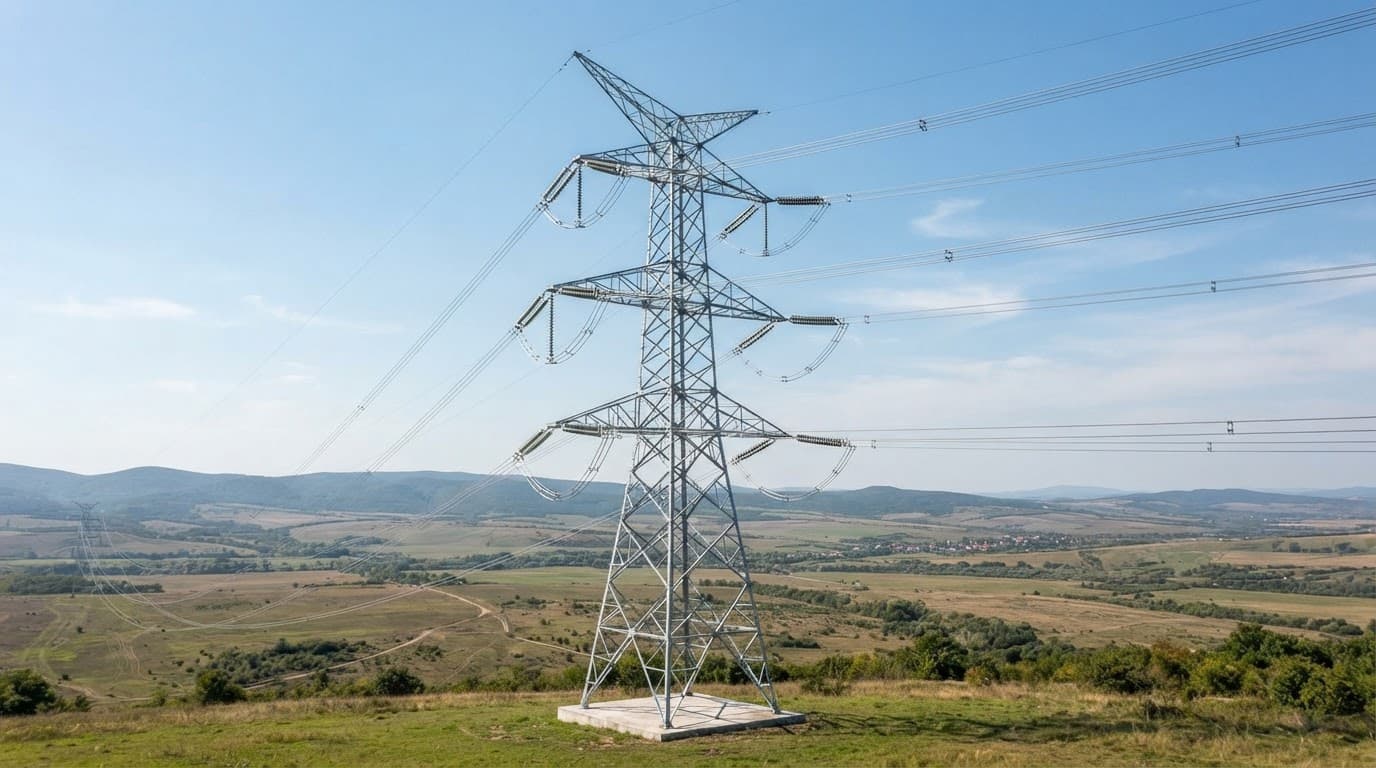
The two, three, or four wires seen on one phase of an extra-high-voltage line are called a bundle. Spacers hold the subconductors apart, often by roughly 30 to 60 centimeters.
Electrically, the bundle behaves like a much larger effective conductor. This lowers the surface gradient on each subconductor, which reduces corona, audible noise, and radio interference.
Twin bundles are common on some 400 kV systems. Some 765 kV systems use quad bundles with four subconductors per phase. Utilities choose the arrangement based on their voltage level, design standards, weather loads, hardware costs, and maintenance needs.
Corona rings smooth stressed equipment edges
A corona ring is a rounded, toroidal metal fitting installed around a high-voltage terminal or other stressed fitting. Its smooth shape redistributes the electric field and prevents intense concentration at sharp edges.
You may see corona rings around transformer bushings, breaker terminals, disconnectors, and cable terminations. They are one part of a broader insulation design that also depends on clearances, grading components, surface condition, and proper installation.
How UV Cameras and PD Sensors Find Corona Early
Corona is more than a loss mechanism. It can also warn maintenance teams that insulation, connections, or equipment geometry has changed.
Corona is one type of partial discharge that occurs in a gas around energized equipment. Partial discharge can also occur inside insulation voids or along contaminated surfaces, so not every partial discharge is corona. Still, increasing corona activity around a bushing, termination, or insulator can justify closer investigation.
UV cameras detect corona in daylight
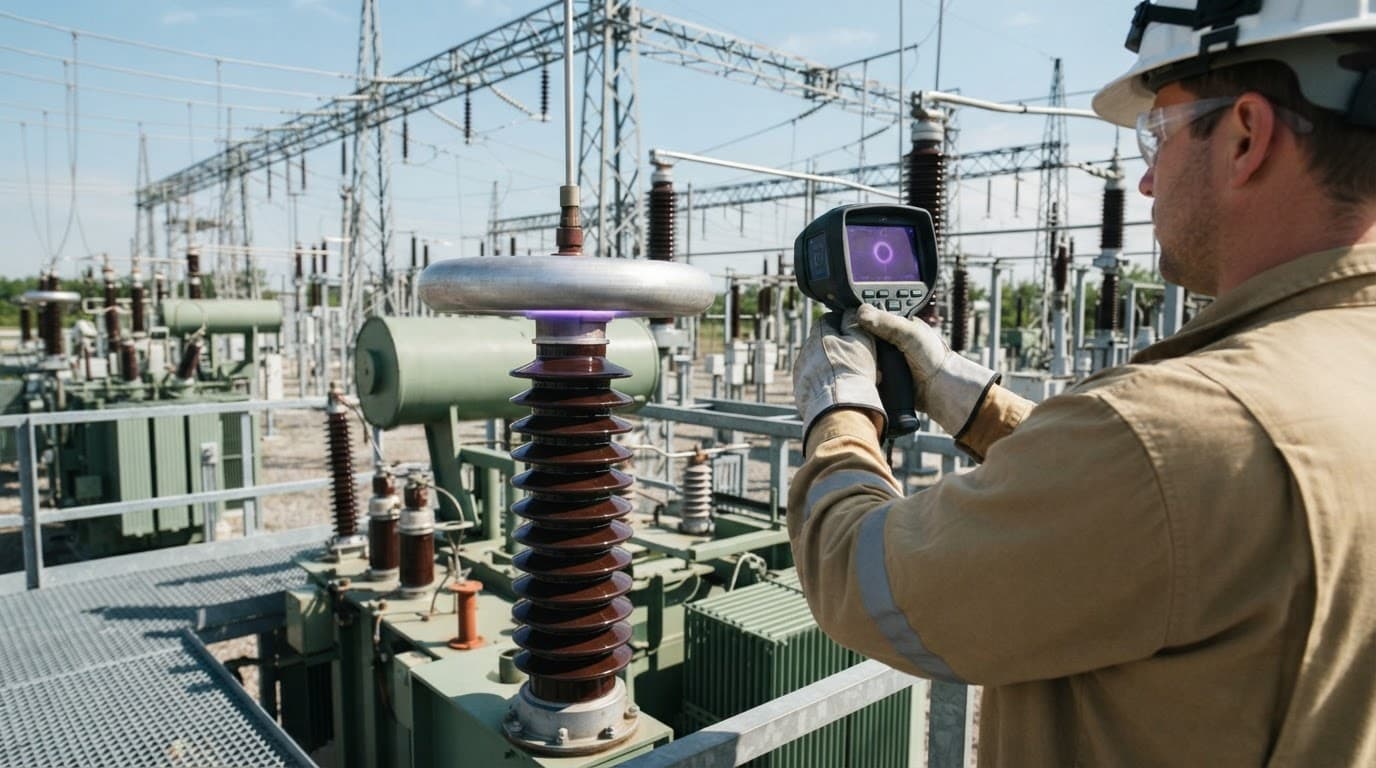
Corona emits ultraviolet radiation that people cannot see. Specialized ultraviolet cameras can detect that radiation even under daylight conditions, then display active spots over an image of the equipment.
A typical inspection compares activity across similar phases or matching components. If one bushing or connection shows repeated UV emissions while nearby equipment does not, technicians can record the location, weather, loading condition, and apparent intensity for follow-up.
A study on camera and sonic corona detection describes the value of locating high-voltage corona early. A UV image alone does not diagnose the full cause. Maintenance teams need equipment history, visual inspection, and electrical test results to interpret it correctly.
Acoustic sensors and HFCTs reveal hidden discharge
Ultrasonic and acoustic sensors can help locate discharge activity around outdoor equipment, where corona produces sound beyond the range of normal hearing. These methods can help crews compare suspected locations without relying on nighttime visibility.
High-frequency current transformers, or HFCTs, detect fast current pulses associated with partial discharge. They can support testing on cables, grounding paths, and enclosed metal-clad equipment where a camera cannot see the active area.
For issues inside distribution equipment, partial discharge in MV switchgear can point to insulation defects, contamination, or weak terminations. No single sensor tells the whole story, so teams compare several measurements before deciding on corrective work.
A corona finding should lead to qualified follow-up
A useful response starts with good records. Capture the asset identification, location, weather, load, inspection distance, and repeatability of the signal. Then compare the result against baseline readings or similar equipment on adjacent phases.
Qualified personnel can inspect for contamination, damaged hardware, poor clearances, loose connections, or degraded insulation. Because energized high-voltage equipment can injure or kill without warning, inspection and repair must follow site procedures and authorized safety practices.
The Meaning Behind the Violet Halo
The violet glow on high voltage lines is air ionization at the edge of a strong electric field. Weather, contamination, and rough surfaces can intensify it, while larger conductors, bundled phases, and corona rings reduce the stress that creates it.
Corona discharge wastes power and can add interference and insulation-aging risks. Yet it can also expose a developing issue before it becomes a failure.
Recognizing corona is useful for students, engineers, and anyone who works near power infrastructure. Inspecting energized high-voltage equipment is work for trained and authorized personnel.