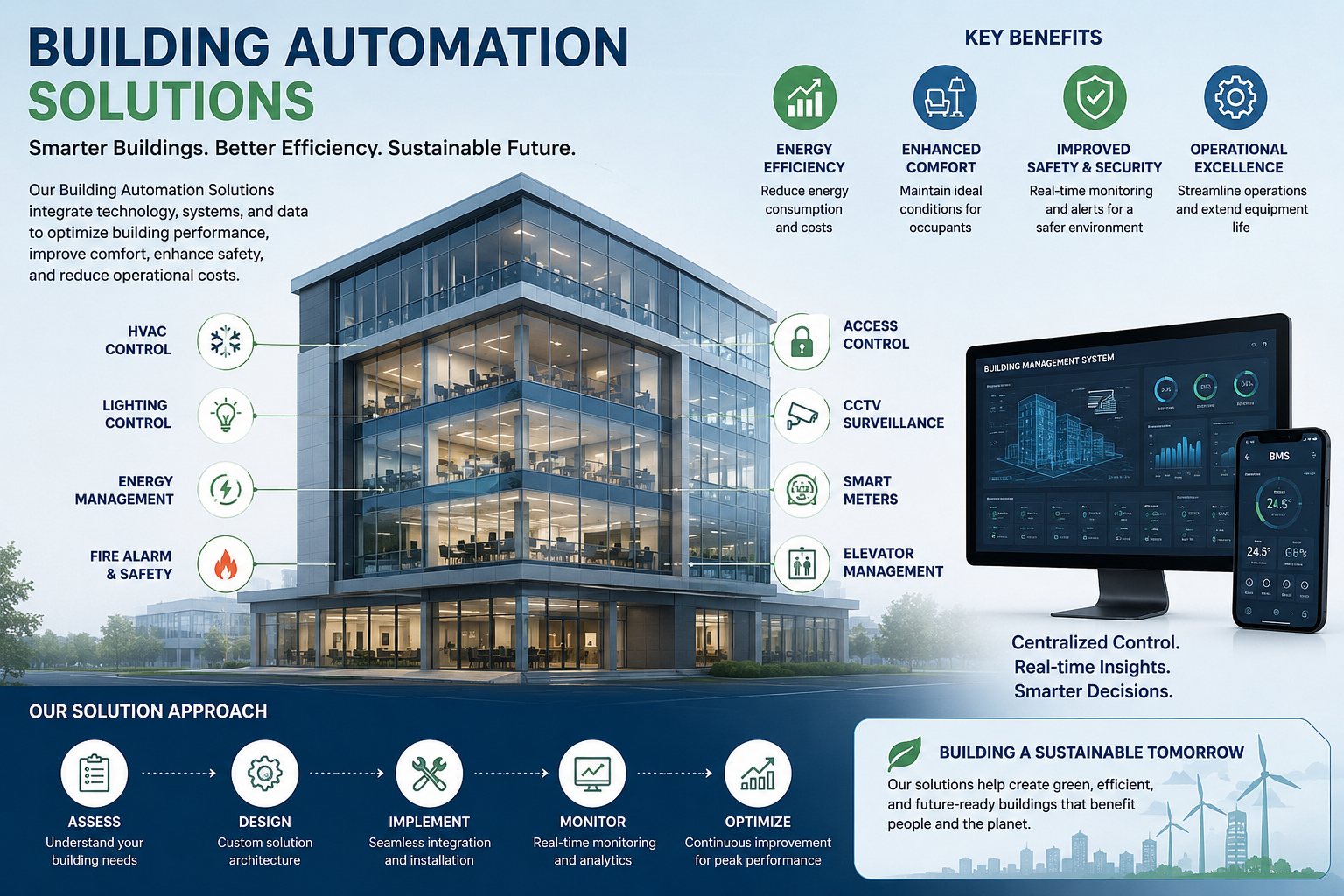
A building can waste energy for hours after its occupants leave, with lights burning and HVAC equipment conditioning empty rooms. Building automation solutions bring those separate decisions into one control network, so a building can lower heating, ventilation, and lighting when spaces sit vacant.
For facility teams, the goal is practical: fewer blind spots, steadier comfort, and less time spent chasing routine problems across disconnected systems.
The right system starts with a clear view of how equipment, data, and people already work together.
Table of Contents
What Building Automation Solutions Do and How They Work
Building automation solutions monitor and control systems such as HVAC, lighting, energy meters, access control, security, and selected fire and life-safety interfaces. Instead of relying on manual adjustments and isolated timers, operators use one platform to see conditions and direct equipment.
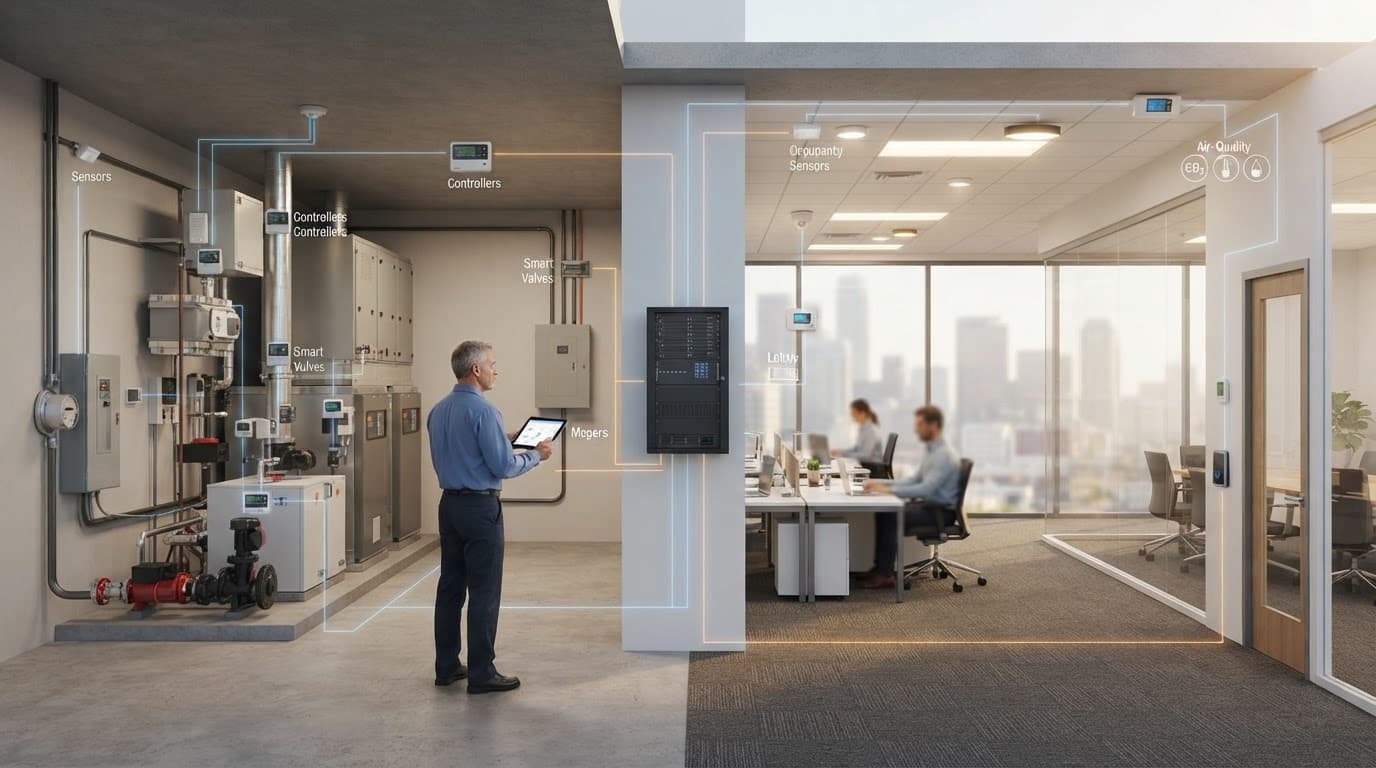
The basic flow is simple. Sensors gather data, controllers interpret it, and software sends commands to fans, valves, dampers, lights, and other connected equipment. NIST’s smart building control work also focuses on how connected building systems can work together safely and reliably.
The Core Parts of a Building Automation System
Sensors measure temperature, humidity, carbon dioxide, occupancy, light levels, and equipment status. Field controllers make local decisions, such as opening a chilled-water valve or starting an air-handling unit.
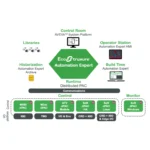
Gateways translate data between older equipment and newer networks. Supervisory software turns thousands of data points into alarms, schedules, trend charts, and dashboards. Cloud services can add remote access and multi-site reporting.
None of these pieces works well alone. A dirty temperature sensor can cause poor control, while an unmaintained controller can leave an entire zone running on a default schedule.
Where HVAC, Lighting, Energy, and Security Meet
HVAC controls can adjust temperature and outdoor-air intake based on schedules, occupancy, and indoor conditions. Lighting controls can dim daylight-facing fixtures or switch off empty conference rooms.
Energy meters expose unusual loads and demand peaks that would otherwise hide in monthly utility bills. Access control data may help identify occupied areas, although security and privacy policies must govern that exchange.
Fire and life-safety systems require special care. They must remain protected, code-compliant, and able to operate independently when required by local regulations.
The Technologies Behind Connected Building Controls
A control platform is only as flexible as its network and protocols. Wired Ethernet often suits major mechanical equipment, while wireless sensors can reduce disruption in occupied spaces. Edge controllers keep local sequences running even when an internet connection drops.
Centralized software gives operators a broad view, but distributed controls handle immediate equipment decisions near the source. Most strong designs use both.
Why BACnet and Interoperability Matter
BACnet is an open, vendor-neutral protocol built for communication among building automation devices. Understanding what BACnet is and why it matters helps buyers ask better questions before selecting controllers or management software.
Open protocols can reduce dependence on a single supplier and make future upgrades less painful. However, a BACnet label doesn’t guarantee effortless integration. Device profiles, point lists, gateway quality, programming, and commissioning still determine whether systems exchange useful data.
Older equipment may need a gateway rather than replacement. That option can preserve a working boiler plant or meter network while adding modern oversight.
Cloud, Edge, and Analytics
Cloud-connected tools support remote dashboards, multi-site reporting, software updates, and long-term trend analysis. A retailer with dozens of locations can compare runtime patterns without visiting every mechanical room.
Edge controllers matter because a building still needs heat, cooling, and local alarms during an outage. They keep scheduled and safety-related functions close to the equipment.
Analytics can flag a fan that runs overnight or a valve that never reaches its commanded position. Yet poor sensor calibration produces poor analysis. Clean point naming and accurate data must come first.
The Business Benefits of Connected Building Controls
The strongest case for automation comes from measurable operating results, not a flashy dashboard. Building schedules, equipment age, utility rates, occupancy patterns, and maintenance habits all shape the return on a project.
Connected controls make waste visible. They also give facility teams a record of what equipment did before a complaint, failure, or utility spike.
Energy Savings Without Sacrificing Comfort
Useful strategies include occupancy-based setbacks, optimum start routines, daylight harvesting, demand management, and ventilation control tied to actual conditions. Each one reduces unnecessary runtime without treating every room as identical.
Poor tuning creates its own costs. An aggressive nighttime setback can lead to cold morning complaints, while weak ventilation control can harm indoor air quality. Building management cybersecurity guidance also reinforces that connected controls need protection as they collect and share more operational data.
Energy savings that create comfort complaints rarely last, because staff will override the schedules that caused them.
Better Operations and Occupant Experience
Alarms and equipment trends help teams find faults sooner. A stuck valve, failing supply fan, or unexplained overnight electric load becomes easier to spot when the system records operating history.
Occupants feel the difference through steadier temperatures, fewer hot and cold zones, and faster response when a space changes use. A classroom used for an evening event shouldn’t follow the same control schedule as an empty hallway.

How to Choose and Implement Building Automation Solutions
Good projects begin with an audit. Map existing equipment, control panels, meters, network connections, and recurring comfort or maintenance issues. Then set measurable goals, such as reducing after-hours runtime or gaining visibility into a particular air-handling unit.
Choose an architecture and protocol plan before buying devices. A strong project scope also covers cybersecurity, staff training, and commissioning, rather than treating them as extras.
Questions to Ask Vendors Before You Buy
Ask vendors which protocols they support, how they connect to existing equipment, and who owns the system data. Request details about software licensing, cloud subscriptions, warranties, remote support, and expansion limits.
A credible proposal includes a point list, network diagram, sample dashboard, installation scope, and references from comparable buildings. Ask which tasks require proprietary tools or factory support.
Security deserves the same attention. NIST’s building automation security guidance recommends removing public IP exposure, restricting remote access, changing factory passwords, and using network segmentation.
A Practical Retrofit Rollout
Retrofits usually work best in phases. Start with high-energy equipment or the areas that create the most complaints. Survey and design come first, followed by installation, configuration, testing, commissioning, training, and post-launch tuning.
Test control sequences under real operating conditions. Confirm that occupancy sensors detect use correctly, alarms reach the right people, and overrides don’t disable essential schedules for weeks.
Calibrate sensors and review trends after launch. A system needs ongoing attention, much like the mechanical equipment it controls.
Leading Providers and Long-Term Value
Commercial buyers often compare Siemens Desigo, Schneider Electric EcoStruxure Building, Johnson Controls OpenBlue, Honeywell, and Trane Technologies. Each provider offers different combinations of controllers, supervisory software, service coverage, analytics, and retrofit options.
Product names, availability, and features can vary by region and project. Local integrator experience may matter as much as the software name on a proposal.
Compare Total Cost and ROI
A project price includes more than controllers. Budget for sensors, network work, software, engineering, installation, integration, commissioning, training, maintenance, and recurring license or cloud fees.
Request a line-item proposal, then compare total ownership costs over several years. Measure ROI through energy consumption, demand charges, staff hours, comfort complaints, maintenance events, and avoided equipment stress.
Building automation solutions can produce better results when the owner tracks those measures before and after installation. Guaranteed payback claims rarely account for changing occupancy or weather.
Cybersecurity and Reliability Belong in the Design
Connected controls expand the attack surface because operational technology can connect with business networks, remote vendors, and cloud services. NIST’s cybersecurity work for building systems treats these systems as a distinct operational security concern.
Use dedicated network segments, firewall rules, least-privilege access, multi-factor authentication, strong passwords, patch management, backups, asset inventories, logging, and an incident response plan. Disable unused services such as Telnet and FTP.
Keep Essential Functions Running
A secure design also needs reliable fallback controls. Local controllers should maintain safe schedules and equipment operation if cloud access fails. Test alarms, backup power, and manual overrides before an emergency exposes a gap.
The building owner, integrator, and software provider should each have written responsibilities for patches, backups, account removal, remote support, and incident response. Shared responsibility without clear ownership often leaves security tasks undone.
Conclusion
The best building automation platform fits the building’s equipment, budget, staff capacity, comfort needs, energy targets, and future plans. Sophisticated features have little value when sensors drift, controls remain untested, or staff can’t use the dashboards.
Start with an audit and measurable targets. Choose interoperable technology, protect the network, and fund commissioning and ongoing tuning so building automation solutions keep delivering useful control long after installation.