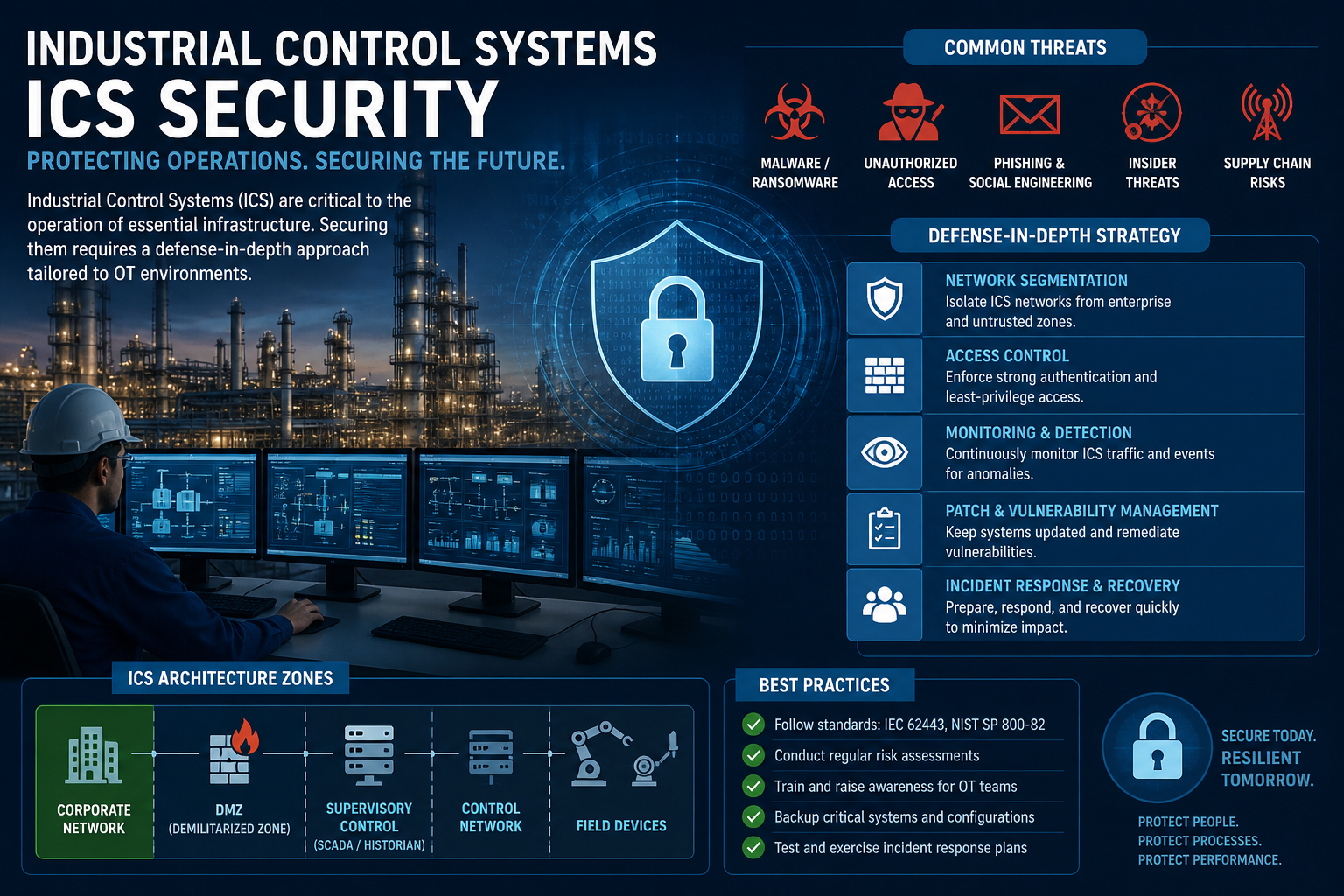
A cyberattack on a factory, water plant, pipeline, or power site can move beyond screens and files. It can halt a conveyor, blind operators to tank levels, or force a facility into manual operation.
Industrial control systems ICS security protects the technology that links digital commands to physical work. PLCs, SCADA platforms, distributed control systems, RTUs, HMIs, and engineering workstations all have a role in keeping processes safe and available. Strong protection begins with understanding what these systems control and how a failure would affect people, equipment, and service.
Table of Contents
Industrial control systems ICS security starts with understanding OT
Industrial control system security protects the hardware, software, networks, and people that operate physical processes. These systems sit within operational technology, or OT, which includes the devices that run machinery, move materials, regulate pressure, and manage production.
IT security often places confidentiality first because it protects data. OT security has a different order of concern. Safety, availability, reliability, and process stability can come before confidentiality because an interrupted command or incorrect setting can cause immediate physical effects.
Many plants also carry decades of technical history. A 20-year-old controller may use a specialized protocol, have limited authentication features, and support only narrow maintenance windows. Taking it offline for a routine patch may stop a line or interrupt a public service. NIST SP 800-82 Rev. 3 addresses those operational constraints in its guidance for OT security.
What systems need protection in an industrial environment?
A useful inventory reaches far beyond servers and laptops. It should cover PLCs, RTUs, SCADA servers, DCS controllers, HMIs, historians, engineering workstations, safety instrumented systems, switches, serial gateways, protocol converters, remote-access tools, and update platforms.
Each component needs an owner, location, model, firmware version, network address, process role, and support status. Teams also need to know which systems depend on it. A historian outage may not stop a pump, for example, but losing the engineering workstation that holds approved controller logic can delay recovery.
For a plain-language comparison of PLC, DCS, and SCADA architectures, focus on how each system makes decisions, presents information, and exchanges commands.
Why a flat or internet-connected control network is dangerous
A flat network lets a problem travel too far. An attacker who compromises an office computer may reach a control asset if business IT and OT share broad trust relationships.
Exposed HMIs, outdated remote-access appliances, weak vendor accounts, and direct internet connections raise the risk. Attackers don’t need to understand every process at first. They may start by stealing credentials, mapping systems, or disrupting a server that operators rely on.
OT connections should be denied by default, then allowed only for approved users and functions. IT and OT network differences matter here because plant-floor traffic often has timing, reliability, and safety requirements that office networks do not share.

The biggest ICS security threats facing industrial operators
Threats to OT rarely arrive in one dramatic form. They often begin with a routine weakness, such as an unattended vendor account, a reused password, an infected laptop, or a misconfigured firewall rule.
Ransomware and extortion can disrupt scheduling, maintenance records, historian access, and operator visibility. Stolen credentials can give an intruder a legitimate-looking path into remote administration tools. Meanwhile, supply-chain risk may enter through compromised updates, contractor devices, or third-party software.
CISA’s security guidance identifies internet-accessible devices and exposed public-facing applications as high-risk conditions. Its Cybersecurity Performance Goals provide a practical baseline for organizations that need to reduce those gaps.
Ransomware, malware, and attacks that interrupt production
In an office, ransomware may lock documents and email. In an industrial environment, it can make process data unavailable, prevent operators from viewing alarms, or delay planned maintenance. Production may continue briefly, but blind operation is not a safe long-term option.
Malware can enter through phishing, removable media, vendor laptops, software updates, or a compromised IT network. Engineering workstations deserve extra protection because they often hold the tools needed to alter PLC logic, firmware, and HMI projects.
CISA advisories regularly document weaknesses in SCADA and HMI products, PLCs, RTUs, engineering update tools, and OT management platforms. Operators should review vendor notices against their actual asset inventory, rather than treating every published vulnerability as equally urgent.
Remote access and vendor accounts create a wide attack path
Always-on vendor access turns convenience into exposure. Shared accounts hide accountability, while weak passwords and exposed administration portals offer easy entry points.
Every remote session should have a named owner, a clear maintenance purpose, and a defined end time. MFA, approval workflows, jump hosts, session recording, and rapid account removal create useful friction without blocking legitimate repairs.
A vendor connection that stays open after maintenance becomes an unmanaged pathway into the control environment.
Build defense in depth for stronger ICS and OT security
No firewall, endpoint tool, or monitoring platform can carry the whole burden. Industrial control systems ICS security works through layers that limit an intruder’s reach and help operators recover if one layer fails.
NIST’s OT guidance describes common system topologies, threats, vulnerabilities, and safeguards. Its overview of the 2023 OT security revision also explains the broader shift from a narrow ICS focus to operational technology.
Create a complete asset inventory before choosing controls
Record the asset owner, vendor, model, firmware, IP address, physical location, safety or business role, dependencies, maintenance window, remote-access status, and internet exposure. Then rank assets by the likely effect of compromise and the difficulty of recovery.
Passive discovery is often safer than active scanning around fragile controllers. A passive sensor can observe industrial traffic without probing devices that may react poorly to unexpected requests. The resulting inventory gives security and operations teams the same map.
Use zones, conduits, firewalls, and controlled pathways
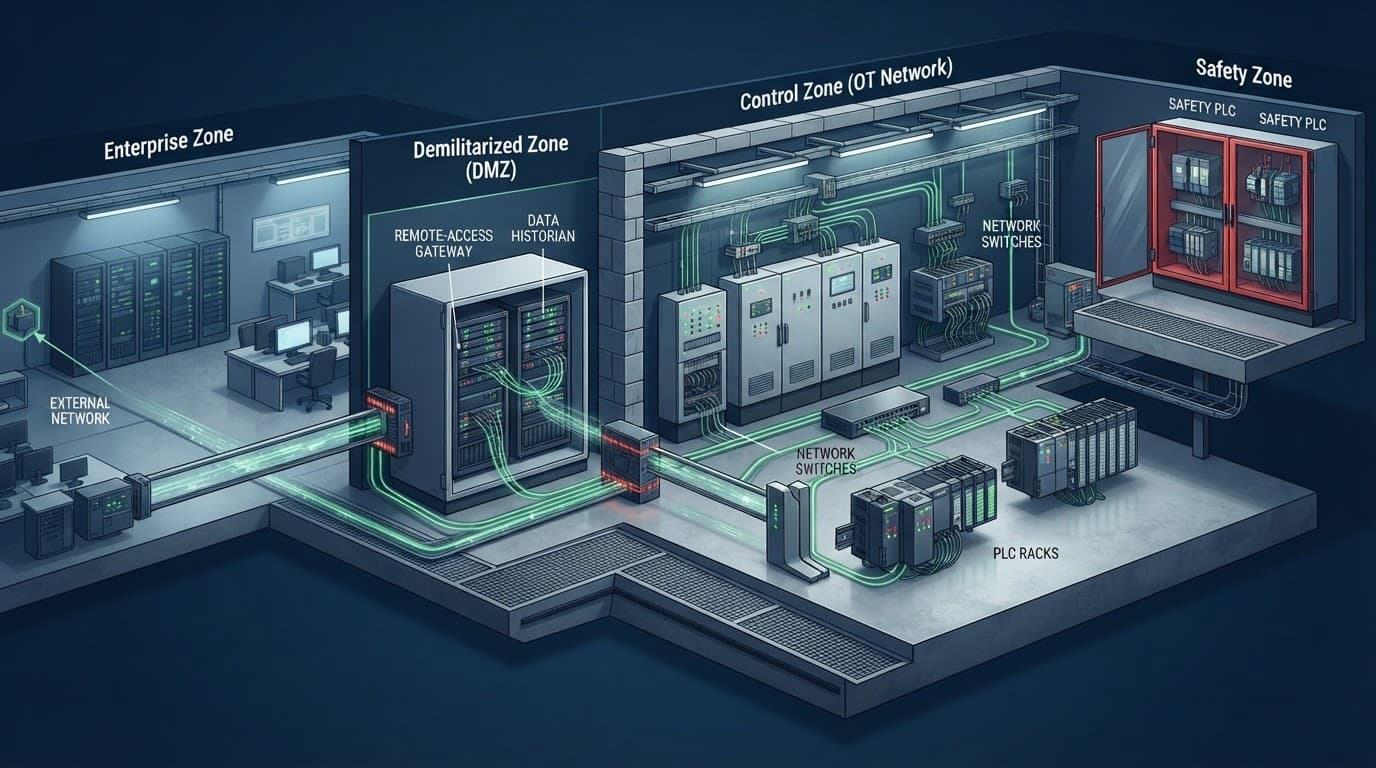
Separate enterprise IT, an industrial DMZ, control networks, safety systems, engineering networks, and remote-access areas. Firewalls should allow only required traffic between those zones, using approved IP addresses, ports, and protocols.
A bastion host or jump box gives administrators a controlled entry point. It also creates a place to apply MFA, record sessions, and revoke access. Direct paths from office systems to PLCs, HMIs, or engineering stations should not exist.
OT network segmentation strategies can combine VLANs, subnets, routing controls, and firewall policy. Segmentation must reflect the real process, not a neat diagram that ignores maintenance work.
Apply least privilege and protect engineering changes
Give each person a separate account and the minimum access needed for assigned work. Use role-based permissions, strong password management, removable-media controls, and application allow-listing where platforms support them.
Treat changes to logic, firmware, software, and configuration as controlled engineering work. Test them, document them, approve them, and keep a rollback path. An unauthorized logic change can be as dangerous as a malware infection.
Secure remote access, monitoring, and vulnerability management
Daily security work depends on visibility and control. Remote access, network monitoring, patching, and configuration tracking should reinforce one another, especially in facilities where devices cannot be scanned or restarted during normal production.
Make remote maintenance temporary, approved, and traceable
Terminate vendor and administrator sessions at a controlled jump host, never directly at a PLC, HMI, or engineering workstation. Require MFA, named accounts, a maintenance window, one-time approval, and a documented work request.
Record sessions and log commands when practical. Remove access as soon as the job ends. Vendors should meet the same access standards as employees because the risk follows the connection, not the employment badge.
Monitor industrial traffic and detect unsafe changes
Passive monitoring can identify new devices, unusual command bursts, unexpected remote sessions, account behavior, and changes in telemetry or historian data. Alerts should also cover hardware, software, firmware, controller logic, and network configuration modifications.
The goal isn’t to flood operators with notifications. Tune alerts around events that need attention, such as a new engineering connection to a controller or an unapproved program download.
Patch carefully and use compensating controls when needed
OT patching needs a risk-based process. Review vendor advisories, test updates in a lab or staging environment, schedule a maintenance window, confirm backups, and prepare a rollback plan before touching production assets.
When a patch can’t be applied, isolate the asset and reduce exposure. Restrict access, remove unneeded services, allow-list applications, strengthen monitoring, and block unnecessary traffic. These compensating controls buy time, but they do not erase the underlying weakness.
NIST’s OT security publication library helps teams track current guidance as standards and recommended practices continue to develop.
Prepare an ICS incident response and recovery plan
An office IT incident plan is not enough for a plant. ICS response starts with people and process safety, then moves to containment, evidence, and restoration.
Build a cross-functional team with operations, engineering, safety, maintenance, IT, cybersecurity, management, and key vendors. Everyone needs defined authority before a stressful event, especially when isolation could affect production.
Respond safely to loss of view, loss of control, and ransomware
First, confirm process conditions. Then identify affected zones and isolate compromised systems without triggering an unsafe shutdown. Operators may need approved manual procedures if HMI screens become unavailable.
A compromised engineering workstation, ransomware in business IT, or suspicious controller logic each require different decisions. Preserve evidence, contact vendors and appropriate authorities, and keep plant leadership informed. Never let hurried containment overwrite the safety case.
Recover with tested backups and realistic exercises
Protect offline or tightly controlled backups of PLC logic, HMI projects, historian data, configurations, firmware, network diagrams, credentials, and operating procedures. Restoring a file is different from returning a physical process to service.
Tabletop exercises and controlled drills expose weak handoffs before a real incident. Test communications, decision rights, manual operations, vendor contact paths, and recovery-time goals under realistic conditions.
Turn guidance into an actionable ICS security roadmap
A mature program doesn’t appear all at once. Start with work that reduces the most serious exposure, then build repeatable operating habits around it.
NIST’s manufacturing-sector ICS practice guide offers implementation examples for application allow-listing, anomaly detection, file integrity, remote access, and authorization. As of 2026, NIST’s OT guidance is still subject to future updates and errata, so teams should review official publications regularly.
Start with the highest-risk gaps
Prioritize work according to safety impact, process importance, exposure, and recovery difficulty:
- Remove direct internet exposure from control assets and identify every critical OT device.
- Disable unused accounts and services, then separate business IT from OT with controlled pathways.
- Secure remote access, protect controller logic backups, and review vendor privileges.
- Add passive monitoring and document incident contacts, manual procedures, and recovery priorities.
This order gives teams tangible risk reduction without waiting for a perfect toolset or a full system replacement.
Measure progress with simple security outcomes
Track the percentage of known OT assets, internet-exposed devices, MFA coverage for remote access, time needed to revoke vendor access, tested backup coverage, unresolved critical vulnerabilities, unauthorized-change alerts, and completed response exercises.
Clear measures help operations and security teams work toward the same outcomes. Progress becomes visible when a plant can prove which assets it owns, who can reach them, and how it will restore them.
Conclusion
Strong ICS security protects people, production, and essential services as well as computers. An accurate inventory, segmented networks, controlled remote access, monitored changes, careful patching, and protected backups make attacks harder to spread and easier to contain.
The opening risk remains the same: a digital intrusion can become a physical problem. Daily cooperation among plant teams, IT, cybersecurity, vendors, and leadership keeps that risk within manageable bounds.