A three-phase system can look clean at the source and still cause trouble where it matters most, at the load. When one phase pulls a different amount of current than the others, the waveforms lose their neat shape, voltages drift, and equipment starts taking stress it was never built to handle.
Many people blame the source first. In most real systems, that isn’t where the problem starts. A healthy generator or utility supply produces three phase voltages 120 degrees apart. The imbalance usually begins after those phases reach motors, lighting circuits, drives, panels, and mixed customer loads.
That distinction matters because an unbalanced 3-phase load doesn’t stay local. It can shift voltage across all phases, raise neutral current, create heat, shorten motor life, and weaken the whole system. To see why that happens, it helps to start with a balanced load.
Table of Contents
What a balanced three-phase load looks like
A balanced three-phase load is simple in principle. Each phase sees the same impedance, so each phase draws the same current and drops the same voltage. The result is a clean set of evenly spaced sine waves.
The source creates the three phases. The load decides whether they stay balanced.
This quick comparison shows the difference:
| Condition | Balanced load | Unbalanced load |
|---|---|---|
| Phase impedance | Same in all three phases | Different from phase to phase |
| Phase current | Equal | Unequal |
| Voltage drop | Equal | Unequal |
| Waveform shape | Clean and evenly spaced | Distorted or shifted |
| Neutral current | Zero or near zero | Present, sometimes high |
In a simple star-connected resistive example, each phase can draw the same current, such as 16.3 A. When that happens, the system behaves exactly as it should. The waveforms line up, the phase spacing stays correct, and the neutral stays calm.
Why equal impedance matters in each phase
Impedance is the AC version of opposition to current. If each phase has the same impedance and sees the same phase voltage, each one draws the same current. That is the heart of a balanced load.
Once one phase changes, the whole picture changes with it. A lower impedance on one branch lets more current flow there. A higher impedance on another branch limits current there. That uneven sharing is where trouble begins.
You can see this in any star-connected load bank, motor group, or panelboard. If all three branches match, current sharing stays even. Because of that, the voltage drop across each phase also stays even, and the current waveforms remain smooth.
Why neutral current drops to zero in a balanced system
In a balanced system, the three phase currents cancel each other at every instant. One phase may be positive while the other two are negative by matching amounts. For example, if one phase is at +1, the other two can be at -0.5 and -0.5. Add them together and the return is zero.
That is why neutral current in a perfectly balanced three-phase star system is zero. The neutral is present, but it doesn’t have work to do.
This also explains a practical design choice in power systems. Transmission networks usually operate with balanced three-phase conditions, so a neutral conductor often isn’t needed. Distribution systems are different because they feed mixed and changing loads. On that side of the grid, neutral matters much more.
What makes a 3-phase load unbalanced
A three-phase load becomes unbalanced when the phases stop sharing work equally. One phase may draw more current, another less, and the third something in between. The source may still be healthy, but the load has pushed the system out of alignment.
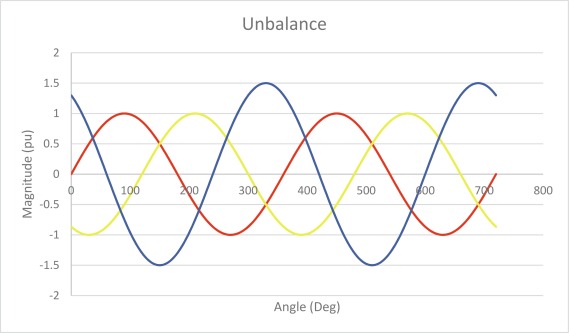
That change shows up fast. The phase currents no longer match, the voltage drops become unequal, and the waveforms stop looking clean. In a real panel or feeder, one disturbed phase can pull the others away from normal conditions too.
Uneven power use across single-phase and three-phase customers
Distribution systems rarely see perfect balance because customers don’t use power equally. Industrial sites may take large three-phase loads, while homes and small businesses often use single-phase circuits. Even two houses on the same street can draw very different amounts of power at the same time.
Because of that, utilities and facility teams can’t keep every phase perfectly equal all day. The load moves with occupancy, production, weather, and operating schedules. Balance is a target, not a permanent state.
Unequal impedance from cable length, wiring, or manufacturing issues
Current also shifts when the phases don’t have the same path. One cable run may be longer, one termination may be weaker, or one winding may not match the others. Each of those changes the impedance seen by that phase.
Motor windings can create the same problem. A manufacturing defect, aging insulation, or partial damage can make one winding behave differently from the other two. Once that happens, the phase currents drift apart even if the supply voltage looks normal.
Faults and nonlinear loads that distort the system
Faults can create sudden imbalance. A single line-to-ground fault, for example, disturbs one phase and forces the remaining system to react. The event may be brief, but the electrical stress can be intense.
Nonlinear loads add another layer. Computers, switched power supplies, and variable frequency drives draw current in pulses instead of a smooth pattern. That creates harmonics, which can worsen imbalance and heat up equipment. In VFD-heavy systems, causes of VFD capacitor failure from voltage imbalance often trace back to this mix of distorted current and extra thermal stress.
The five biggest problems caused by unbalanced 3-phase loads
A problem on one phase rarely stays on one phase. Shared conductors, common neutral points, and magnetic coupling spread the effect across the whole system.
Even a small mismatch in one branch can turn into a system-wide voltage and heat problem.
Unequal voltages can shorten equipment life
Voltage imbalance is often the first serious warning sign. In a star-connected system, changing the load on one phase can shift the neutral point. Once that happens, the voltages across all three phases can move, even if only one branch changed.
A simple simulation makes this easy to picture. One phase voltage might sit around 265 V, then rise to 281 V after a different phase load is disturbed. That change doesn’t look huge at first glance, but equipment feels it. Lamps run hotter, electronic power supplies work harder, and insulation sees more stress.
The danger is not limited to overvoltage. Undervoltage is harmful too because motors and other devices may pull more current to do the same job. A good overview of the impact of voltage 3-phase unbalance points to the same outcome: uneven phase voltage turns into equipment stress quickly.
High neutral current can overheat cables and create fire risk
In a balanced three-phase system, the neutral current cancels to zero. In an unbalanced system, it does not. The neutral now carries the leftover current that the three phases failed to cancel.
That matters because the neutral is often not sized for full phase current. In many distribution cables, you will hear the term 3.5-core cable. The three main cores carry the phase conductors, while the half-sized neutral reflects the expectation that neutral current should stay lower than the phase current.
When imbalance grows, that assumption breaks. The neutral can run hot, terminations can discolor, and insulation can age fast. If the heating continues, insulation may fail. Then the problem moves from poor power quality to short circuit risk, and in the worst case, fire.
More losses mean more heat inside the system
Electrical losses rise with current, and they rise fast. Copper loss follows the familiar I^2R relationship. That means if current climbs, heating climbs even faster.
This is where an unbalanced load starts wasting money as well as damaging hardware. One phase conductor might have been intended for 26 A, then suddenly carry 44 A because the load shifted. The extra current turns into extra heat in the cable, busbar, transformer winding, and terminals along that path.
Heat ages everything. Insulation becomes brittle, connections loosen, resistance rises again, and the cycle feeds on itself. Left alone, that chain can end in breakdown, nuisance trips, or a hard fault.
Motors suffer vibration, lower efficiency, and early failure
Three-phase motors expect three healthy, evenly spaced phase voltages. When they don’t get that, the magnetic field inside the motor becomes uneven. Torque stops being smooth, and the motor starts to run rough.
That roughness shows up as vibration, noise, and higher temperature. Meanwhile, efficiency drops because the motor must work harder to deliver the same output. Rotor and stator heating can rise even when the average current doesn’t look alarming at first glance.
This is why motor protection settings matter so much in industrial systems. Features such as negative-sequence protection for industrial motors help catch current imbalance before it burns the rotor or shortens insulation life. For large motors, unbalanced voltage is never a small issue.
System stability gets weaker as the imbalance spreads
Once voltage shifts, current rises, and the neutral starts carrying stress, the wider system becomes less stable. Feeders run hotter, protection margins shrink, and sensitive loads become more likely to trip or misbehave.
The damage also stacks across different parts of the network. Harmonics, poor phase loading, and voltage drift can all exist at once. When that happens, diagnosing the root cause gets harder because the symptoms overlap. A practical summary of three-phase load imbalance causes and solutions describes the same pattern seen in the field: one uneven phase can spread trouble through the whole installation.
Power factor can suffer too. If the system keeps running with poor power factor, utilities may add penalty charges. That turns an electrical quality problem into a cost problem.
How to reduce unbalanced load problems in real power systems
You can’t remove every source of imbalance. Loads change, customers change, and faults still happen. What matters is how well the system is planned, monitored, and corrected.
Use load balancing and phase planning wherever possible
The first fix is still the simplest one: spread demand across the phases as evenly as you can. In facilities with many single-phase circuits, that means reviewing panel schedules and avoiding the habit of stacking new loads onto the easiest open breaker.
The same idea applies on feeders and at transformer level. When current trends show one phase running consistently higher, rebalancing should happen before heat damage appears. On the distribution side, transformer connection and neutral arrangement also matter, especially where mixed loads are common. This explanation of the role of neutral connections in handling load unbalance is useful when you compare star and delta behavior.
Add power quality tools that support the system
When load planning is not enough, correction equipment can help hold the system together. Reactive power controllers and automatic power factor correction banks support voltage and improve power factor. Harmonic filters help when computers, drives, or other nonlinear loads distort current.
Large systems may also use battery energy storage for reactive power support, frequency support, and voltage stabilization. That won’t erase poor load planning, but it can soften the impact of fast load swings and keep the network inside safer limits.
Monitoring matters just as much as correction. If you only look at total power, you can miss a serious phase imbalance building underneath. Phase-by-phase current, neutral current, voltage trend, and harmonic data tell the real story.
Final thoughts
A balanced three-phase system is quiet in the best way. Currents share evenly, voltages stay where they should, and the neutral stays nearly idle. Once the load drifts out of balance, that calm disappears.
The biggest lesson is simple: unbalanced 3-phase problems usually begin at the load, then spread through the rest of the system. Unequal voltages, high neutral current, rising heat, motor damage, and weak system stability all come from that same shift.
Good phase planning, better monitoring, and the right power quality tools protect equipment, lower risk, and cut avoidable cost. In electrical systems, balance is not a nice extra. It is part of safe operation.