A good protection device only gets noticed when something goes wrong. That is why the best ones are often the easiest to overlook, they sit in the panel, do their job, and give you one less thing to worry about.
Schneider Electric’s Go9 range is built for that kind of everyday role. It targets homes, small offices, cafes, and retail spaces where space, cost, and clear operation all matter. The details show a product line shaped for daily use, not only for spec sheets.
Where Go9 fits in everyday electrical distribution
Go9 is aimed at the places where electrical protection needs to be dependable without becoming complicated. That includes homes, small offices, and smaller commercial sites such as neighborhood shops or cafes. These are the spaces where a panel has to be practical, easy to read, and easy to service, because downtime quickly turns into inconvenience or lost business.
Schneider Electric presents Go9 as a range built around three ideas, reliability, convenience, and availability. That sounds simple, but it points to something useful. In smaller installations, people are rarely asking for exotic features. They want protection devices that are easy to identify, easy to install correctly, and easy to source when needed.
The product description also adds a standards and compliance layer to that message. Go9 is presented with IEC 60898-2 certification, CE marking, and Energy Limiting Class 3 capability. Those details matter because they frame Go9 as a serious final distribution offer, not a stripped-back entry point.
Schneider also places Go9 within a broader protection story. Its wider 9 Series master range focuses on final distribution for homes and buildings, and Go9 clearly follows that same direction with a more everyday, access-focused approach.
Go9’s main appeal is not novelty. It is clear, familiar protection for the kinds of places that need dependable performance every day.
That positioning helps explain why the range concentrates on the basics that matter most in smaller panels, clear labeling, straightforward device selection, and configurations that cover common installation needs without adding extra complexity.
The Go9 range covers the core protection devices most small sites need
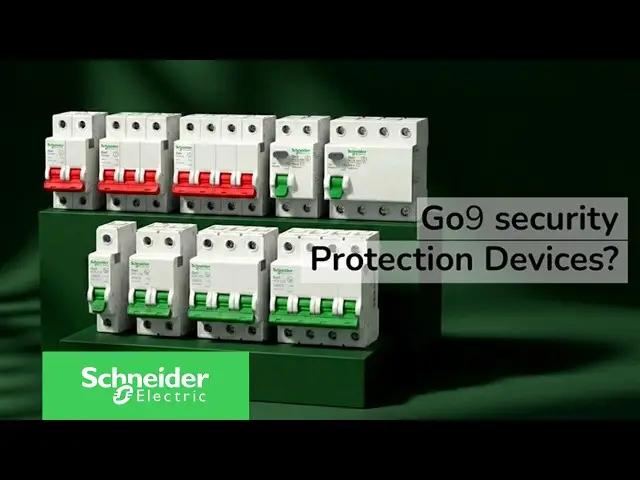
Go9 is not a single breaker. It is a family of final distribution devices that includes miniature circuit breakers, residual current circuit breakers, and isolators. Together, those products cover the protection and switching tasks that show up again and again in smaller buildings.
This quick comparison shows how the range is organized:
| Device type | Main role | Details highlighted by Schneider Electric |
|---|---|---|
| MCB | Protects against overloads and short circuits | Breaking capacity up to 4.5 kA, clear laser markings, Energy Limiting Class 3, pictograms, green toggle, fast closure mechanism |
| RCCB | Protects against earth leakage | 30 mA leakage protection, Type AC, available in 2-pole and 4-pole versions |
| Isolator | Safely disconnects circuits | Ratings up to 80 A for maintenance or emergency isolation |
The value of this lineup is its coverage. A home panel, a small office board, or a compact retail installation often does not need a sprawling catalog. It needs a short list of devices that fit together cleanly and meet common distribution needs. Go9 appears built with that reality in mind.
The range is also described as available in multiple configurations, which matters more than it may seem at first glance. Installations vary. Some need simple branch circuit protection. Others need leakage protection in different pole arrangements. A small shop might need safe local isolation during maintenance. By covering those basics in one design family, Go9 reduces the friction that comes from mixing unrelated products.
For readers comparing protective device roles, this breakdown of Acti9 Resi9 RCBO protection gives useful context on how overcurrent and leakage protection are often combined or separated in low-voltage distribution. Go9 does not center on RCBOs in this launch video, but the comparison helps make the MCB and RCCB split easier to understand.
A consistent naming approach across the range adds another small but practical benefit. Clear nomenclature reduces mix-ups during selection, installation, and later maintenance. In a busy panel, that kind of clarity goes a long way.
What stands out in the Go9 MCB design
The miniature circuit breakers in the Go9 range carry most of the visible design details discussed in the launch. Schneider Electric highlights a breaking capacity of up to 4.5 kiloamperes, which places these MCBs in the everyday final distribution space the range is meant to serve.
Two smaller details make the MCBs easier to picture in real use. First, Schneider calls out clear laser markings and intuitive pictograms. That sounds modest, yet these are the details that often help electricians and maintenance staff read a panel quickly without second-guessing device identity. Better labeling also lowers the chance of simple mistakes during installation or service.
Second, the breaker uses an ergonomic green toggle. The point is not style. A secure grip makes operation feel more deliberate, especially when working inside a compact board. Schneider also mentions a fast closure mechanism, which is presented as a way to support device life in small-scale commercial spaces. That matters in places where switching may happen more often than in a typical home panel.
The MCB offer also carries an Energy Limiting Class 3 rating. In plain terms, that tells readers Schneider is emphasizing current-limiting performance as part of the safety story. Combined with the compliance notes from the product description, this helps frame Go9 as a practical, standards-based option rather than a bare-minimum range.
Taken together, these details point to a familiar goal. Go9 MCBs are made to be easy to identify, easy to operate, and solid enough for repeated daily use in the kinds of sites that cannot afford confusion at the distribution board.
How Go9 handles leakage protection and safe isolation
MCBs cover overloads and short circuits, but they are only one part of a smaller installation’s protection plan. Go9 also includes RCCBs and isolators, which fill two different jobs, one focused on earth leakage protection, the other on safe disconnection.
Go9 RCCBs focus on 30 mA leakage protection
Schneider Electric says the Go9 RCCBs provide 30 milliampere leakage protection and are available in 2-pole and 4-pole Type AC versions. That positions them for common final distribution applications where protection against leakage current is required.
The key point is that Go9 does not stop at overcurrent protection. It includes devices for installations that need residual current protection as part of the board layout. That widens the range from “breaker line” to “protection family,” which is more useful in real panels.
Go9 isolators support safe disconnection
The range also includes isolators rated up to 80 amps. Their role is straightforward, safe circuit disconnection during maintenance or emergency conditions. That function is essential but often underappreciated. In a small office, shop, or cafe, the ability to isolate part of a circuit safely can make service work faster and easier to manage.
This is where Go9 becomes more than a collection of parts. It forms a compact toolkit for final distribution. One set of devices protects circuits from overloads and faults. Another handles leakage protection. Another gives safe isolation when work has to happen. The result is a more complete board design for smaller sites.
If you are mapping out a broader protection strategy around a distribution board, a separate Acti9 SPD surge protection guide adds helpful context on another layer of panel protection, surge control, which plays a different role from MCBs, RCCBs, and isolators.
Installation looks simpler because the range is designed as one family
A product line often feels messy when the devices do not look related. Different toggles, different labeling systems, and inconsistent markings can turn a neat panel into a puzzle. Go9 tries to avoid that problem by using a shared design language across the range.
Schneider Electric says Go9 fits smoothly into a wide range of DIN-mounted distribution boards, which is a practical point, not a flashy one. DIN mounting is the everyday setting for many low-voltage protection devices in homes and smaller commercial spaces. A range that drops into common boards without fuss has a clear advantage during both new installs and replacements.
The company also stresses clear pictograms, improved labeling, and a simplified design. Those are the kinds of choices that can help reduce errors during installation and operation. A panel should not feel like a guessing game. When device identification is faster, work tends to move with more confidence.
Consistent appearance also changes how the finished board looks. A panel filled with related devices reads as organized and professional. That may sound cosmetic, yet appearance and clarity often overlap in electrical work. When a board is easier to read, it is often easier to service.
Availability is part of this same story. Schneider describes Go9 as designed to scale through strong retail presence and wider access across countries and channels. That supports the range’s core promise. A protection device is most useful when it is easy to find, easy to replace, and familiar enough that people know what they are handling.
Packaging and product access matter more than they seem
Electrical protection devices spend most of their lives out of sight, so it is easy to treat packaging and supply as side notes. Still, both shape the day-to-day experience of using a range like Go9.
Schneider Electric says Go9 comes in eco-friendly packaging, with the goal of reducing waste and lowering carbon footprint. That is a small detail at the product level, but it fits a wider shift in electrical products, less excess material, cleaner presentation, and fewer disposable extras surrounding routine installations.
The launch description also leans on availability as a core selling point. That is worth paying attention to. In smaller projects, people often buy from local stock rather than wait on long lead times or special ordering. When a product family is easier to source through retail channels, it becomes easier to standardize around it. That reduces friction later when a device needs to be matched or replaced.
There is also a quiet benefit in the way Go9 groups protection devices under one naming system and one visual language. Panels are easier to read. Product selection becomes less confusing. Stocking common spares becomes more predictable. None of that is dramatic, but it is the sort of practical improvement that shows up in daily work.
The result is a range that feels built around the routine moments of electrical distribution, choosing devices, mounting them in compact boards, reading labels quickly, isolating safely, and replacing like-for-like parts without turning the job into detective work.
Good protection is not only about how a breaker trips. It is also about how easily the whole system can be understood and maintained over time.
Go9’s strongest point is that it stays focused on that reality. For homes, small offices, cafes, and retail spaces, clear and dependable protection often matters more than flashy features. That is the space this range is trying to fill.