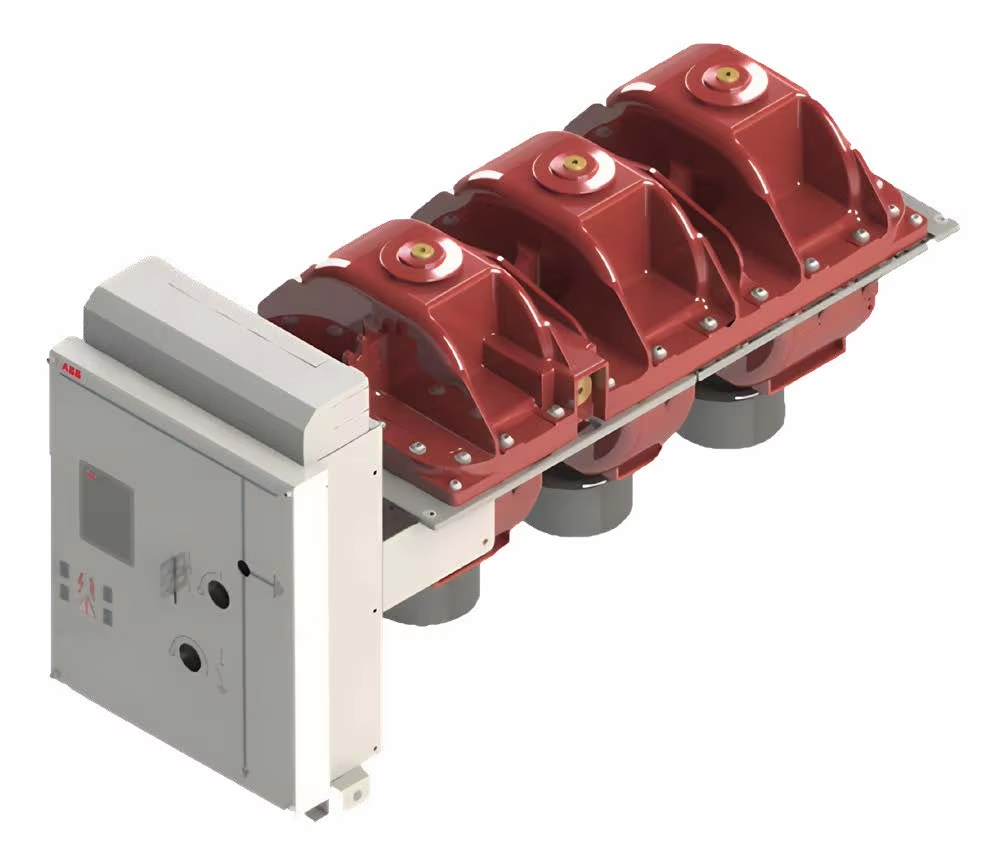
Rules around fluorinated gases are closing in on medium-voltage switchgear. If you’re tracking the move away from SF6, ABB’s GSec Air shows what that shift looks like in real equipment.
It brings dry air insulation, a compact safety-focused layout, and higher transfer-current capability into a switch disconnector built for secondary distribution. Those details matter because lower-emission designs only count when they still fit everyday grid work.
Why the move away from SF6 is picking up speed
The push toward SF6-free switchgear is no longer a side topic. It is now tied to regulation, product design, and long-term asset planning.
ABB frames GSec Air as a response to that pressure. In the video, the company points to European rules around fluorinated gases as a force that is speeding up the transition. That matters because switchgear choices stay in service for years, and the insulation medium inside them shapes maintenance, compliance, and replacement planning over time.
For utilities, panel builders, and industrial operators, the question is no longer only about electrical function. It is also about what kind of equipment will still make sense as rules tighten and fleets age. A product that reduces emissions exposure but still behaves like a practical piece of secondary distribution gear gets immediate attention.
That is where dry air enters the picture. ABB describes its SF6-free approach as dry air technology with zero global warming potential, and places GSec Air within its broader SF6-free medium-voltage portfolio. This is not a cosmetic change in wording. It is a different insulation choice with a different operating profile.
Still, the insulation medium alone does not make a product useful. Secondary distribution equipment has to stay compact, safe, and adaptable to real network layouts. It has to work in varied configurations. It also has to meet ordinary protection and connection duties without turning into a maintenance burden.
That is why GSec Air is interesting. It is not presented as a concept piece. ABB presents it as a general-purpose switch disconnector for medium-voltage secondary distribution, built around a dry air design that aligns with changing rules and day-to-day operating needs.
Where GSec Air fits in secondary distribution
At its core, GSec Air is a three-position general-purpose switch disconnector for medium-voltage secondary distribution. That description tells you a lot. This is equipment meant for real distribution networks, not a niche one-off application.
In practice, secondary distribution gear has to fit many different layouts and duties. Space can be tight. Transformer ratings can vary. Equipment may sit in utility installations, industrial sites, or other compact electrical rooms where flexibility matters. ABB says GSec Air is suitable for a wide range of configurations and applications, which is a strong point in this part of the grid.
If you want a wider view of how switch disconnectors fit into a broader lineup of protection and isolation equipment, this guide to medium voltage switchgear basics gives helpful context.
ABB’s main points fit well into a quick reference table.
| What ABB highlights | What it means in plain terms | Why it matters |
|---|---|---|
| SF6-free dry air insulation | The unit uses dry air instead of SF6 | Supports lower-emission switchgear design |
| Three-position general-purpose switch disconnector | It is built for standard switching and isolation duties in secondary distribution | Makes it easier to apply across different setups |
| Wide range of configurations and applications | The design is not boxed into one narrow use case | Gives planners more flexibility |
| Active parts segregated in less than 25 L | The live section is enclosed in a compact internal volume | Supports a safety-focused layout |
| Higher transfer currents than the original GSec | The unit has more current-handling headroom | Better suited to higher-rated transformer protection |
The pattern is clear. GSec Air is not being pitched as an experiment or a future promise. ABB places it within the existing family on its GSec & GSec Air overview, and the message is practical: this is a switch disconnector designed for secondary distribution, updated for an SF6-free direction.
That practical fit matters because distribution equipment rarely gets judged on one feature alone. A greener insulation choice helps, but only if the unit also drops into the kinds of configurations engineers already work with every day.
Dry air changes the maintenance conversation
One of the strongest points in ABB’s message is not flashy. It is about service life and upkeep.
GSec Air is completely SF6-free and dry air insulated. According to ABB, that removes the need to manage specific gas mixtures. In plain terms, the insulation approach avoids a layer of gas-related handling that would otherwise need attention over the life of the product.
That is why ABB calls it a low-maintenance solution. The benefit is easy to miss if you only look at the emissions angle. Yet for field teams and asset owners, maintenance requirements often decide how attractive a product feels after installation day. A switch disconnector might look great on paper, but if it adds extra steps in service planning, enthusiasm fades fast.
Dry air changes more than the emissions profile. It also changes what teams need to manage over the life of the equipment.
This is where GSec Air feels grounded. ABB ties the SF6-free story to an operating reality that buyers already understand. The less special handling an insulation medium demands, the easier it is to fit the equipment into normal maintenance practices. That does not erase every service task, of course, but it removes one specific source of complexity.
There is also a broader signal here. ABB is not talking only about lower emissions. It is also talking about meeting “evolving regulatory and operational requirements.” That combination matters. Regulation might start the conversation, but operations usually decide whether a new design gets traction in the field.
Secondary distribution assets often sit in large numbers across a network. Because of that, small service simplifications can matter a lot over time. GSec Air’s dry air design speaks to that reality in a direct way.
A compact safety design with more headroom for transformers
Performance and safety have to stay intact in any SF6-free design. ABB leans on both points with GSec Air.
Active parts are segregated in less than 25 L
ABB says all active parts are segregated in an internal volume of less than 25 L. That is a compact figure, and it is central to the product’s safety message.
In switchgear, the placement and containment of active parts matter. A tightly defined internal zone helps shape how the equipment is built, protected, and handled. ABB does not dress this up in vague language. It points to a clear design fact, all active parts are enclosed within that small internal volume.
That compact approach also suits the spaces where secondary distribution equipment often lives. Electrical rooms are not always generous. Panels and assemblies still need to fit into real sites with real constraints. A design that keeps the active section contained while staying practical for medium-voltage use meets a familiar need.
Higher transfer currents improve transformer protection fit
The other key update is current capability. ABB says GSec Air handles higher transfer currents than the original GSec. That is not a minor footnote. It directly affects where the unit can be applied.
ABB ties that higher transfer-current performance to the protection of higher-rated transformers. That makes sense in secondary distribution, where transformer duties can push equipment requirements upward. If a switch disconnector cannot keep up with those demands, its low-emission credentials will only go so far.
This is one of the reasons GSec Air feels more like a practical product update than a branding exercise. The SF6-free story is paired with added electrical headroom, not treated as a tradeoff that users simply have to accept.
In many networks, gear like this also sits within compact distribution assemblies. If you want more background on that broader setup, this RMU switchgear guide adds useful context around secondary distribution equipment.
ABB sums up the product’s role in a short phrase: GSec Air is designed to connect and protect an evolving grid. That line works because the supporting details are concrete. Dry air replaces SF6. Active parts sit in less than 25 L. Transfer-current capability rises beyond the original GSec. The result is a switch disconnector that addresses regulation, safety, and transformer duty in the same package.
Final thoughts
The pressure to move away from SF6 is real, but product choices still come down to daily use. GSec Air stands out because it combines an SF6-free dry air design with the compact, safety-minded performance secondary distribution expects.
ABB’s message is straightforward. Replace the fluorinated gas, avoid special gas-mixture management, keep the active parts tightly segregated, and add the transfer-current headroom needed for higher-rated transformers. For an evolving grid, that is what a credible SF6-free step looks like.