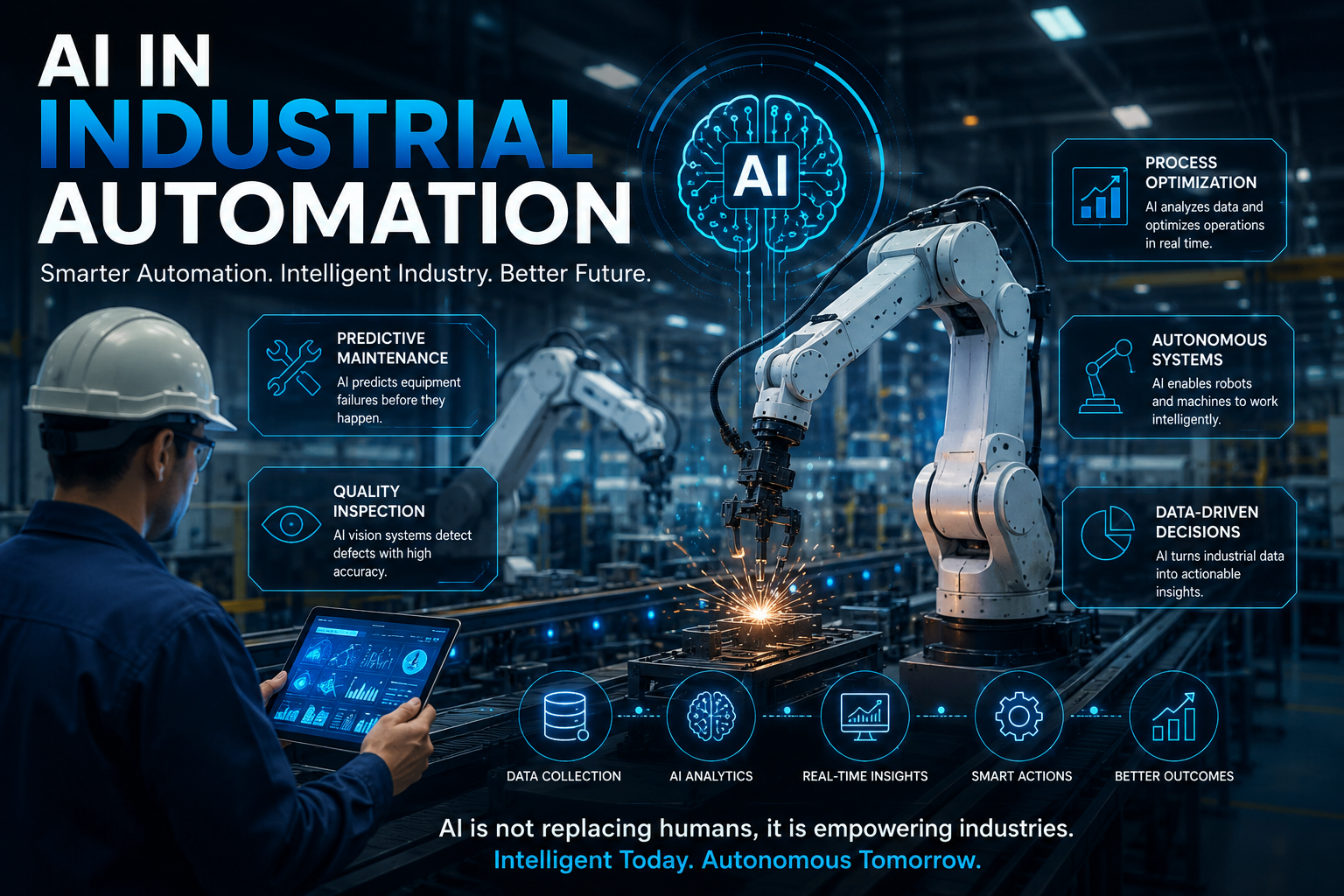
A modern factory can catch a hairline crack before it becomes a returned product, flag a failing motor before it stops a line, and reshuffle work when an urgent order arrives. ai in industrial automation makes those faster decisions possible by turning machine data into useful signals.
The technology doesn’t replace every operator, engineer, PLC, or control room. It adds pattern recognition and decision support where fixed rules struggle. For plant leaders, the practical question is where AI can improve a real constraint without adding risk or another disconnected dashboard.
Table of Contents
How ai in industrial automation works
AI in a plant uses data from sensors, PLCs, SCADA systems, MES platforms, ERP records, robots, and cameras. It finds patterns in that data, then recommends an action or triggers an approved response.
Traditional automation follows defined logic. A PLC might stop a conveyor when a guard door opens. Machine learning spots a pattern, such as a motor’s vibration shifting before failure. Computer vision interprets images, while generative AI can search manuals, summarize alarms, and draft work instructions.
The data foundation every smart factory needs
Most AI projects stumble long before model selection. Machines may use incompatible protocols, maintenance records may sit in spreadsheets, and timestamps may not match across systems.
A useful foundation connects historians, sensor networks, MES, and ERP data through a governed data layer or unified namespace. It also checks for missing values, duplicate tags, bad sensor calibration, and unauthorized access. NIST describes manufacturing AI as a way to analyze operational data and improve decisions, but the value depends on data that people can trust. See NIST’s overview of AI in U.S. manufacturing.
Edge computing matters when latency is tight. A vision system that rejects a defective part may need to act in milliseconds, while weekly forecasting can run in the cloud.
Where AI fits with PLCs, robots, and people
AI should support existing control architecture, not bypass it. Safety-rated PLC logic, interlocks, emergency stops, and established operating limits remain in charge.
Instead, an AI model can recommend a maintenance window, rank likely causes of a fault, tune a schedule, or send uncertain inspection images to a quality technician. Engineers and operators still judge exceptions, approve high-impact changes, and keep people safe. A clear PLC, DCS, and SCADA comparison helps define which system should own each decision.
The most valuable AI use cases in industrial automation
Plants get the strongest results when they start with a visible problem, reliable data, and a measurable cost. Current adoption snapshots often place predictive maintenance near 58 percent, computer-vision inspection near 49 percent, demand forecasting around 46 percent, and scheduling optimization near 41 percent. Those figures are directional, because surveys use different plant sizes, industries, and definitions of adoption.
Predictive maintenance reduces surprise downtime
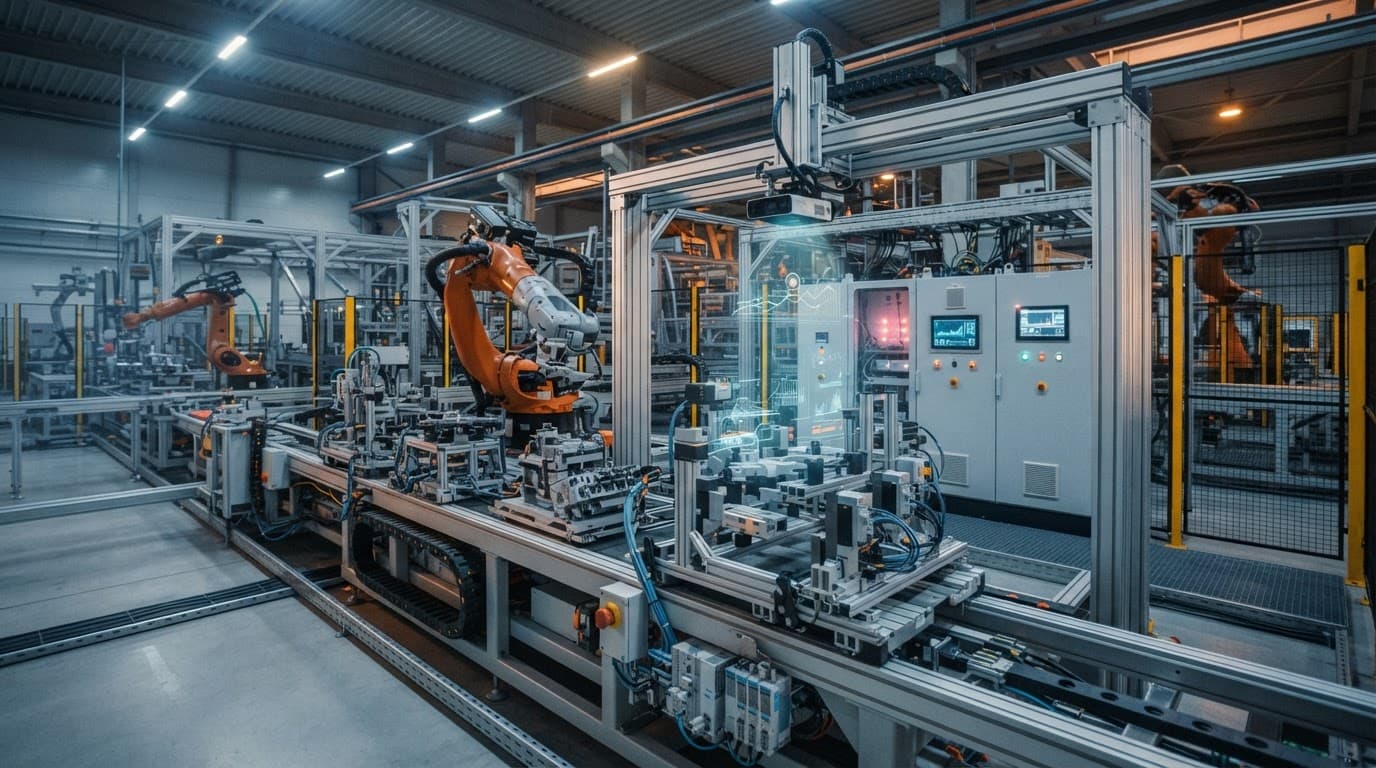
Reactive maintenance waits for failure. Preventive maintenance follows a calendar. Predictive maintenance reads vibration, temperature, pressure, electrical current, runtime, and repair history to find abnormal behavior before a breakdown.
That can improve spare-parts planning and reduce emergency work. The Association for Advancing Automation outlines how to begin AI-based predictive maintenance, including availability and inspection-cost gains that depend on the asset and data quality. False alarms, however, can quickly erode operator trust.
Computer vision strengthens quality inspection
AI cameras can identify cracks, scratches, missing components, weld defects, incorrect labels, and surface flaws. They can inspect every unit at line speed, while human reviewers handle uncertain cases and unusual defects.
Good lighting, fixed camera placement, representative labeled images, and edge processing matter as much as the model. Research on explainable AI for quality and condition monitoring also points to a central need: quality teams must understand why the system flagged a part. Treat a reported 4.2x ROI as a case-study outcome, not a promise.
AI improves schedules, energy use, and planning
Scheduling models can balance order priority, machine capacity, changeover time, materials, labor availability, and promised delivery dates. If a key machine fails, the model can test alternative sequences before a planner revises the schedule.
Similar models forecast demand, set inventory targets, optimize furnace or compressor energy use, and support digital twins. The goal is not automatic control everywhere. It is a better next decision when production conditions shift.
Generative AI and copilots speed up routine work
Industrial copilots can search maintenance histories, summarize alarm floods, retrieve answers from machine manuals, and prepare first drafts of PLC code or root-cause reports. That saves time during handovers and fault investigations.
Generated text and code need testing, review, and approval before anyone uses them in live production. A confident answer can still be wrong, especially when it lacks current plant context.
Benefits and risks on the factory floor
AI can improve uptime, first-pass yield, throughput, energy per unit, and response speed. Bain estimates that AI-enabled industrial automation could create nearly $70 billion in new market value by 2030, yet many manufacturers remain far from scaling successful pilots across several plants.
The gap usually comes down to execution. A useful model must fit real workflows, work with existing controls, and earn operator confidence.
Measure business benefits before the pilot starts
Start with a baseline. Track unplanned downtime, OEE, scrap rate, first-pass yield, mean time to repair, maintenance cost, schedule adherence, inventory turns, energy per unit, or hours saved on manual analysis.
Choose only the measures tied to the project. For example, a bearing-monitoring pilot should not claim victory because a dashboard gained users. It should show fewer unplanned stops, more accurate maintenance calls, or lower repair cost over a defined period.
A model that detects faults without changing a maintenance decision has not yet created plant value.
Data, security, and trust create the hardest problems
Fragmented systems, inconsistent tags, poor connectivity, limited failure examples, and model drift can weaken results. Cybersecurity adds another concern because a connection between IT and operational technology expands the attack surface.
Use network segmentation, least-privilege identities, audit logs, model monitoring, tested backups, and a documented incident-response process. Workers also need training and a way to challenge bad recommendations. AI should make experienced people more effective, not leave them guessing why a system acted.
Choosing edge, cloud, and hybrid industrial AI
Deployment choices should match the decision’s speed, sensitivity, and data volume. A camera rejecting parts or a model warning of unsafe pressure needs local processing. A cloud platform suits multi-site comparisons, enterprise reporting, and model training on larger datasets.
Keep time-sensitive decisions close to equipment
An edge device can process camera frames, vibration readings, or acoustic signals without sending every data point off-site. That reduces latency and may help with data-residency requirements.
Still, edge systems need patching, backup plans, and monitoring. A failed gateway should never remove a safety function or leave operators without a manual path.
Use the cloud for shared learning
Cloud tools can combine data from plants, connect ERP demand signals with shop-floor performance, and manage model versions. Hybrid designs often work best because they keep fast plant decisions local while allowing central teams to compare results.
For visual systems, cameras can also become condition-monitoring sensors. This guide to computer vision for predictive maintenance explains where visual evidence can complement traditional vibration and temperature data.
How to start an AI industrial automation project
A focused pilot beats an expensive plant-wide launch. Select one asset, one inspection point, or one scheduling problem with a known cost and a team willing to test new workflows.
Choose a use case with a clear payback
Predictive maintenance, visual inspection, and production scheduling are strong starting points because their pain is easy to see. Calculate what the current problem costs in lost output, scrap, labor, expedited freight, energy, and safety exposure.
Then set a realistic target. For a vision pilot, measure false rejects and escaped defects. For maintenance, track alert precision and avoided downtime rather than counting alerts.
Build a cross-functional team and test in shadow mode
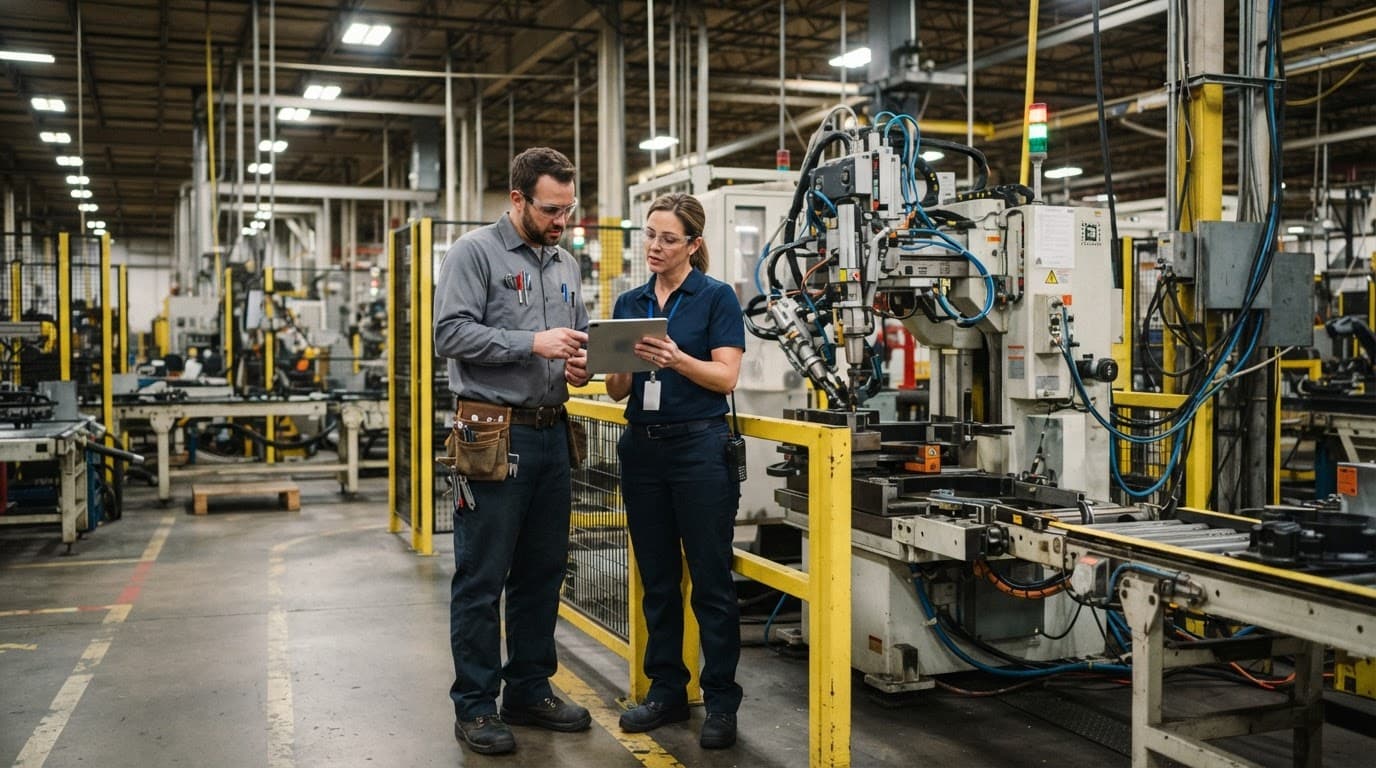
Include operations, maintenance, controls, quality, IT, cybersecurity, data, finance, and the operators who will use the system. Record baseline performance before the pilot begins.
Run the model in shadow mode where possible. It can make recommendations without changing production, while operators compare its calls with actual outcomes. This reveals data gaps and creates a safer path to adoption.
Scale only after results and governance hold up
After a successful line-level pilot, standardize tag naming, documentation, data access, retraining rules, drift checks, cybersecurity reviews, and user training. Test rollback procedures before expanding to more assets or sites.
Scaling AI is an operating-model task, not a software purchase. The same process discipline that protects a production line should protect the model that advises it.
Industrial AI platforms and vendors to compare
No single vendor fits every plant. The right option depends on the installed automation stack, industry requirements, data maturity, integration needs, security policies, and internal technical skills.
Data and industrial analytics platforms
Palantir Foundry, C3 AI, Databricks, Snowflake, InfluxData, CrateDB, HighByte, Litmus, Cybus, and Cumulocity help collect, organize, govern, and analyze industrial data. Some focus on contextualizing data at the edge, while others support enterprise-scale analytics and machine learning.
These platforms can require significant integration work. A polished demo doesn’t prove that a plant’s old controllers, historian tags, maintenance records, and ERP codes will connect cleanly.
Automation suites, asset intelligence, and vision systems
Siemens, Rockwell Automation and Plex, AVEVA PI System, Inductive Automation Ignition, SAP, Microsoft, Oracle, and Critical Manufacturing span control, operations, data, and enterprise software. Asset-focused providers include Augury, Uptake, Guidewheel, and Infinite Uptime. Landing AI and Cognex are well-known options for industrial vision.
Compare deployment model, integration depth, explainability, support, total cost, and reference customers with a similar process. For broader context on AI and robotics in smart manufacturing, evaluate platforms against the plant problem rather than a generic feature checklist.
Final thoughts
AI earns its place on the factory floor when it solves a defined operational problem on top of reliable data, safe controls, and experienced judgment. Predictive maintenance, visual inspection, and production optimization are practical places to begin.
Build a baseline, run a controlled pilot, protect operational technology, and train the people who will act on the results. Useful AI makes the next factory decision clearer, faster, and safer.