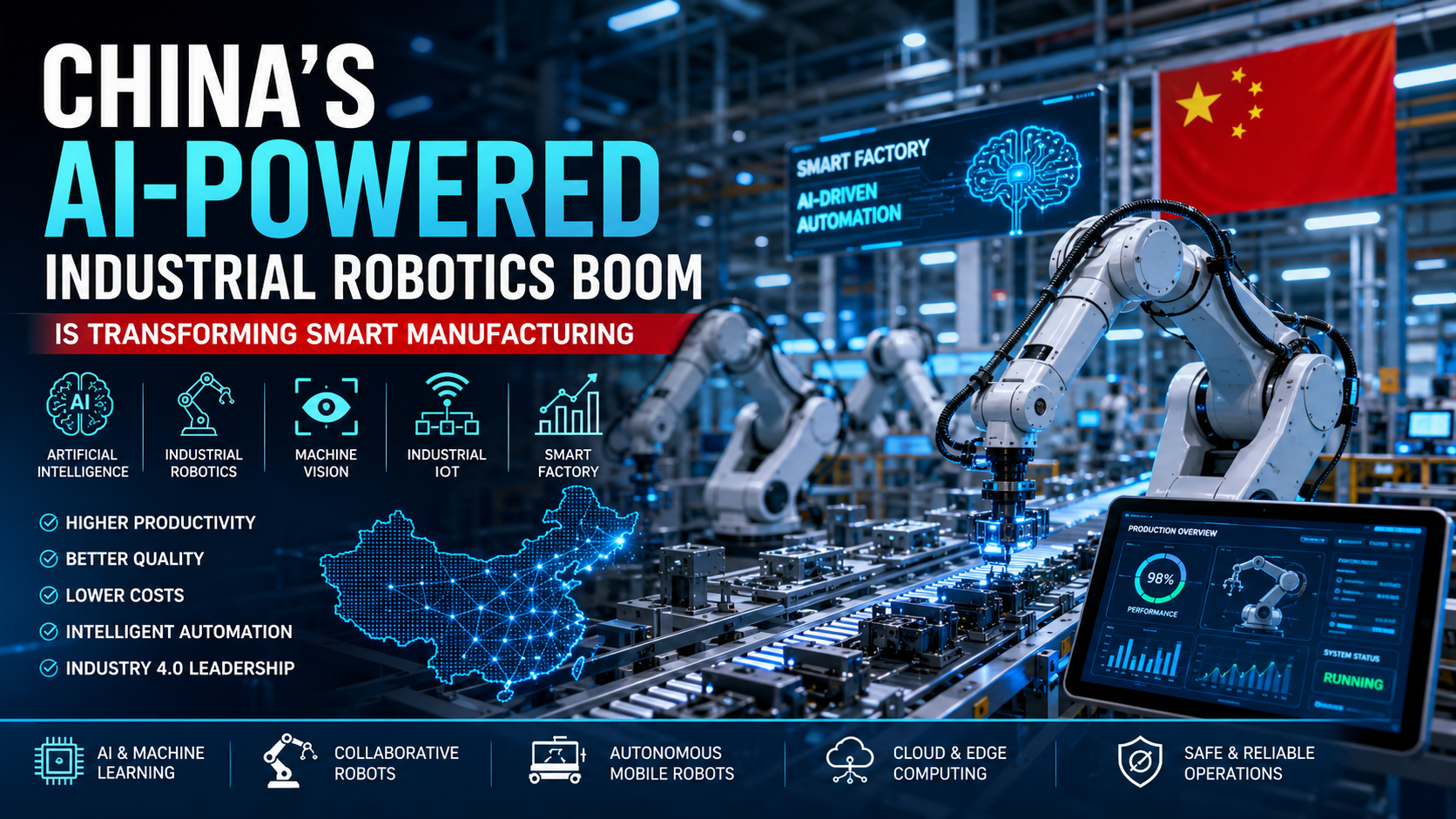
China has become one of the world’s fastest-growing markets for industrial automation, and artificial intelligence (AI) is accelerating that transformation. Manufacturers across the country are deploying intelligent robots, AI-powered vision systems, collaborative robots (cobots), and Industrial Internet of Things (IIoT) platforms to create highly connected and efficient smart factories.
From automotive production and semiconductor fabrication to electronics assembly and logistics, AI-driven industrial robotics is improving productivity, reducing operational costs, and enabling manufacturers to respond more quickly to changing market demands.
As global competition increases, China’s investment in intelligent manufacturing is setting new benchmarks for Industry 4.0 adoption.
Table of Contents
Why China Is Investing Heavily in AI-Powered Robotics
Several factors are driving China’s rapid adoption of industrial robotics:
- Rising labor costs
- Demand for higher manufacturing quality
- Government support for smart manufacturing
- Growth of electric vehicle (EV) production
- Expansion of semiconductor manufacturing
- Increasing global competition
- Digital transformation initiatives
- Adoption of Industry 4.0 technologies
Manufacturers are no longer focusing solely on automating repetitive tasks. Today’s factories are using AI to optimize entire production systems, allowing machines to make intelligent decisions based on real-time operational data.
What Is AI-Powered Industrial Robotics?
AI-powered industrial robotics combines traditional industrial robots with advanced technologies such as:
- Artificial Intelligence (AI)
- Machine Learning
- Computer Vision
- Edge Computing
- Industrial Internet of Things (IIoT)
- Cloud Analytics
- Predictive Maintenance
- Digital Twin Technology
Unlike conventional robots that follow fixed programming, AI-enabled robots can adapt to production changes, improve accuracy, optimize movement, and continuously learn from operational data.
Key Technologies Driving Smart Manufacturing in China
1. Collaborative Robots (Cobots)
Collaborative robots safely work alongside human operators, assisting with assembly, inspection, packaging, and material handling.
Benefits include:
- Increased productivity
- Improved worker safety
- Flexible production
- Faster deployment
2. AI Machine Vision
Machine vision systems powered by AI inspect products with exceptional speed and accuracy.
Common applications include:
- Surface defect detection
- PCB inspection
- Weld quality verification
- Barcode recognition
- Product sorting
3. Autonomous Mobile Robots (AMRs)
AI-guided Autonomous Mobile Robots transport raw materials and finished goods throughout manufacturing facilities without requiring fixed pathways.
Advantages include:
- Flexible navigation
- Reduced manual handling
- Improved warehouse efficiency
- Real-time route optimization
4. Predictive Maintenance
Instead of waiting for equipment to fail, AI continuously monitors machine conditions using sensors and analytics.
This enables manufacturers to:
- Detect abnormalities early
- Reduce unexpected downtime
- Extend equipment lifespan
- Lower maintenance costs
5. Digital Twin Technology
Digital Twins create virtual replicas of production lines and manufacturing equipment.
Manufacturers use them to:
- Test production changes
- Simulate workflows
- Improve production planning
- Reduce commissioning time
Industries Leading AI Robotics Adoption
China’s AI-powered robotics revolution spans multiple industries, including:
Automotive Manufacturing
Automotive factories use robotic welding, painting, assembly, quality inspection, and autonomous logistics to increase production efficiency.
Electronics Manufacturing
Electronics manufacturers deploy precision robots for PCB assembly, semiconductor packaging, and smartphone production.
Semiconductor Industry
AI-powered cleanroom robots perform high-precision tasks with minimal contamination.
Logistics and Warehousing
Distribution centers rely on AI-powered robots for inventory management, order picking, and automated transportation.
Food and Beverage
Robotics improve packaging, palletizing, sorting, and hygiene compliance while increasing production speed.
Benefits of AI-Powered Industrial Robotics
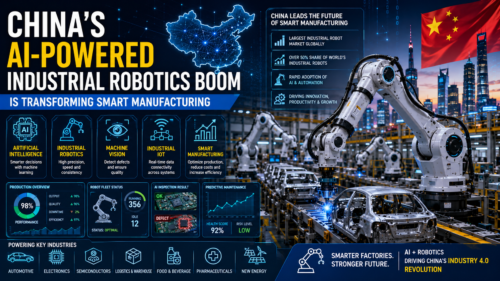
Manufacturers implementing intelligent robotics gain several competitive advantages.
Higher Productivity
Robots operate continuously with minimal downtime, significantly increasing production capacity.
Better Product Quality
AI-based inspection systems reduce manufacturing defects while improving consistency.
Lower Operating Costs
Automation minimizes labor-intensive processes and reduces operational expenses.
Improved Workplace Safety
Robots perform hazardous tasks that would otherwise expose workers to dangerous environments.
Greater Manufacturing Flexibility
Modern AI systems allow factories to quickly adapt production lines for new products and changing customer demands.
Challenges Facing Industrial Robotics
Despite rapid growth, manufacturers still face several challenges.
- High initial investment
- Skilled workforce shortages
- Cybersecurity risks
- Legacy equipment integration
- AI implementation complexity
- Data management requirements
However, continued advances in software, cloud computing, and industrial connectivity are making intelligent automation more accessible.
Future Trends in AI Industrial Robotics
Several emerging technologies are expected to shape the next generation of smart factories.
Physical AI
AI systems capable of making autonomous manufacturing decisions in real time.
Humanoid Industrial Robots
Human-like robots designed to perform flexible manufacturing tasks.
AI Production Scheduling
Artificial intelligence automatically optimizes production planning based on changing demand.
Edge AI
Real-time decision-making directly on factory equipment without relying entirely on cloud computing.
Autonomous Manufacturing
Factories capable of self-optimizing production with minimal human intervention.
Why This Matters for Global Manufacturing
China’s rapid deployment of AI-powered industrial robotics demonstrates how intelligent automation is becoming essential for maintaining global competitiveness.
Manufacturers worldwide are increasingly adopting similar technologies to improve efficiency, reduce production costs, and support sustainable manufacturing practices.
As AI, robotics, and Industrial IoT continue to evolve, smart factories will become more connected, autonomous, and data-driven than ever before.