“Siemens ET200 vs Allen-Bradley POINT I/O comparison for 2025. Understand features, communication protocols, cost, performance, installation and best use cases.”
Distributed I/O systems play a crucial role in modern industrial automation, especially in smart factories where efficiency, modularity and real-time communication are essential. Today, two of the most widely used systems are the Siemens ET200 family and the Allen-Bradley POINT I/O platform. Both are reliable, compact and compatible with advanced PLC systems—but each has strengths that suit different industries and applications.
In this detailed comparison, we cover features, performance, pricing, protocols, ease of installation, scalability, and best use cases. This guide will help you choose the right system for your industrial project in 2025.
1. Overview of Both Systems
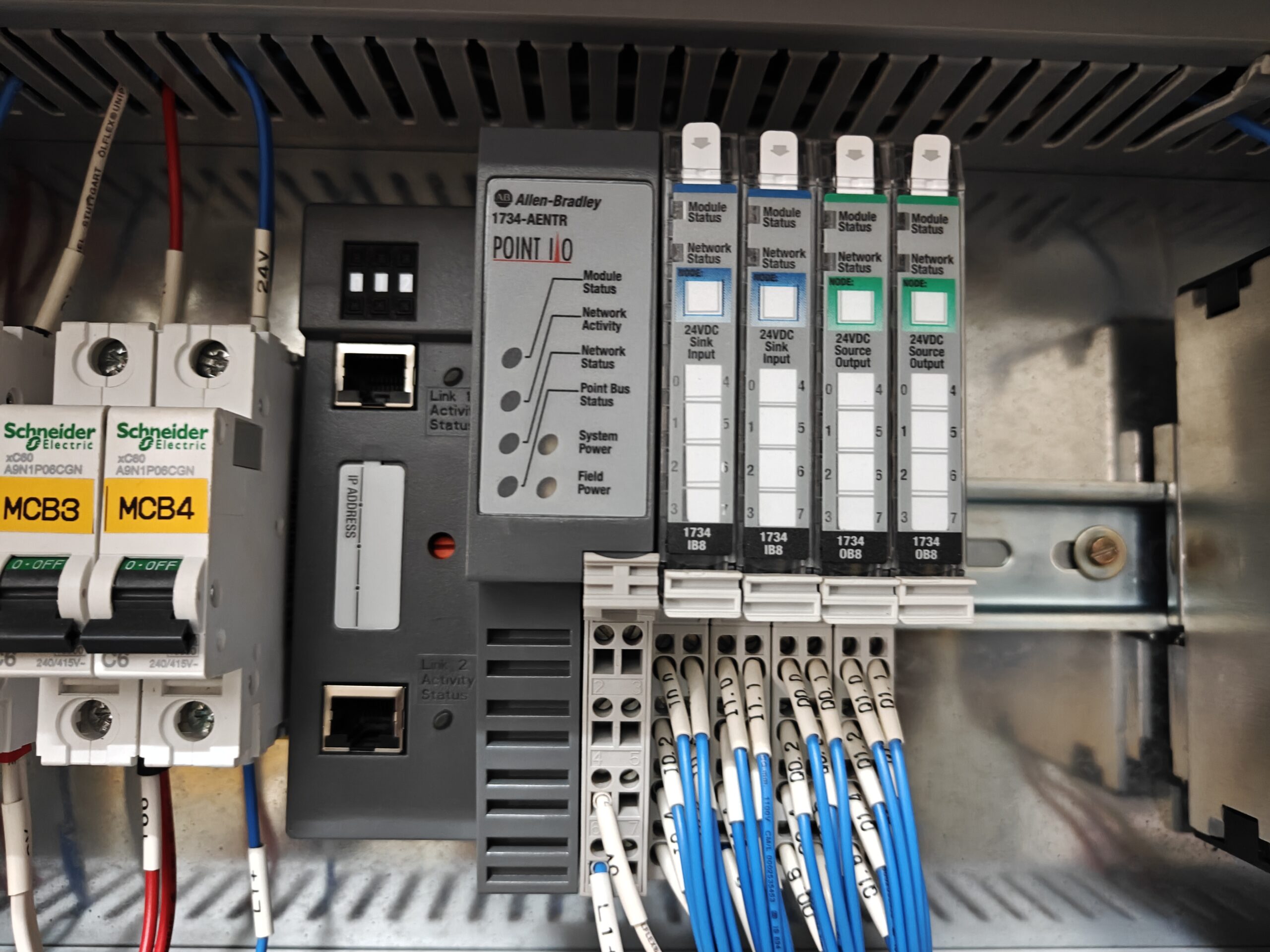
Allen-Bradley POINT I/O
- Brand: Rockwell Automation
- Focus: Modular distributed I/O
- Communication: Ethernet/IP
- Known for: Compact size, integration with Logix PLCs, strong diagnostics
- Best for: Industries using CompactLogix or ControlLogix PLCs
Siemens ET200 Family
- Brand: Siemens
- Focus: Wide distributed I/O platform (ET200S, ET200SP, ET200MP)
- Communication: PROFINET / PROFIBUS
- Known for: High performance, rugged design, flexible I/O options
- Best for: Siemens PLC users (S7-1200, S7-1500)
2. System Architecture Comparison
| Feature | Siemens ET200 | Allen-Bradley POINT I/O |
|---|---|---|
| Form Factor | Compact, modular | Ultra-compact modular |
| Mounting | DIN rail | DIN rail |
| Expansion | Up to 64+ modules | Up to 63 modules |
| Power Distribution | Strong, multiple base modules | Terminal base with integrated bus |
| I/O Density | High-density options | Mainly low–medium density |
| Hot Swapping | Yes | Yes |
Winner: Tie
Both systems offer strong modular architectures, but POINT I/O is slightly more compact, while ET200 offers more variations and density.
3. Communication Protocol Comparison
| Protocol | Siemens ET200 | Allen-Bradley POINT I/O |
|---|---|---|
| PROFINET | ✔ Supported | ✖ Not supported |
| PROFIBUS | ✔ Supported | ✖ Not supported |
| Ethernet/IP | ✖ Not supported | ✔ Fully supported |
| DLR Support | ✔ (ET200SP) | ✔ (1734-AENTR) |
| OPC UA | ✔ (with modules) | ✔ (via PLC gateway) |
Winner: Depends on PLC brand
- If you use Siemens PLCs, ET200 is the clear winner.
- If you use Allen-Bradley PLCs, POINT I/O is the best choice.
4. Installation & Wiring Comparison
Allen-Bradley POINT I/O
- Very compact
- Snap-on terminal bases
- Fast wiring & labeling
- Minimal panel space needed
Siemens ET200
- Wider range of terminal modules
- Clean wiring arrangement
- Strong mechanical design
Winner: Allen-Bradley POINT I/O
POINT I/O saves more space, uses fewer terminals, and is faster to install in small panels.
5. Diagnostics & Troubleshooting
Siemens ET200
- Advanced PROFINET diagnostics
- Detailed fault messages
- Module-level and channel-level alarms
- TIA Portal integration
Allen-Bradley POINT I/O
- Clear LED indicators
- Built-in web diagnostics (AENTR)
- Quick link to Studio 5000
Winner: Siemens ET200
Diagnostics in Siemens ET200 are deeper and more detailed through TIA Portal.
6. Software Environment Comparison
| Criteria | Siemens ET200 (TIA Portal) | Allen-Bradley POINT I/O (Studio 5000) |
|---|---|---|
| Ease of Use | Medium | Easy |
| Learning Curve | Steep | Moderate |
| Library Support | Excellent | Good |
| Device Integration | Very strong | Very strong |
Winner: Depends on experience
- TIA Portal is powerful but complex.
- Studio 5000 is more user-friendly for beginners.
7. Reliability & Industrial Performance
Siemens ET200
- Designed for harsh environments
- Better temperature and vibration tolerance
- Industry-leading reliability
Allen-Bradley POINT I/O
- Highly reliable
- Ideal for machine-level automation
- Strong performance for small/medium applications
Winner: Siemens ET200
ET200 is more rugged and better suited for heavy-duty industrial environments.
8. Cost Comparison (2025)
| Cost Factor | Siemens ET200 | Allen-Bradley POINT I/O |
|---|---|---|
| Module Cost | Higher | Moderate |
| Adapter/Head Module | Higher | Lower |
| Engineering Time | Slightly higher | Lower |
| Overall Project Cost | Higher | Medium |
Winner: Allen-Bradley POINT I/O
POINT I/O is generally more cost-effective, especially for small-to-medium systems.
9. Best Use Cases
Siemens ET200 – Best For
- Large industrial plants
- Harsh environments
- High-speed automation
- PROFINET/Siemens PLC-based systems
- Complex process automation
Allen-Bradley POINT I/O – Best For
- OEM machinery
- Compact control panels
- Distributed machine I/O
- Ethernet/IP networks
- Rockwell PLC systems
Final Verdict: Which One Is Better?
The choice depends entirely on your PLC ecosystem and application requirements:
✔ Choose Siemens ET200 if:
- You are using Siemens S7-1200 or S7-1500 PLCs
- You need high performance and rugged design
- You require PROFINET/PROFIBUS support
- You want advanced diagnostics
✔ Choose Allen-Bradley POINT I/O if:
- You use CompactLogix or ControlLogix PLCs
- You need compact, space-saving I/O
- You want easy installation and lower cost
- Your system is mostly machine-level automation




![Voltage Sag vs Interruption: Causes, Impact, and Fixes A plant can lose a production line from a blink of power, even when the lights come back almost at once. If you've seen a VFD trip, a contactor drop out, or a PLC reset after a split-second dip, you've seen power quality turn into a production problem. The issue is often not a full outage. It's a short voltage event that sensitive equipment can't ride through. Start with the basics, and the failure starts to make sense. What voltage sag and interruption mean A voltage sag is a short drop in RMS voltage below normal, usually to 10% to 90% of rated voltage, for 0.5 cycles up to 1 minute. In a 415 V system, a brief drop to 280 V or 250 V is a sag, not a blackout. Duration matters. If voltage stays low for more than a minute, that is usually undervoltage, not sag. A sag arrives fast, recovers fast, and can still stop a machine. This quick comparison makes the difference easier to see: EventWhat happensTypical durationVoltage sagVoltage drops but does not go to zero0.5 cycles to 1 minuteVoltage interruptionVoltage is zero or near zeroLess than 1 minuteUndervoltageVoltage stays below normal for longerMore than 1 minute An interruption is more severe because supply is lost completely, or almost completely, for less than a minute. If it clears in a few seconds after auto-reclosing, it is a momentary interruption. If it stays off beyond a minute, it becomes a sustained interruption. Why these events happen The most common cause is a fault on the power system. That could be a single line-to-ground fault, line-to-line fault, double line-to-ground fault, or a three-phase fault. When fault current rises, voltage drops across the network until protection clears the problem. If the fault is on your feeder, you may see a sag first and then an interruption when the breaker opens. If the fault is on another feeder from the same substation, your breaker may never trip, but your plant can still see a bus voltage dip. That is why equipment can trip even when "our feeder never opened." Large motor starting is another frequent cause. An induction motor can draw five to seven times full-load current during start. In a weak system, or where the motor is large compared with the transformer, that inrush can create a temporary sag. Transformer energization, capacitor switching, welding loads, arc furnaces, and sudden heavy loading can do the same. Why a tiny dip can stop a large machine > The main motor may ride through a sag, but the control power often won't. Older plants had more electromechanical loads, and many of them tolerated short dips. Modern plants rely on PLCs, VFDs, servo drives, electronic power supplies, sensors, relays, and SCADA. Those devices make automation possible, but many are more sensitive to voltage dips than the motor they control. Massive steel control panels and heavy machinery dominate the floor as overhead lights cast a chaotic, flickering glow. Sharp shadows and sparks suggest a sudden surge in the facility power grid. [https://user-images.rightblogger.com/ai/f382171e-d1b1-4320-b7eb-289d9b53ee27/industrial-factory-power-instability-93e17dc7.jpg] A short sag may not stop a spinning motor because inertia keeps it moving. Still, the contactor coil can drop out, the VFD can detect undervoltage, and the PLC power supply can reset. Once the control chain breaks, the process stops. In process plants, that can mean lost batches, reset time, scrap, labor loss, and delayed delivery. Magnitude and duration both matter. Some equipment can tolerate 80% voltage for five cycles, but not 40% for the same time. That is why ride-through curves matter, and why event recording matters too. Good monitoring tools, such as monitoring power quality with PME 2024 R2 [https://www.interestingautomation.com/schneider-pme-2024-r2/], help capture minimum voltage, duration, and affected phases. Practical ways to reduce voltage sag problems The most cost-effective fix starts with the weak point. If a 200 kW machine trips because a 230 V PLC supply resets, you usually do not need to protect the whole machine. You need to protect the control power. * Specify ride-through performance when buying critical PLCs, drives, relays, and controls. * Add a small UPS, DC backup, or capacitor ride-through module for control power. * Use a voltage sag compensator or dynamic voltage restorer for sensitive process loads. * Apply online UPS systems where transfer time cannot be tolerated. * Consider motor-generator or flywheel systems where short interruptions happen often. * Use static transfer switches only when the two sources are truly independent. Source quality matters too. Utilities reduce events with better protection coordination, faster fault clearing, line maintenance, tree trimming, and feeder automation. On the plant side, grid automation and fault visibility also help, which is why tools for using Easergy T300 for fault detection [https://www.interestingautomation.com/brief-explain-easergy-t300-features-benefits-and-complete-guide/] are relevant in systems that need faster disturbance response. Final thoughts A blink in voltage can do more damage to production than a short outage, because the failure often happens inside the control system before anyone sees a breaker trip. That is the core lesson behind voltage sag and interruption studies. The best fix is rarely the biggest one. Find what actually trips, measure how deep and how long the event lasts, and protect the most sensitive part first. A brief dip should not turn into hours of downtime.](https://www.interestingautomation.com/wp-content/uploads/2026/05/Voltage-Sag-vs-Interruption-Causes-Impact-and-Fixes-150x150.jpg)