A flowmeter upgrade can turn a short maintenance job into a piping project. Siemens is trying to avoid that with the new SITRANS FM generation, built around a modern transmitter that can still work with many installed MAC sensors.
That idea shapes the whole lineup. Along with the SITRANS FMT020 transmitter, Siemens introduced the FMS500, FMS300, and FMS100 sensor families, plus retrofit kits, a revised verifier, and a more modular service concept. The transmitter comes first, because it sets the tone for everything else.
Why the SITRANS FMT020 is the center of the new portfolio
The SITRANS FMT020 replaces the older MAC 5000 and MAC 6000 transmitter series. The practical value is clear: Siemens kept hardware compatibility with existing sensors, so many plants can modernize the electronics without tearing into the pipework. For maintenance teams, that changes the shape of an upgrade from a mechanical job to an instrumentation job.
Siemens framed the new family around three themes, universal use, lower power draw, and stronger diagnostics. In daily operation, the FMT020 uses about 15% less energy than the previous generation. It also adds broader status monitoring, data handling, and communication options that older MAC installations often lack.
The front of the unit is easier to work with, too. A full-graphic display improves readability and can show up to 14 characters or digits, compared with 8 on the earlier model. Capacitive touch buttons sit behind protective glass, so operators can change settings without opening the housing. That keeps dust and moisture out while making setup faster.
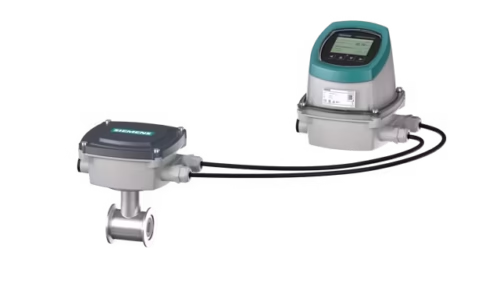
Physical design got real attention, not only a new look. The housing is made from UV-resistant polycarbonate that also resists aggressive chemical vapors. Because the body is lighter than metal, Siemens says it handles vibration better. Impact resistance jumps to 7 joules, while the old MAC 5000 and 6000 housings were rated at 1 joule. The transmitter is also more compact than the MAC 6000, which helps in narrow cabinets, pits, and crowded skid layouts.
Environmental protection is strong. The FMT020 operates from -40°C to +65°C, carries IP66 and IP67 protection, and can be ordered with IP68 protection where heavy washdown or water ingress is a risk. Siemens also added a memory card concept for data logging, safe parameter backup, and easier firmware updates. For an official feature list, Siemens publishes the SITRANS FMT020 product page.
The biggest practical shift is simple: many older MAC systems can move to a newer transmitter without replacing the sensor already in the line.
What changed in field setup and day-to-day use
A transmitter can look great on paper and still frustrate people in the field. Siemens addressed that with a better local interface and built-in wireless access. The Bluetooth module sits inside the transmitter electronics, so technicians do not need to open the cover or add a separate adapter to connect.
That matters when the device sits in a hard-to-reach place. A meter mounted high on a pipe rack, inside a narrow well, or behind process equipment is much easier to check from a phone than from a ladder and a screwdriver. The free SITRANS Mobile IQ app lets users view live process values and adjust settings from a smartphone. According to the presentation, the app can show current flow, velocity, and conductivity in real time. Because wireless access reaches configuration menus, Siemens protects that access with password control.
The on-device interface also feels more thought through. The display module can rotate in 90-degree steps through a full 360 degrees, and the transmitter housing itself can be oriented relative to the sensor. So whether the flowmeter is mounted horizontally, vertically, or at an angle, the screen can still face the operator the right way. That is a small detail until you have to read a meter in a wet pit at 6 a.m.
Siemens also says the local user interface supports more than 20 languages. For setup, the transmitter includes a 13-step wizard that walks through sensor-related configuration, including flow direction, line frequency, empty-pipe detection, and conductivity measurement. Different screen layouts can be chosen depending on whether the operator needs a large reading from a distance or more detailed measured values up close. Status symbols follow the NAMUR NE107 approach, so the device condition is easier to read at a glance. For wiring and setup details, Siemens provides the FMT020 operating instructions.
Communication options now fit modern control systems
The old MAC generation often did the measurement job well, but newer plants ask more from the data path. The FMT020 answers that with a wider protocol list. Siemens said the transmitter supports HART 7, Modbus RTU, Modbus TCP/IP, PROFIBUS PA, PROFIBUS DP, PROFINET, EtherNet/IP, and Bluetooth.
Just as important, the communication hardware is modular. Users can choose the communication module that matches the control system today and swap that module later if the plant standard changes. The presentation described this as a quick replacement, removing one module and inserting another like a chip. That approach gives plants more room to standardize over time without replacing the full transmitter.
Ethernet-capable versions add another useful feature, a built-in web server. Instead of installing special software, a technician can type the device IP address into a standard browser and open a page with general device status, live measurement values, settings, and fault history. For plants that want fewer service tools on laptops, that matters.
The control-system side looks broad as well. Siemens discussed support for WinCC and PCS 7, plus integration with other systems through HART, including Emerson DeltaV, ABB, and Honeywell environments. In Siemens TIA Portal, PROFINET-based integration is designed to open device settings directly from the project tree. For Rockwell users, Studio 5000 Logic Designer can recognize the meter on EtherNet/IP with the right EDS file. In plain terms, the FMT020 is trying to meet the plant where it already works, whether that plant is Siemens-heavy, mixed-vendor, or in the middle of a migration.
The three FMS sensors cover very different processes
The sensor side of the new lineup is just as important as the transmitter. Siemens kept the mounting dimensions compatible with the older MAC sensor families, which means replacements do not demand a pipework redesign. In the new naming structure, the sensor and transmitter form a complete flowmeter system. For example, pairing an FMS500 sensor with the FMT020 transmitter creates an FM520 flowmeter.
This quick comparison shows where each sensor fits best.
| Sensor | Replaces | Best fit | Main design focus |
|---|---|---|---|
| FMS500 | MAC 5100W | Water, wastewater, irrigation | Water-duty materials, submersible use, utility applications |
| FMS300 | MAC 3100 | Chemical, oil and gas, process industry | Fully welded body, broad liner and electrode choices |
| FMS100 | MAC 1100 | Food, beverage, pharmaceutical | Hygienic construction, sanitary connections, high-temperature options |
If a process only needs an estimated flow value rather than a measured electromagnetic one, flow estimation without a flowmeter is a different route. For applications that need actual process measurement, the FMS family stays in the flowmeter lane.
FMS500 is built for water and wastewater work
The FMS500 replaces the MAC 5100W and targets water-heavy applications, including water supply, wastewater treatment, distribution networks, and irrigation systems. Siemens quoted a standard accuracy of 0.4%, with optional calibration to 0.2%. That fits the kind of duty where stable utility measurement matters and the instrument may stay installed for years.
Material choices match that focus. EPDM lining is used for clean water, while NBR is offered for wastewater and sewer service. Each sensor includes a SENSORPROM memory unit that stores factory calibration data and serial information. When the sensor is connected to a new FMT020 transmitter, the system can read that stored data and configure itself in seconds.
The presentation also stressed installation flexibility. Siemens says the FMS500 does not require straight pipe runs before or after the sensor. Size coverage is broad, from DN15 to DN2000, with flange options across common standards and pressure ratings up to PN40, depending on flange design. Electrode material is Hastelloy C276, and the medium temperature range is -10°C to +70°C. Protection is IP67 as standard, with IP68 available where permanent immersion is possible.
That last point matters because this sensor is meant to survive flooded wells and other rough utility locations. Siemens also discussed hazardous-area versions. FMS500 can be ordered with ATEX and IECEx approvals for Zone 2 gas and vapor areas and Zone 22 dust areas. In a remote-mount setup, the sensor can sit in the hazardous area while the transmitter stays in a safe area. In a compact hazardous-area installation, both sensor and transmitter need the proper approval.
FMS300 fits chemical, oil and gas, and abrasive duties
The FMS300 takes over from the MAC 3100 and moves into harsher process territory. Siemens positioned it for chemical plants, oil and gas work, and demanding industrial services where temperature, pressure, vibration, or media aggressiveness rule out lighter-duty designs.
Its signature feature is a fully welded construction. That design improves tightness and mechanical strength, which matters in plants where the meter is exposed to vibration and rough external conditions. The body can be supplied in carbon steel with anti-corrosion coating or in full stainless steel. As with the FMS500, Siemens quoted 0.4% standard accuracy and optional 0.2% calibration.
Material choice is where the FMS300 opens up. The line supports PTFE for high chemical resistance, PFA for higher temperatures and vacuum duty, ebonite for abrasive media, and Linx soft rubber for very abrasive fluids such as coarse slurries. Electrode materials include stainless steel, Hastelloy, tantalum, platinum, and titanium. That range lets the meter match the chemistry instead of forcing the chemistry to fit the meter.
The process range is wide, too. Nominal sizes run from DN15 to DN2200, while process temperature can span -20°C to +180°C, depending on liner material. Siemens said the sensor also monitors insulation resistance and electrode noise, which allows it to warn about severe liner wear before the problem becomes a leak or a bad reading. Like the FMS500, the FMS300 is available in compact and remote versions, with IP67 standard protection and optional IP68.
When the job includes hot liquids, aggressive chemicals, high pressure, or abrasive slurries, the FMS300 is the sensor in this family that looks ready for the fight.
FMS100 targets hygienic process lines
The FMS100 replaces the MAC 1100 and is aimed at plants where hygiene is part of product quality, not a paperwork line item. Siemens positioned it for food production, beverage processing, and pharmaceutical applications, where material finish, cleanability, and sanitary connections matter as much as raw measurement performance.
Two versions stand out. The HTR version is meant for high-temperature duty, and Siemens described it as suitable for liquids up to +180°C, depending on lining. Later in the presentation, the overall process range was given as -20°C to +200°C, depending on configuration. The Food version is designed for direct contact with food and medicinal products. Instead of standard flanges, it uses sanitary process connections such as dairy unions, clamp connections, threaded fittings, and weld ends. That reduces dead zones where liquid can stagnate.
Siemens also simplified ordering. Compared with the older MAC 1100 approach, the new FMS100 uses a unified base order structure, with version choices handled as options inside the same ordering code. Process connections and seals are integrated into that code as well, which should make specification less messy.
Construction stays fully hygienic. The body is stainless steel only. Lining options are ceramic and PFA. Ceramic is positioned for high temperatures and abrasive cleaning agents, while PFA adds chemical resistance and a smooth surface. Electrodes are typically flush with the liner so they do not interrupt cleaning. Electrode materials include platinum and Hastelloy. Maximum pressure reaches 40 bar.
One more detail deserves attention. The FMS100 system supports a self-test through the quick-start wizard. That test checks the coils, electrode input signals, insulation, and memory. The result appears on the display or in SITRANS Mobile IQ, with green checks for pass conditions and red marks where issues appear.
Retrofit kits make the move from MAC to FMT020 much simpler
Many plants do not want a new sensor. They want a new transmitter and a short outage. Siemens built a retrofit path around that reality. If an existing MAC sensor is still healthy, the company offers upgrade kits that let users move to the FMT020 while keeping the installed sensor body.
The method depends on the mounting style. In a compact setup, where the old MAC 6000 sat directly on the sensor, the old transmitter is removed from the sensor terminal box. An adapter plate goes in its place, and the new FMT020 mounts on top. In a remote setup, where the old transmitter was on a wall or in a control cabinet, the job is simpler. The installer replaces the electronics unit with the new FMT020 and reconnects the existing coil and electrode cables to the new terminal blocks.
To choose the correct retrofit combination, the installer needs a few details:
- the existing sensor model and serial number
- whether the meter is compact or remote-mounted
- the required power supply, either 100 to 240 VAC or 11 to 30 VDC
- the communication interface needed in the new system
That sounds like a lot, yet the order itself is short. Siemens said the retrofit normally needs only two items, the FMT020 transmitter and the upgrade kit.
The best part is what stays off the job list. A transmitter replacement does not require recalibrating the whole flowmeter. Siemens supplies the new FMT020 with a fresh SENSORPROM memory module that already contains the sensor data, including calibration factors, diameter, serial number, and related parameters. Once installed, the transmitter reads that data and is ready to run.
Siemens also updated the programmer used for SENSORPROM modules. The new version works with both old and new memory types, which helps when a module is damaged, when a spare duplicate is needed, or when sensor data must be converted from an older format to the newer one.
For plants with a large MAC installed base, the retrofit story may matter more than any single new feature on the transmitter itself.
Verification, spare parts, and service get more practical
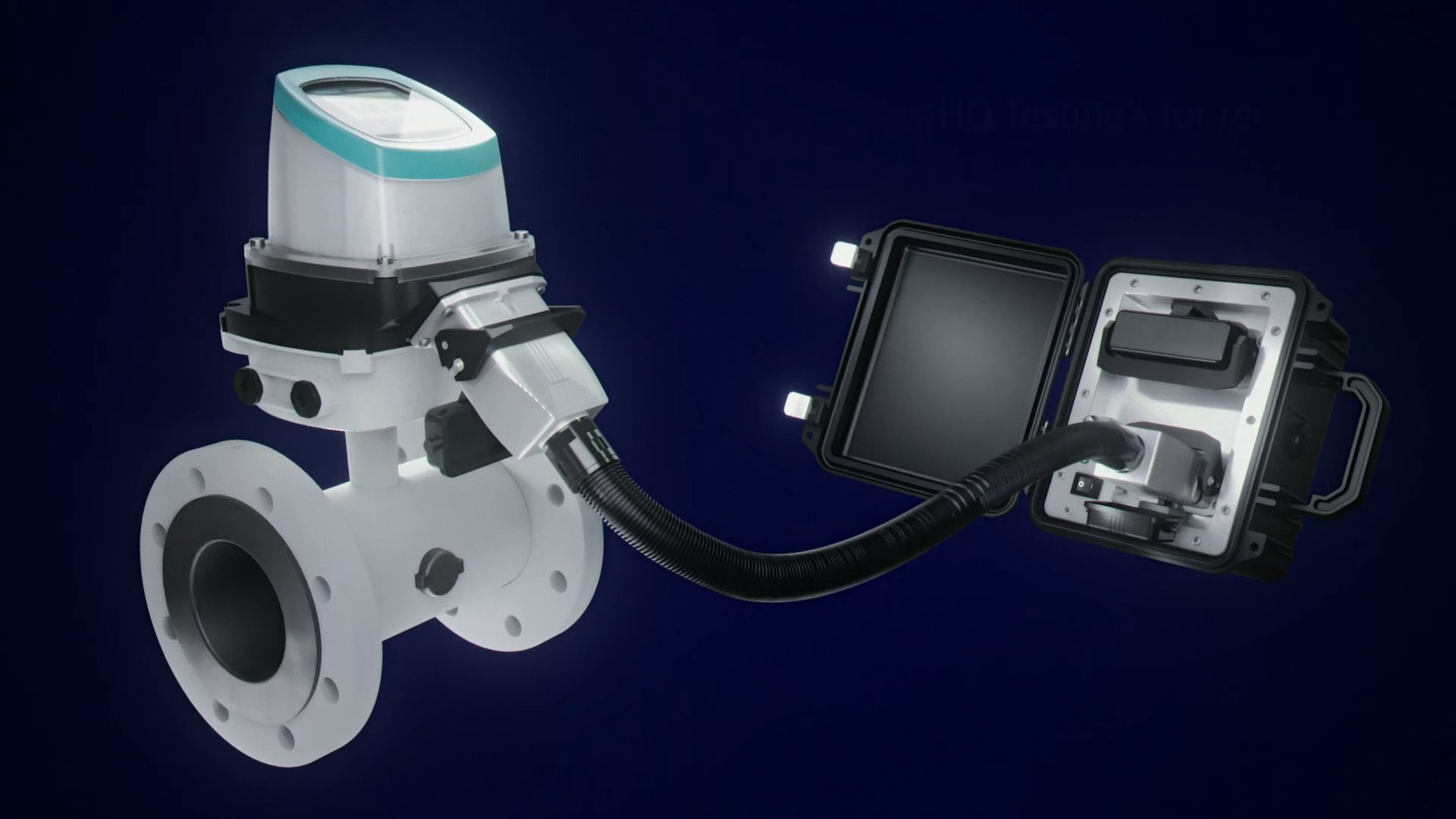
Flowmeter service often breaks down into one hard question: do you stop the process, or do you keep guessing? Siemens is trying to reduce that tension with an updated verifier for the new SITRANS FM line. The device comes in a protective case and runs on an internal battery, so it can be used in the field without line power.
According to the presentation, the verification test takes 15 minutes and does not require process shutdown, sensor removal, or pipe disassembly. After the test, the app produces an official PDF verification certificate. That is a major step up from the old style of service visit where the result lived in a notebook, a memory card, or someone’s head.
The verifier connects through Bluetooth to a phone, tablet, or laptop, and SITRANS Mobile IQ controls the test. The checks depend on the sensor type, but the system can evaluate lining wear, electrode condition, coil status, and other technical parameters against the reference values recorded when the meter was built. For plants running acids, alkalis, or abrasive slurries, that type of comparison can catch trouble before it reaches the process report.
There is a licensing detail worth knowing. Each verification consumes one license token, but Siemens said a repeat test on the same sensor within the same week does not use another token. That gives a technician time to fix a problem and confirm the repair without paying twice for the same troubleshooting cycle. Tokens can be ordered with the equipment or added later.
The service concept around the transmitter is also more modular than before. Siemens offers individual replacement parts for the connection board, upper housing, terminal box, local display and control unit, SENSORPROM memory module, display frame, covers, seals, terminals, and even the nameplate. Accessories include communication modules, wall-mount kits, cable glands, retrofit kits, industrial memory cards, sunshields, standard and double-shielded remote cables, and IP68 sealing kits. That approach keeps repairs closer to component level instead of turning every fault into a full device replacement.
Where the new SITRANS FM line makes the biggest difference
The strongest idea in this release is continuity. Siemens updated the transmitter, expanded diagnostics, modernized communications, and kept a path open for existing MAC sensors to stay in service.
That matters because most plants do not start with a blank sheet. They start with installed pipe, old spare shelves, limited shutdown windows, and a meter that still has to read correctly on Monday morning. In that setting, the new SITRANS FM family looks less like a flashy refresh and more like a practical way to move forward without undoing what already works.