Why is Modbus Still Alive in 2025? Discover the reasons why this 40-year-old industrial communication protocol continues to thrive in automation, IoT, and Industry 4.0.
Table of Contents
- Introduction: The Legacy of Modbus
- A Brief History of Modbus
- The Core Features That Make Modbus Timeless
- Simplicity
- Openness
- Interoperability
- Cost-effectiveness
- Modbus Variants: Serial, TCP, and Beyond
- Why Industries Still Rely on Modbus in 2025
- Industrial Automation
- Energy & Utilities
- Building Automation
- Transportation & Infrastructure
- Agriculture & Smart Irrigation
- Modbus in the Age of IoT and Industry 4.0
- The Advantages of Modbus Over Newer Protocols
- Limitations of Modbus: Why Isn’t It Obsolete?
- Modbus Gateways, Converters, and Modern Adaptations
- Cybersecurity Challenges and Solutions for Modbus
- Case Studies: Real-World Use of Modbus in 2025
- The Future of Modbus: Coexistence with Modern Protocols
1. Introduction: The Legacy of Modbus
In the world of industrial automation and communication, technologies come and go. Proprietary systems vanish, new wireless standards emerge, and complex IoT protocols fight for dominance. Yet, one protocol, born in 1979, continues to stand strong even in 2025: Modbus.
For many, the survival of Modbus is surprising. Why would an almost 50-year-old protocol still be relevant when faster, more secure, and more advanced options exist? The answer lies in its simplicity, reliability, and adaptability.
This article explores why Modbus is still alive in 2025, its advantages, challenges, and how it continues to find a place in Industry 4.0, smart grids, and IoT ecosystems.
2. A Brief History of Modbus
Modbus was developed by Modicon (now Schneider Electric) in 1979 for programmable logic controllers (PLCs). It quickly became popular because it was:
- Open and free
- Simple to implement
- Vendor-neutral
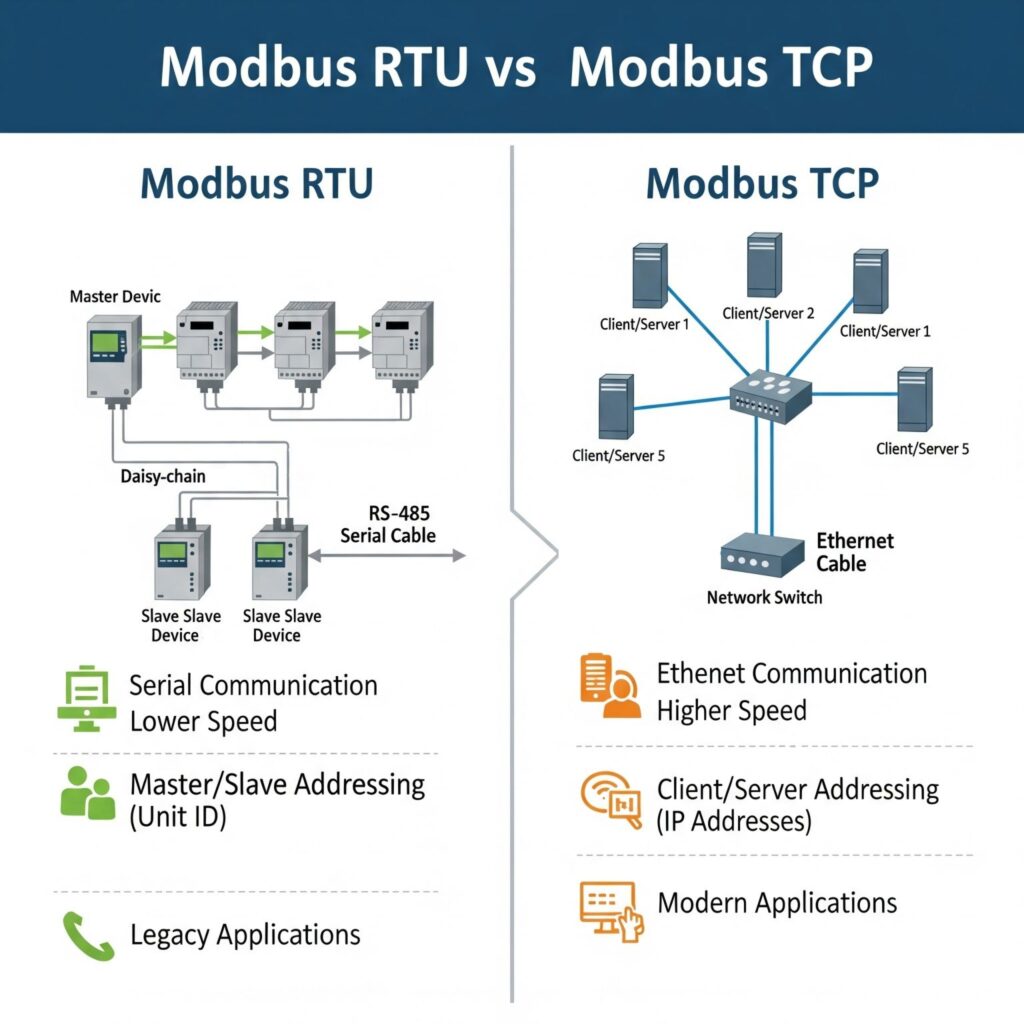
Over the decades, Modbus expanded into different versions: Modbus RTU (serial), Modbus ASCII, and Modbus TCP/IP. Despite the emergence of modern protocols like EtherCAT, PROFINET, MQTT, and OPC UA, Modbus has never faded away.
3. The Core Features That Make Modbus Timeless
Simplicity
Modbus is easy to understand, implement, and debug. Engineers can set it up with minimal training. This is crucial in industries where downtime is costly.
Openness
Being an open protocol, Modbus does not require licensing fees. This lowers costs and makes it attractive to OEMs, integrators, and engineers worldwide.
Interoperability
Thousands of devices—sensors, meters, PLCs, and gateways—support Modbus. It acts as a universal language for equipment from different vendors.
Cost-effectiveness
Legacy equipment is expensive to replace. Modbus allows industries to extend the life of existing systems without massive reinvestment.
4. Modbus Variants: Serial, TCP, and Beyond
- Modbus RTU: Runs over RS-485 or RS-232. Still common in industrial plants and energy meters.
- Modbus ASCII: A less common version for serial communication.
- Modbus TCP/IP: Runs over Ethernet, making it compatible with modern networks.
- Modbus Plus and other hybrids: Adaptations for special use cases.
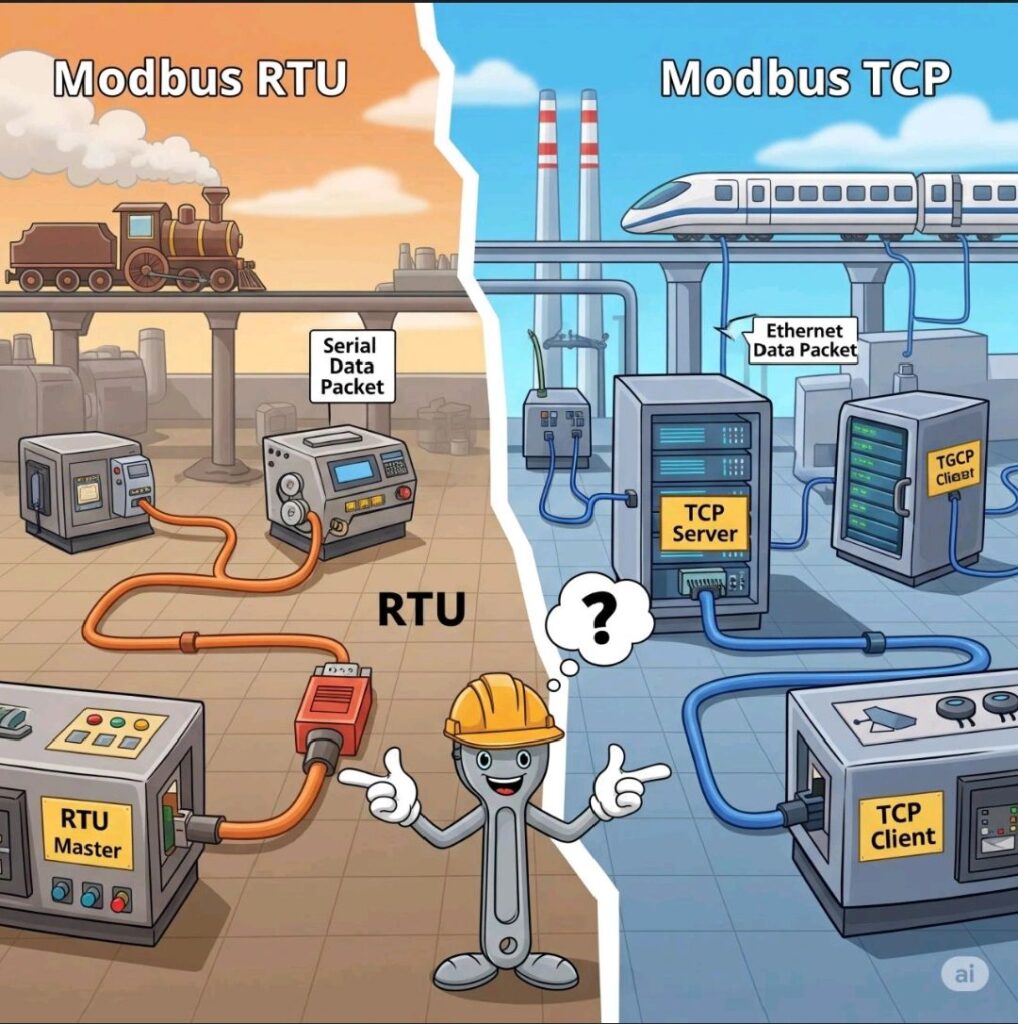
By 2025, Modbus TCP/IP has gained popularity, but Modbus RTU remains deeply entrenched in legacy equipment.
5. Why Industries Still Rely on Modbus in 2025
Industrial Automation
Factories continue using Modbus because PLCs, HMIs, and drives support it natively. It offers deterministic communication that is often enough for monitoring and control.
Energy & Utilities
Power plants, substations, and renewable energy farms rely on Modbus for metering and monitoring. Its simplicity makes it ideal for smart grids.
Building Automation
HVAC systems, lighting, elevators, and access control systems frequently use Modbus. It integrates well with BACnet and KNX.
Transportation & Infrastructure
Railway signaling, water treatment plants, and oil pipelines continue to use Modbus due to its ruggedness and reliability.
Agriculture & Smart Irrigation
Low-cost sensors and controllers in agriculture often use Modbus RTU because of its low power and low bandwidth requirements.
6. Modbus in the Age of IoT and Industry 4.0
At first glance, Modbus seems outdated for IoT. But with IoT gateways and cloud connectors, Modbus devices can now connect to MQTT brokers, OPC UA servers, and cloud platforms like AWS or Azure.
For example, a Modbus-based temperature sensor in a factory can feed data into an AI-driven predictive maintenance system via an edge gateway. This hybrid approach ensures that legacy devices are not left behind in the digital revolution.
7. The Advantages of Modbus Over Newer Protocols
- Widespread adoption – Almost every industrial device supports Modbus.
- Low cost of ownership – No licenses or expensive hardware.
- Ease of integration – Works well with SCADA systems.
- Reliability – Proven over decades in harsh conditions.
- Longevity – Existing infrastructure is difficult and costly to replace.
8. Limitations of Modbus: Why Isn’t It Obsolete?
Despite its strengths, Modbus has weaknesses:
- Limited speed and bandwidth (9600–115200 baud typical for RTU).
- Lack of advanced security (authentication, encryption).
- No standard for complex data types (compared to OPC UA).
- Master-slave structure (less flexible than publish-subscribe).
Yet, Modbus isn’t obsolete because its strengths outweigh its weaknesses in many practical scenarios.
9. Modbus Gateways, Converters, and Modern Adaptations
To bridge the old and new, protocol converters and gateways are widely used.
Examples include:
- RS485-to-USB converters for laptops.
- Modbus-to-MQTT gateways for IoT integration.
- Modbus-to-BACnet converters for building automation.
These solutions extend the life of Modbus devices while enabling integration with modern IT and OT systems.
10. Cybersecurity Challenges and Solutions for Modbus
Because Modbus lacks built-in security, it is vulnerable to:
- Spoofing attacks
- Data interception
- Unauthorized control commands
By 2025, solutions include:
- VPN tunneling and firewalls
- Secure Modbus over TLS
- Network segmentation
- Integration with cybersecurity frameworks
This balance allows Modbus to remain useful while minimizing risks.
11. Case Studies: Real-World Use of Modbus in 2025
Case Study 1: Solar Energy Farm
A 500 MW solar plant in India uses Modbus RTU over RS-485 to monitor inverters and weather stations. Data is aggregated via Modbus TCP and sent to a cloud-based dashboard.
Case Study 2: Smart Building in Europe
A commercial building in Germany integrates HVAC, lighting, and metering systems through Modbus. A gateway translates data into BACnet/IP for building management software.
Case Study 3: Water Treatment Plant in the U.S.
Critical pumps and valves run on PLCs communicating over Modbus RTU. A cybersecurity wrapper ensures safe data transmission.
12. The Future of Modbus: Coexistence with Modern Protocols
Rather than disappearing, Modbus is coexisting with newer protocols. It plays the role of a foundation layer, especially for legacy equipment, while gateways and middleware bridge the gap to IoT, AI, and advanced analytics.
In 2030 and beyond, Modbus may not dominate, but it will continue to silently power critical infrastructure, much like TCP/IP does for the internet.
So, why is Modbus still alive in 2025?
Because it is simple, cost-effective, universal, and adaptable. Despite its age and limitations, industries worldwide continue to rely on Modbus as the backbone of industrial communication. With the help of gateways, IoT integration, and cybersecurity enhancements, Modbus has transformed from a legacy protocol into a bridge between the past and the future of automation.
In other words, Modbus is not just alive in 2025—it is thriving.



![Voltage Sag vs Interruption: Causes, Impact, and Fixes A plant can lose a production line from a blink of power, even when the lights come back almost at once. If you've seen a VFD trip, a contactor drop out, or a PLC reset after a split-second dip, you've seen power quality turn into a production problem. The issue is often not a full outage. It's a short voltage event that sensitive equipment can't ride through. Start with the basics, and the failure starts to make sense. What voltage sag and interruption mean A voltage sag is a short drop in RMS voltage below normal, usually to 10% to 90% of rated voltage, for 0.5 cycles up to 1 minute. In a 415 V system, a brief drop to 280 V or 250 V is a sag, not a blackout. Duration matters. If voltage stays low for more than a minute, that is usually undervoltage, not sag. A sag arrives fast, recovers fast, and can still stop a machine. This quick comparison makes the difference easier to see: EventWhat happensTypical durationVoltage sagVoltage drops but does not go to zero0.5 cycles to 1 minuteVoltage interruptionVoltage is zero or near zeroLess than 1 minuteUndervoltageVoltage stays below normal for longerMore than 1 minute An interruption is more severe because supply is lost completely, or almost completely, for less than a minute. If it clears in a few seconds after auto-reclosing, it is a momentary interruption. If it stays off beyond a minute, it becomes a sustained interruption. Why these events happen The most common cause is a fault on the power system. That could be a single line-to-ground fault, line-to-line fault, double line-to-ground fault, or a three-phase fault. When fault current rises, voltage drops across the network until protection clears the problem. If the fault is on your feeder, you may see a sag first and then an interruption when the breaker opens. If the fault is on another feeder from the same substation, your breaker may never trip, but your plant can still see a bus voltage dip. That is why equipment can trip even when "our feeder never opened." Large motor starting is another frequent cause. An induction motor can draw five to seven times full-load current during start. In a weak system, or where the motor is large compared with the transformer, that inrush can create a temporary sag. Transformer energization, capacitor switching, welding loads, arc furnaces, and sudden heavy loading can do the same. Why a tiny dip can stop a large machine > The main motor may ride through a sag, but the control power often won't. Older plants had more electromechanical loads, and many of them tolerated short dips. Modern plants rely on PLCs, VFDs, servo drives, electronic power supplies, sensors, relays, and SCADA. Those devices make automation possible, but many are more sensitive to voltage dips than the motor they control. Massive steel control panels and heavy machinery dominate the floor as overhead lights cast a chaotic, flickering glow. Sharp shadows and sparks suggest a sudden surge in the facility power grid. [https://user-images.rightblogger.com/ai/f382171e-d1b1-4320-b7eb-289d9b53ee27/industrial-factory-power-instability-93e17dc7.jpg] A short sag may not stop a spinning motor because inertia keeps it moving. Still, the contactor coil can drop out, the VFD can detect undervoltage, and the PLC power supply can reset. Once the control chain breaks, the process stops. In process plants, that can mean lost batches, reset time, scrap, labor loss, and delayed delivery. Magnitude and duration both matter. Some equipment can tolerate 80% voltage for five cycles, but not 40% for the same time. That is why ride-through curves matter, and why event recording matters too. Good monitoring tools, such as monitoring power quality with PME 2024 R2 [https://www.interestingautomation.com/schneider-pme-2024-r2/], help capture minimum voltage, duration, and affected phases. Practical ways to reduce voltage sag problems The most cost-effective fix starts with the weak point. If a 200 kW machine trips because a 230 V PLC supply resets, you usually do not need to protect the whole machine. You need to protect the control power. * Specify ride-through performance when buying critical PLCs, drives, relays, and controls. * Add a small UPS, DC backup, or capacitor ride-through module for control power. * Use a voltage sag compensator or dynamic voltage restorer for sensitive process loads. * Apply online UPS systems where transfer time cannot be tolerated. * Consider motor-generator or flywheel systems where short interruptions happen often. * Use static transfer switches only when the two sources are truly independent. Source quality matters too. Utilities reduce events with better protection coordination, faster fault clearing, line maintenance, tree trimming, and feeder automation. On the plant side, grid automation and fault visibility also help, which is why tools for using Easergy T300 for fault detection [https://www.interestingautomation.com/brief-explain-easergy-t300-features-benefits-and-complete-guide/] are relevant in systems that need faster disturbance response. Final thoughts A blink in voltage can do more damage to production than a short outage, because the failure often happens inside the control system before anyone sees a breaker trip. That is the core lesson behind voltage sag and interruption studies. The best fix is rarely the biggest one. Find what actually trips, measure how deep and how long the event lasts, and protect the most sensitive part first. A brief dip should not turn into hours of downtime.](https://www.interestingautomation.com/wp-content/uploads/2026/05/Voltage-Sag-vs-Interruption-Causes-Impact-and-Fixes-150x150.jpg)


![Why MV Switchgear Fails: 5 Causes That Lead to Major Faults A 36 kV switchgear panel can sit closed for two years, carry load without complaint, and still fail on the one day you need it to clear a fault. That is the risk hiding behind a quiet panel. If the breaker won't trip, if protection doesn't detect the fault, or if insulation breaks down inside the cubicle, the result can be fire, arc flash, equipment loss, and a hard production stop. The real job is not waiting for failure and reacting later. It is spotting the warning signs before the panel runs out of margin. What counts as a switchgear failure Not every defect in a medium-voltage panel is a true failure. That distinction matters because reliability studies do not count every bad lamp, loose label, or minor nuisance the same way they count a breaker that won't trip. IEC 62271-1, clause 3.1.12, defines a major failure as a failure of switchgear and controlgear that causes the loss of one or more fundamental functions. It also says a major failure leads to an immediate change in system operating conditions, such as backup protection having to clear a fault, or forces unscheduled removal from service within 30 minutes. Major failures affect the core job of the panel In plain language, a major failure means the switchgear can no longer do one of its main jobs. Those jobs include switching, protection, monitoring, and control. If a fault occurs and the protection system does not detect it, that is a major failure. If the relay sends a trip command and the vacuum circuit breaker stays closed, that is also a major failure. The same goes for a situation where one bus section fails and the plant has to shift supply to another bus to keep running. The standard's wording about "immediate change in operating conditions" is useful because it points to real plant behavior, not theory. When primary protection fails and backup protection has to step in, the system has already moved into an abnormal state. If a breaker will not close because of a spring problem and must be removed from service at once, the equipment has lost its reliability. Minor failures are different, even if they still need attention A minor failure is anything that does not take away those core functions. An LED indication lamp that has gone dark is annoying, but it does not stop the panel from switching or protecting the system. A cosmetic defect may need correction, but it does not belong in the same category as a breaker mechanism that sticks. That distinction helps when you look at failure data. Most reliability studies focus on major failures, because those are the events that threaten safety, uptime, and equipment life. > A panel does not become dangerous only when it burns. It becomes dangerous the moment it can no longer switch, protect, or isolate a fault as intended. The five failure modes behind most serious problems Across published guidance and field experience, the same trouble spots keep showing up in MV switchgear. Insulation breakdown and mechanical faults sit near the top, while overheating, environmental stress, and aging keep chipping away at the system until something gives. A single medium voltage switchgear panel stands inside a clean and brightly lit industrial facility. [https://user-images.rightblogger.com/ai/f382171e-d1b1-4320-b7eb-289d9b53ee27/medium-voltage-switchgear-panel-dc9d5203.jpg] This quick summary helps frame where the risk usually sits: | Failure mode | Typical share or impact | Common triggers | Best early warning | | | | | | | Insulation failure | About 20% to 30% of failures | Partial discharge, insulation defects, contamination | PD testing or continuous PD monitoring | | Internal arc | Less about share, more about severity | Insulation breakdown, loose parts, human error, foreign objects | Arc detection plus proper panel design and rating | | Busbar and connection overheating | Major contributor within remaining failures | Poor joints, high contact resistance, loose terminations | Thermal inspection or continuous temperature monitoring | | Environmental and aging effects | Significant long-term driver | Moisture, dust, corrosion, seal failure, material degradation | Inspection, humidity monitoring, life assessment | | Mechanical failures | About 30% to 40% of failures | Trip coil issues, dry lubrication, worn parts, weak spring energy | Breaker monitoring and functional testing | The headline is simple. A switchgear failure usually starts as a small loss of margin, then turns into a major event when nobody is watching. Insulation failure usually starts where you can't see it Insulation failure is one of the biggest reasons MV switchgear fails. The hard part is that the panel can look healthy from the outside while the weakness grows inside cable insulation, busbar insulation, or instrument transformer resin. Partial discharge is small at first, then destructive Partial discharge starts when electrical stress concentrates inside tiny voids, impurities, or defects within insulation. In a cable, for example, a manufacturing void or a badly prepared termination can create a weak point. Stress collects there because the local dielectric strength is lower. Once the stress exceeds what that spot can withstand, a localized discharge starts. It is called "partial" because the discharge does not bridge the full insulation path at first. Still, the damage does not stay small. Repeated discharges eat away at the insulation until a much larger fault develops. A wood beam with termites offers a good comparison. The outside may still look sound, while the inside has already lost strength. By the time the damage is visible, the collapse is close. In MV panels, partial discharge often shows up in cable terminations, cable insulation itself, CT and VT epoxy insulation, and insulated busbar systems. The danger is that it rarely gives an obvious warning unless you are looking for it. For a broader research view, the review of medium-voltage switchgear fault detection [https://www.mdpi.com/1996-1073/15/18/6762] covers common detection methods and fault behavior in more detail. Periodic partial discharge testing helps, but it has a limit. You only see the panel at the moment of the test. Continuous monitoring fills the blind spot between maintenance visits. That difference matters more as the switchgear ages. Internal arc is where hidden weakness becomes immediate danger Internal arc is one of the worst events that can happen inside switchgear because it combines heat, pressure, smoke, and metal vapor in a confined space. It is not the same thing as a normal short circuit. An internal arc is a fault that develops inside the enclosure and puts people nearby at direct risk. Insulation failure can trigger it. So can a loose connection, a dropped tool, a foreign object left behind after maintenance, or simple human error. A screwdriver bridging two phases is enough to turn a routine task into a violent event. Besides fire damage, the smoke from an internal arc is hazardous on its own. That is why this topic is not only about asset protection. It is also about human safety. Modern panels may include arc detection systems that watch for both light and current. When they detect an arc, they send a trip command in milliseconds. It also pays to check whether the panel has been tested for internal arc classification, because that tells you how the equipment is expected to behave during this kind of fault. Heat at joints and contacts can undo a good panel Every electrical joint carries some risk. If the connection is poor, resistance rises. When current keeps flowing through that resistance, I squared R losses turn into heat, and heat becomes the start of the next failure. This issue appears again and again at busbar joints, cable terminations, breaker contacts, and earthing connections. The busbar connection between two panels is a common weak point. So is the cable end where termination quality depends on careful stripping, clean surfaces, correct materials, and proper tightening. In withdrawable breakers, primary contact engagement needs extra attention because poor seating can cause local hot spots. The physics is simple, but the effect is expensive. A small increase in contact resistance can push the temperature high enough to damage insulation, oxidize surfaces, weaken spring pressure, and set up the next arc fault. That is why overheating is a recurring theme in switchgear failure analysis, including this overview of switchgear failures and solutions [https://blog.exertherm.com/causes-of-switchgear-failures-and-solutions]. Good workmanship cuts most of this risk at the start. Joints need the right preparation, the right torque, and the right method from the manufacturer. After installation, thermal checks matter. A handheld IR inspection helps during rounds, but large sites with many panels often need more than occasional scans. Fixed thermal sensors on critical joints can track temperature all day and flag a problem before the panel forces a shutdown. Age and environment wear down the margin of safety Switchgear does not fail only because something was assembled badly. Time and environment also wear down the panel, even when operation looks normal. A typical service life is often described as about 25 to 30 years, though real life depends on duty, environment, maintenance, and design. Once equipment gets deep into that age range, the risk rises. Insulation can crack. Corrosion can creep across sheet metal and hardware. Seals can weaken in gas-filled compartments. Contacts wear. Springs lose strength. Materials that looked stable for years start to drift out of their original condition. Environmental stress speeds that process up. Moisture is a common problem because it lowers insulation resistance and can help contamination become conductive. Dust does the same thing when it settles where it should not. Some reported failure summaries tie a large share of busbar trouble to moisture and dust exposure, and this medium-voltage switchgear problem summary [https://www.green-energy-elec.com/common-problems-in-medium-voltage-switchgear/] highlights that pattern clearly. The fix depends on the site. Air-insulated panels in humid, dusty areas need more cleaning and inspection. Higher IP ratings help when the environment is harsh. In some applications, enclosed technologies such as GIS or solid-insulated systems reduce exposure. Humidity sensors inside selected panels also help, because they warn you when the room condition and the cubicle condition are drifting apart. Mechanical failures stop the breaker when it matters most Mechanical trouble is often the biggest single contributor to MV switchgear failure. That makes sense because a fault may be detected perfectly, yet the system still fails if the breaker mechanism cannot move. A breaker that has stayed closed for two years can look healthy, but that does not prove it will trip on demand. The trip coil may be open or shorted. Lubrication may have dried out or picked up contamination. Stored-energy springs may have weakened. Linkages may seize. Contacts may be worn. Any one of those problems can turn a valid trip command into a non-event. That is the nightmare scenario in a live plant. Fault current continues to flow because the breaker remains closed. Backup protection may clear the fault later, but the delay can mean heavier equipment damage, a wider outage, and greater risk to people nearby. Routine maintenance helps because it proves the mechanism can still move. Still, periodic checks have gaps. A breaker can pass a test in January and develop a mechanical issue in March. That is why breaker monitoring is gaining ground. Modern systems can track operating count, contact wear, gas or pressure status where relevant, opening and closing speed, and other health indicators that point to a weakening mechanism. For teams that already use connected diagnostics on breakers, tools such as a Pact series breaker diagnostic and testing interface [https://www.interestingautomation.com/schneider-electric-service-interface-kit-pact-series-circuit-breakers-installation-compatibility-expert-review/] show how live measurements and event data can shorten troubleshooting time and expose developing faults before a trip failure happens. > A breaker is not reliable because it stayed closed. It is reliable because you have evidence that it can still open. Why monitoring beats calendar-based maintenance alone Traditional maintenance still matters. Panels need cleaning, inspection, tightening, lubrication, and testing. Yet calendar-based maintenance only gives you snapshots. It cannot tell you what happened between visits. Monitoring changes that. A continuous system can watch temperature rise at a joint, catch partial discharge activity, track humidity inside a cubicle, and record breaker operation data around the clock. It also makes condition-based maintenance possible. Instead of opening equipment on a fixed calendar, you act when data shows the condition is changing. That approach is often the difference between "repair after failure" and "intervene before failure." On new switchgear, you may not need every sensor from day one. On older panels, on hard-worked breakers, or across a large fleet, the case for monitoring becomes much stronger. A plant-wide supervision layer also helps because raw data is not enough by itself. Operators need one place to see alarms, status changes, and events in context. Platforms focused on real-time monitoring with Schneider EPAS [https://www.interestingautomation.com/schneider-electric-epas/] show why visibility matters when a feeder trips or a breaker changes state. Faster fault isolation starts with seeing the right information at the right time. Final thoughts The most dangerous switchgear failures do not start with a dramatic event. They start with a missed warning, a weak joint, a dry mechanism, or insulation that is breaking down in silence. If there is one takeaway to keep, it is this: reliability needs proof. A breaker that has been closed for two years is only comforting when you know it can still trip today, and the rest of the panel can still do its core job when the fault arrives.](https://www.interestingautomation.com/wp-content/uploads/2026/05/Why-MV-Switchgear-Fails-5-Causes-That-Lead-to-Major-Faults-150x150.jpg)