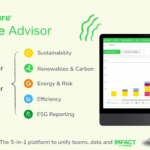
Sustainability teams are getting squeezed from both sides. Reporting expectations keep rising, while energy systems keep getting harder to model and manage. In response, Schneider Electric and SE Advisory Services introduced Resource Advisor+, a next-generation energy and sustainability intelligence platform designed to turn sustainability data into action.
“We are at a pivotal moment because the need for sustainability expectations reporting is increasing.”
In a live launch discussion, Frederic Godemel (Executive Vice President, Energy Management Business, Schneider Electric) and Steve Wilhite (Vice President, Schneider Advisory Services) laid out why the timing matters, what Resource Advisor+ includes, and how agent-based AI changes the day-to-day work of sustainability and energy management.
The live launch and what makes this announcement different
 Two leaders discussing energy and emissions performance.
The core message from the session was simple: sustainability data work has outgrown spreadsheets, manual checks, and disconnected tools. Organizations now have to make decisions faster, prove their numbers, and show progress across emissions, energy, suppliers, and risk.
Resource Advisor+ was introduced in a high-visibility setting, the World Economic Forum in Davos. That matters because it signals where enterprise sustainability is headed: toward unified platforms that combine data, workflows, and decision support.
The live format also reinforced a practical angle. This was not framed as research or a future concept. It was presented as an “available now” platform launch with additional modules planned over the year.
For background on Schneider Electric’s existing platform positioning, see Schneider Electric’s own Resource Advisor platform overview.
Why now: sustainability reporting pressure and a capacity gap
If you manage energy, carbon, or ESG reporting, the problem is rarely a lack of ambition. It’s bandwidth and complexity.
Godemel and Wilhite described an inflection point driven by three forces:
First, more reporting obligations. Teams must deliver more disclosures, more often, and with higher scrutiny. They also have more internal KPIs tied to business performance.
Second, operational complexity keeps rising. Energy procurement and energy sources change quickly, and that creates more variables in the data and the decisions that follow.
Third, most sustainability teams are under-resourced. Even in large enterprises, a small team often owns carbon accounting, stakeholder reporting, program management, and audit support. That workload doesn’t scale with manual processes.
Traditional automation helps with individual tasks, but it doesn’t solve the broader system problem. Even “basic AI” that produces analytics outputs is not enough when teams need systems that can interpret data quality issues, trace decisions, and support repeatable processes across regions and business units.
This is where the discussion shifted to agent-based systems.
Agentic AI: why “analytics” isn’t the goal anymore
Wilhite described a move beyond basic analytics to agentic AI, which he characterized as capable of planning, memory, multi-step reasoning, and autonomous action. The key point was not autonomy for its own sake. The point was to handle enterprise-scale sustainability work that spans many steps and many stakeholders.
At the same time, both speakers stressed a limitation: AI alone can’t handle the market complexity of energy and sustainability. Their claim is that AI becomes useful at scale when it is guided by domain expertise, including consulting experience and real-world constraints.
That combination is intended to produce outcomes such as:
- More accurate emissions calculations, supported by consistent factors and traceable logic
- Stronger data validation, including automated detection of gaps and anomalies
- Decarbonization plans grounded in feasibility, not just theoretical targets
In other words, the platform is positioned to reduce the workload of “keeping up,” so teams can spend more time on decisions and execution.
Inside Resource Advisor+: an AI-native platform built as one connected environment
 A sustainability intelligence workspace concept.
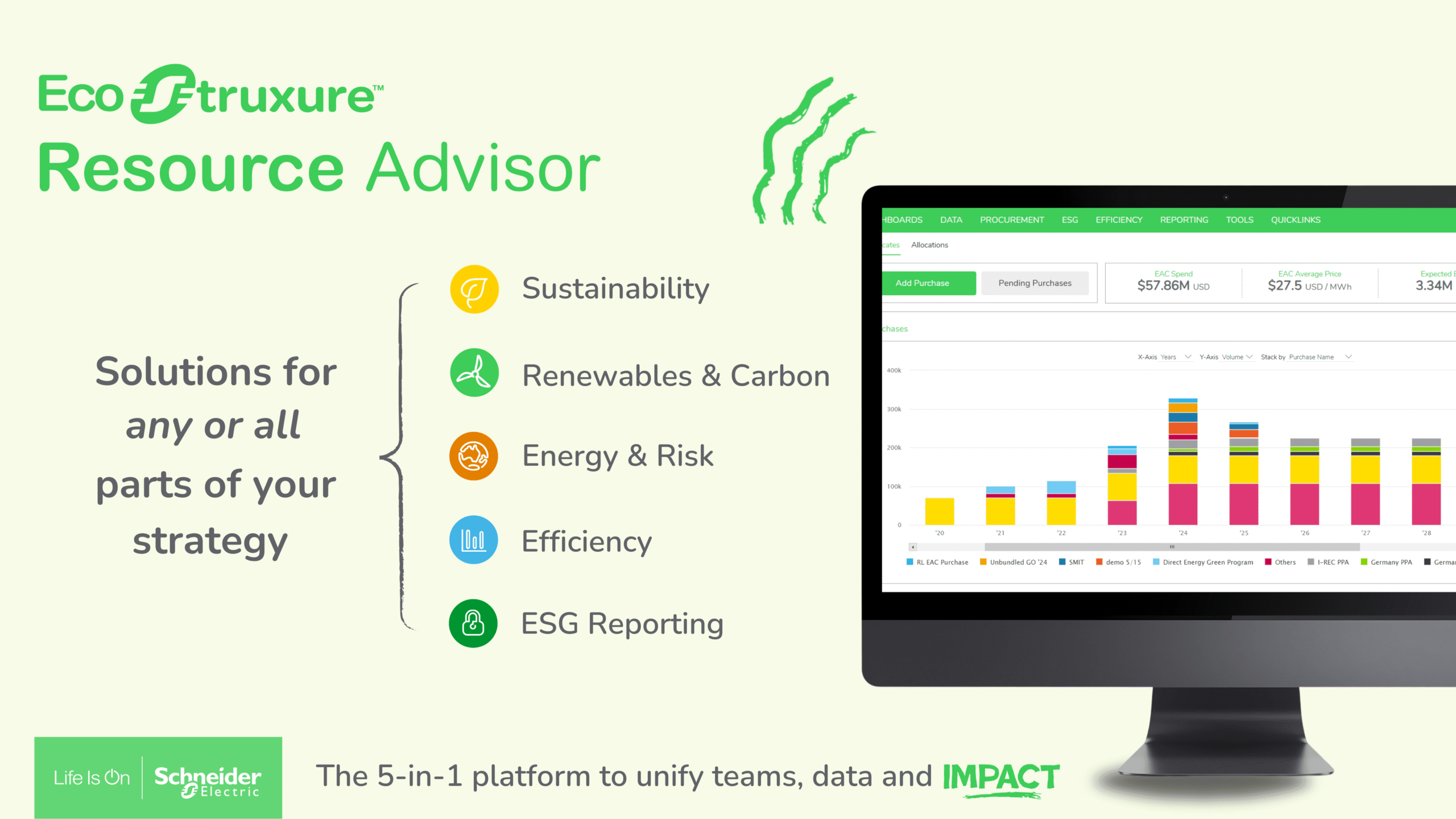
Resource Advisor+ was presented as a major reinvention of Schneider Electric’s flagship enterprise sustainability and energy management reporting platform. The emphasis was on consolidation and connection.
Instead of separate tools for carbon, supply chain, risk, and reporting, Resource Advisor+ is designed as an AI-native multi-product environment where modules work together. That matters because a sustainability number is rarely isolated. Scope 3 work depends on supplier engagement. Reporting depends on validated indicators. Energy data affects both cost and emissions.
The platform’s foundation is described in three layers:
- A unified data hub to consolidate energy and sustainability data into a trusted environment
- An intelligent AI orchestration layer to connect, validate, and act on that data across the organization
- A proprietary knowledge layer, described as SE Advisory Intelligence, to embed decades of consulting and regulatory context into workflows
Wilhite also highlighted the scale of the underlying dataset and operating footprint: millions of invoices (energy and supply chain), IoT data, hundreds of thousands of locations, and billions of data points, paired with decades of advisory work.
This “data plus expertise” framing is central to how Schneider positions Resource Advisor+ as more than a reporting tool.
For a broader view of how industrial systems are moving toward AI-enabled energy optimization, see 2025 industrial automation trends for energy efficiency.
Core products in Resource Advisor+: what’s available now and what’s coming
 A global supply chain emissions data flow concept.
The launch discussion separated the Resource Advisor+ offering into products available now and products planned for later in the year. The theme across each module is consistent: make the work auditable, decision-ready, and operational.
To make the suite easier to scan, here’s how the modules were described in the session:
| Product area | Status in the launch | What it’s meant to do |
|---|---|---|
| Supply chain | Available now | Measure and manage Scope 3 across global value chains, with tailored experiences for sponsors and suppliers |
| Carbon performance | Available now | Automated, auditable tracking for Scope 1, 2, and 3, plus targets and scenario modeling |
| Climate risk | Coming this year | Assess physical risk across climate scenarios, visualize impacts, support adaptation and disclosure |
| Reporting and compliance | Coming this year | Centralize ESG indicators, automate qualitative extraction with generative AI, export in multiple formats |
| Energy management | Available (enhanced experience) | Utility tracking, cost analysis, and efficiency management within the platform |
The takeaway is that Resource Advisor+ is not pitched as a single “carbon accounting app.” It’s designed as a connected workspace that supports execution across multiple sustainability functions.
Resource Advisor+ for supply chain: Scope 3 with supplier adoption in mind
Supply chain emissions work fails when suppliers can’t or won’t participate. Resource Advisor+ for supply chain is designed around that adoption problem.
Wilhite described three elements:
- A tailored experience that provides action-oriented guidance to participants
- Flexible data collection and reporting, including inputs from ERP systems and spreadsheets
- Distinct platform experiences for program sponsors and supply chain participants, to improve program adoption and emissions reduction
That split experience is important because sponsors and suppliers don’t have the same incentives, systems, or maturity. A single interface often forces one group to “speak the other group’s language,” which slows the work.
Resource Advisor+ for carbon performance: auditable, automated, built for action
The carbon performance module focuses on enterprise emissions tracking and decarbonization actions, with an explicit emphasis on auditability.
It’s described as calculating and monitoring Scope 1, Scope 2, and Scope 3 using verified emissions factors, flagging data gaps, and enabling target setting and scenario modeling.
One practical point from Wilhite: compliance frameworks increasingly require the work to be auditable. That’s difficult when workflows are manual, or when the “why” behind a number sits in a chain of emails and spreadsheets.
Agent-based workflows can record the actions taken by software agents, which supports traceability when audit questions arise.
That leads to the intended shift: away from static reporting cycles and toward dynamic, decision-ready carbon intelligence.
For context on how connected operations data feeds sustainability analytics, PLC programming in IoT applications provides a useful view of data collection patterns (remote monitoring, analytics, and energy management).
Modules planned for later: climate risk and reporting across frameworks
Two additional product areas were described as coming during the year.
Climate risk focuses on physical risk assessment across climate scenarios, impact visualization, and adaptation strategy development. The emphasis was on “decision-grade” insights grounded in real-world scenarios, with support for climate risk disclosure.
Reporting and compliance centralizes ESG indicator management and supports disclosure reporting. Wilhite described automating qualitative data extraction using generative AI, plus exporting disclosures in multiple formats. He also noted that most companies report to multiple frameworks, not just one, which creates repeated work when systems aren’t connected.
For third-party coverage of the Resource Advisor+ announcement, see Environment and Energy Leader’s Resource Advisor+ launch write-up.
The intelligence layer: agentic AI, collaborative intelligence, and “frugal AI”
 A network of cooperating AI agents concept.
The platform message isn’t “replace people with AI.” It’s closer to “build a digital teammate that reduces the busywork and raises the quality bar.”
Godemel described agent-based software as a shift from tools that help you do tasks to systems that can do much of the work for you, while still keeping humans in control of the goals and decisions. In their framing, this creates a multiplier effect: automation handles complex analytics and recurring tasks, while people focus on strategy and innovation.
SE Advisory Intelligence: digitizing consulting context for better decisions
Wilhite described an architectural core called SE Advisory Intelligence, a proprietary knowledge layer that “digitizes” decades of consulting and advisory expertise.
In practical terms, that means encoding patterns from thousands of projects, regulatory differences, and operating realities into a context layer. AI workflows and agents then reference that context as they answer queries and complete tasks.
This is a key technical claim: better outcomes come from pairing algorithms with domain context, rather than relying on generic models alone.
Responsible innovation: why frugal AI matters
Wilhite also raised a constraint many teams now face: AI consumes energy, and data centers are already under pressure. Because Schneider operates in energy management and data center contexts, the company framed its approach as frugal AI, meaning computational efficiency and responsible resource usage.
The point is not academic. If AI-enabled sustainability tools add significant compute load, that can undercut the sustainability story and raise operating costs.
For related coverage of Schneider Electric’s AI focus at Davos, see Schneider Electric AI energy solutions coverage.
Meet Sarah: the client-facing AI agent coordinating other agents
Resource Advisor+ includes an activation layer presented through Sarah, the external-facing AI agent that clients interact with. Sarah is described as a proactive sustainability partner who can interpret complex datasets, model scenarios, detect anomalies, and coordinate work behind the scenes.
An important design detail: Sarah is not alone. Wilhite described “dozens of other agents” that Sarah can call on. Two examples mentioned:
- Anna, the anomaly agent
- Reggie, a registration agent
The platform’s claim is that these agents, plus the connected suite of products, reduce fragmentation across carbon accounting, compliance, supply chain engagement, energy management, and climate risk.
That’s the goal state: a unified workspace where the intelligence layer cuts across modules and helps teams deliver measurable enterprise outcomes.
For a related view of Schneider Electric platforms used in industrial settings, EcoStruxure Foresight provides context on how asset visibility and predictive insights fit into operational performance.
Conclusion: What Resource Advisor+ signals for enterprise sustainability teams
Resource Advisor+ was introduced as an AI-native, connected platform built to handle the real constraints sustainability teams face: more reporting, higher scrutiny, and not enough time. The suite focuses on Scope 3 supplier engagement, auditable carbon performance, and upcoming climate risk, plus multi-framework reporting, all built on a unified data hub and an agent-based intelligence layer.
The big shift is that collaborative intelligence becomes part of the workflow, not a separate analytics step. As the year progresses and more modules launch, the real test will be whether teams can move faster while improving traceability and decision quality.