If you think the robot race is mostly about Silicon Valley or China, South Korea is easy to miss. That’s a mistake, because some of the most striking robotics work in the world is already showing up there in factories, airports, hotels, and mobility devices.
What stands out isn’t one flashy machine. It’s the range of systems being built, from giant human-piloted robots to exoskeletons, home assistants, parking robots, and factories designed to run with little or no human presence on the floor. That broader picture is where South Korea starts to look less like a lab and more like a preview.
South Korea turned movie-style robots into working machines
For years, giant robots belonged to movies. They were props for battles, rescue scenes, and dystopian futures. South Korea helped drag that image into the real world.
One of the most memorable public moments came during the 2018 Winter Olympics torch relay, when a large bipedal robot carried the torch in front of a global audience. That mattered because it wasn’t tucked away in a research lab. It appeared in a live, symbolic event, in front of crowds and cameras.
Giant robots with human pilots are no longer fantasy
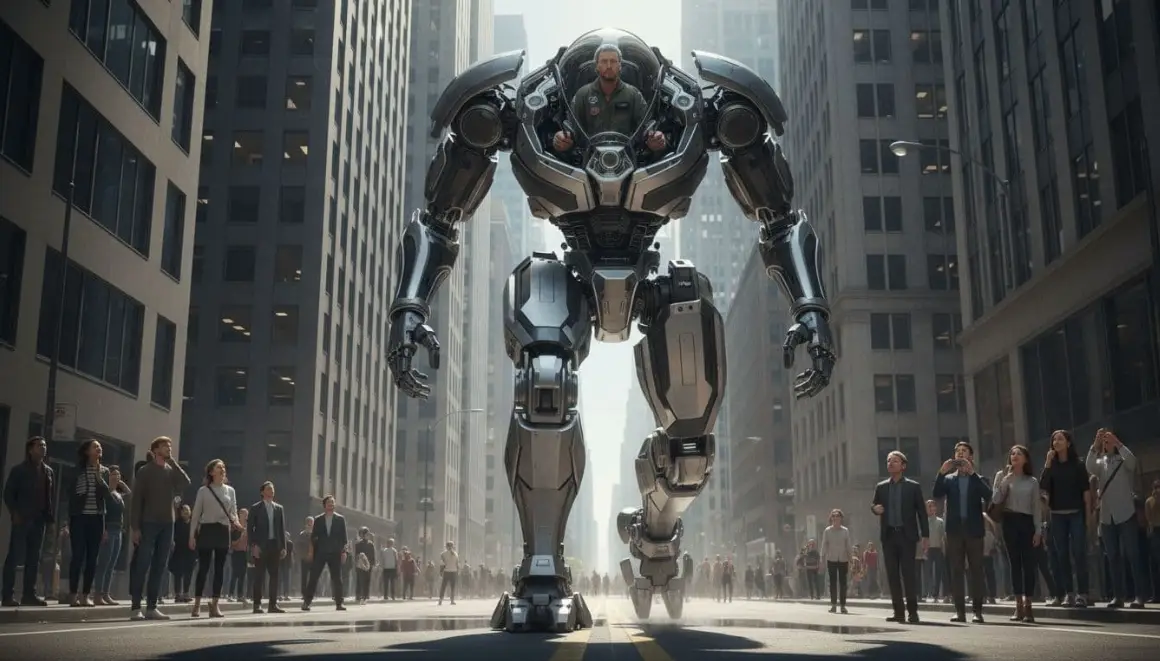
Another standout project was Method-2, developed by Hankook Mirae Technology with design work connected to the Hollywood artist known for imagined mech suits on screen. The machine stood about 13 feet tall, used a body made mostly from carbon fiber and aluminum, and placed a human pilot inside the chest.
Every movement from the operator translated into the robot’s body. Arms swung, hands gripped, and the whole machine moved with the strange weight of something that looks impossible until it takes a step.
These machines are still far from everyday products. Even so, they show an important pattern in South Korean robotics. The country hasn’t limited itself to software demos or small lab prototypes. It has shown a willingness to build physical systems at full scale, even when the result looks like it wandered off a movie set.
That same spirit now shows up in much smaller robots with much clearer jobs.
Humanoid robots are heading to real work
South Korea’s next step is even more important than giant pilots and showpiece machines. It’s pushing humanoid robots toward useful work, especially in manufacturing and logistics.
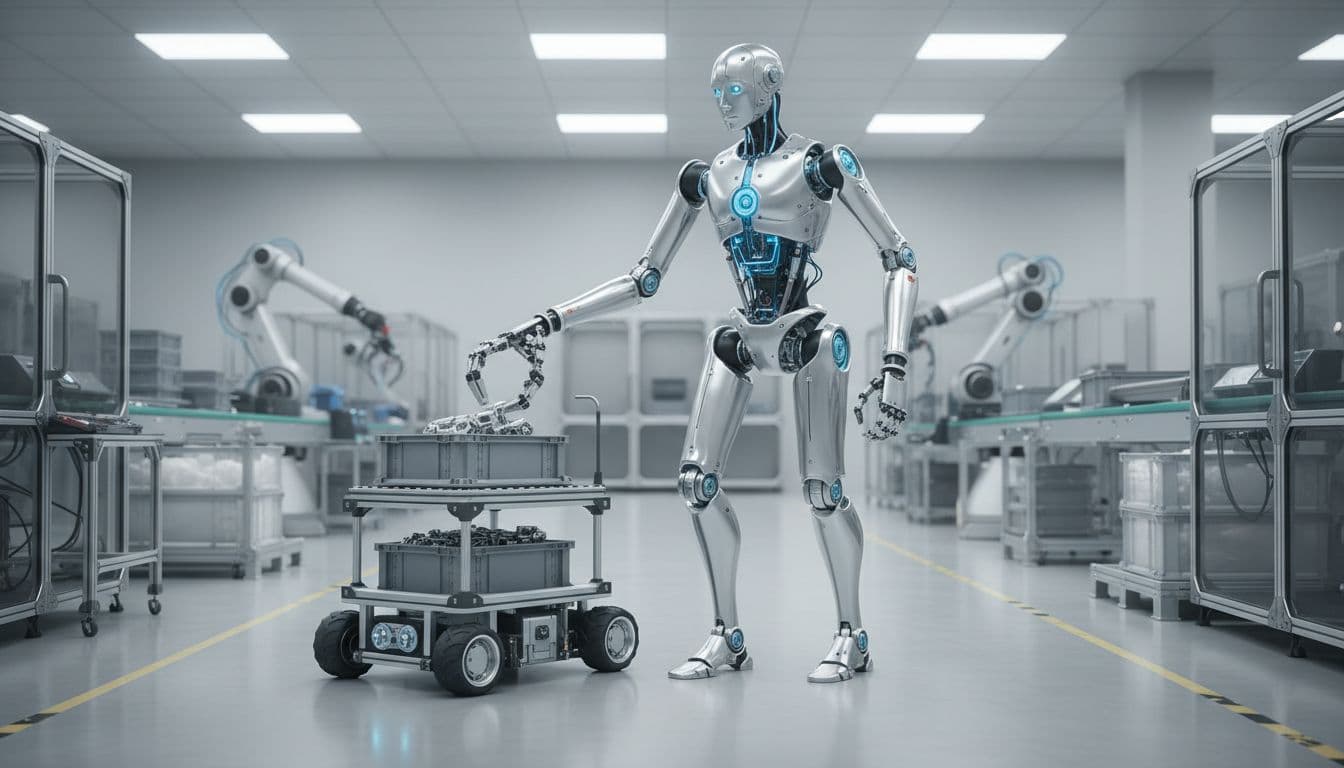
At CES 2026, a humanoid called Alice 4 drew attention for handling parts, recognizing objects, and adjusting grip strength on its own. It worked alongside a wheeled partner, Alice M1, which supported logistics tasks. That pairing matters because it hints at how robots may be deployed in the real world, not as lone machines, but as teams with different bodies and roles.
The goal is a full humanoid ecosystem
Behind that effort is the K-Humanoid Alliance, a government-backed coalition that includes more than 40 companies and universities. The group, as described in the video, brings together names such as Samsung, LG, Hyundai, KIST, and Rainbow Robotics with a shared goal of making South Korea a humanoid leader by 2030.
That helps explain why the country’s robotics push feels different. It isn’t resting on one company or one prototype. It’s building an ecosystem where carmakers, electronics giants, labs, and robotics firms all feed the same larger push.
If you want a US point of comparison, AI and robots reshaping US automation shows how much current robotics progress still centers on manufacturing gains and industrial deployment.
ALEX focuses on the hardest part, safe physical contact
Many robots can see. Fewer can handle touch well. That’s where ALEX, developed by WI Robotics, stands out.
Founded by former Samsung robotics engineers, WI Robotics built ALEX to work in situations where contact, force, and reaction matter. The robot’s hands offer 15 degrees of freedom, can sense subtle force without tactile sensors, and deliver up to 40 newtons of fingertip force. According to the video, its grip is strong enough to hold 66 pounds.
That combination opens a wide range of tasks. ALEX can manage fine motion, such as buttoning a shirt or folding laundry, while still handling heavier objects. Its arms also use much lower friction and rotational inertia than conventional robots, which helps movement look smoother and feel safer around people.
South Korea’s edge isn’t one famous humanoid. It’s the way robotics keeps showing up as a system, with hardware, sensors, mobility, and real job design all moving together.
Exoskeletons are doing two jobs at once
Humanoid robots get attention because they look familiar. Exoskeletons may matter more because they attach directly to human work and human recovery.
South Korea is building both kinds. Some systems reduce strain for workers who repeat tough motions all day. Others help people walk with less effort, or even help users stand and move after paralysis.
Hyundai VEX is built for factory strain
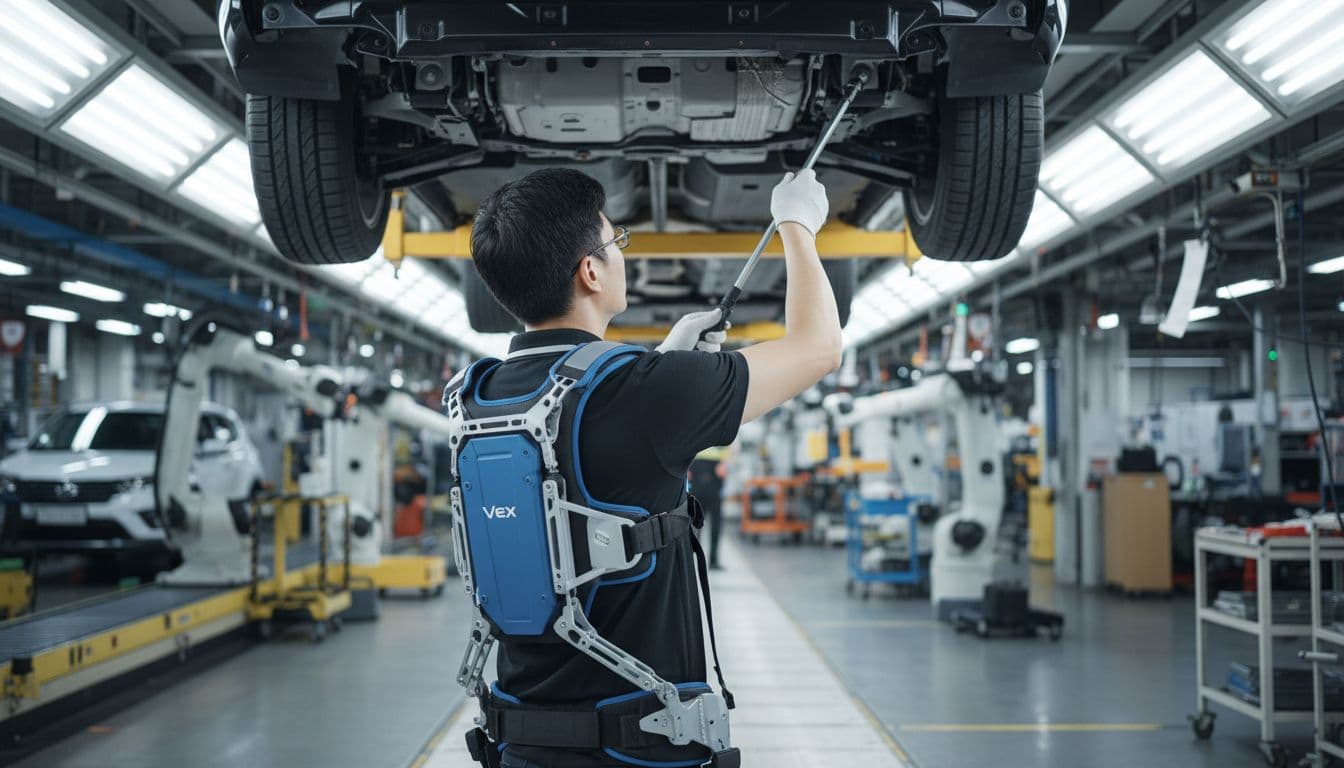
Hyundai’s Vest Exoskeleton, or VEX, was designed for workers who spend long hours doing overhead tasks. Think about jobs under a vehicle body, where someone holds tools above shoulder level again and again. That kind of work wears down the upper body fast.
The VEX weighs only 5.5 pounds and, according to the video, is up to 42 percent lighter than competing products. It’s worn like a backpack and offers six levels of force assistance, up to 12 pounds. It also avoids batteries and charging, which is a practical choice for long shifts.
Instead of a simple hinge, Hyundai used a polycentric axis with multiple pivot points. That lets the motion track the shoulder’s natural elliptical path more closely.
That may sound like a small engineering detail. It isn’t. If an exoskeleton fights your body, workers won’t want it. If it moves with you, it has a shot at becoming normal equipment.
Walking support is becoming more personal and more capable
The wearable system called WIM takes a different path. It’s a waist-worn device with two robotic arms that assist each leg while walking. The idea is simple and strong, help people walk with less effort, or train them to walk better.
The device includes several modes, including assist mode for older adults, resistance mode for strength work, hiking mode for rough ground, and a slow-gait mode for rehab. Its app tracks walking speed, balance, and symmetry, then estimates “gait age” and builds a training plan. In a four-week test described in the video, seniors showed a 78 percent improvement in physical function.
Then there’s WalkON Suit F1, built by KAIST. This full-body exoskeleton can move toward the user, wrap around the body, and help the person stand and walk without someone else helping them into the suit. The system weighs 110 pounds, uses 12 electric motors, and can climb stairs and cross uneven terrain.
At the 2024 Cybathlon, the video says it completed every challenge in 6 minutes and 41 seconds to win gold. That result gives the story real weight. This isn’t only about research milestones. It’s about mobility returning in a form users can control.
South Korea is building places where robots do the background work
Some of the country’s most interesting robotics work isn’t shaped like a person at all. It’s built into the places people use every day.
That includes factories, parking garages, charging stations, airports, and hotels. In those settings, the robot isn’t the show. The service is.
The dark factory idea is no longer a distant concept
Hyundai WIA has described a future dark factory built through the integration of industrial robots, proprietary control systems, and AI. The concept is simple. Robots handle assembly, transport, and quality control around the clock, so the floor needs little or no human presence.
When people talk about “lights-out” manufacturing, this is what they mean. The lights stay off because the machines don’t need them.
For a broader look at where factory automation is going, industrial automation 2025 trends helps place these ideas in the larger smart manufacturing shift. Hyundai has also framed its wider robotics strategy publicly at CES, as shown in Hyundai Motor Group’s AI robotics showcase.
Reuters has also reported that Hyundai Motor Group plans to deploy humanoid robots at its US factory from 2028, which suggests the group sees these machines as part of production planning, not only exhibition material.
Here’s a quick look at how broad that robotics footprint has become:
| System | Where it works | What it changes |
|---|---|---|
| Dark factory systems | Manufacturing plants | Automates assembly and inspection with little human floor presence |
| Parking robots | Parking facilities | Moves vehicles into tighter spaces than most drivers can manage |
| Automatic charging robots | EV charging areas | Handles plug-in charging after parking |
| MobED platform | Logistics, inspection, delivery | Carries different modules across uneven terrain |
| Airport guide and cleaning robots | Airport terminals | Assists travelers and automates cleaning routes |
The takeaway is clear: South Korea isn’t treating robots as one product category. It’s weaving them into infrastructure.
Cars are being rebuilt as robotic machines
Hyundai Mobis showed how far that thinking can go. At CES 2026, it unveiled more than 30 next-generation technologies, including a holographic windshield display that turns the front windshield into a transparent information screen.
It also showed X-by-Wire, which replaces mechanical steering and braking links with electronic control systems that back each other up. Then there’s the e-Corner system, demonstrated on the Hyundai Ioniq 5. Each wheel gets its own in-wheel motor, steer-by-wire, brake-by-wire, and damper.
That creates movement most drivers have never seen in a normal car. The vehicle can crab-walk sideways, spin in place, move diagonally, and pivot far more sharply than a standard setup allows.
After the drive, automation continues. Hyundai WIA’s parking robot uses thin platforms that slide under a vehicle, lift the wheels, and move the car in any direction. The video says each unit is only 4.3 inches thick and can handle vehicles up to 4,850 pounds, while one control system can coordinate as many as 50 robots. Hyundai’s automatic charging robot then identifies the vehicle, checks battery status, and plugs in the charger on its own.
That’s a striking shift. Parking and charging start to look less like chores and more like background services.
Home, airport, and hotel robots show the end goal
The clearest sign of South Korea’s robotics ambition may be where these machines appear outside industry. They’re moving into places where people expect convenience, comfort, and help, not spectacle.
At home, the pitch is less work and more support
LG’s CLOi home robot fits into the company’s “Zero Labor Home” idea. As described in the video, it can help with meal planning, laundry management, and other household tasks. It uses two articulated arms with seven degrees of freedom each, plus five actuated fingers per hand for precise handling.
LG says it runs on “Affectionate Intelligence,” which means the system is meant to learn from interactions and get more tailored over time.
Samsung takes a slightly different route. Ballie is the companion, a small rolling robot with a projector, LiDAR-based navigation, and Google Gemini-powered AI. It can handle calls, control smart-home functions, play content on walls or floors, and interact with pets. Bot Handy 2 is the chore robot, built for tasks such as loading dishwashers, sorting laundry, setting tables, and pouring drinks. Bot Care focuses on reminders, routine tracking, and checking in on health habits and family members.
These aren’t all trying to be the same thing. Some are helpers. Some are companions. Some are house workers.
For more on how service robots and factory robots are starting to blend into one larger trend, latest US automation news on AI robotics offers a useful contrast from the American side.
Airports and hotels are becoming test beds for everyday robotics
At Incheon International Airport, robotics already looks close to normal. The airport introduced guide robots that can answer questions, recognize voice input, and escort travelers to gates. For passengers who can’t walk long distances, the self-driving Air Ride vehicle provides transport through the terminal.
LG’s airport cleaning robot adds another layer. It detects which areas need the most attention, stores those locations, and calculates the best route to clean them.
Hotels are joining in too. Hyundai’s AI-based self-driving hotel delivery robot is already operating at Rolling Hills Hotel near Seoul. Guests can order food, drinks, or amenities by phone. The robot handles the trip, uses deep learning to recognize the guest, opens its storage compartment, and rides elevators without human help. If an elevator is too crowded, it waits for the next one.
That detail says a lot. The robot isn’t only following a preset route. It’s handling the little problems that turn a demo into a service.
South Korea’s robot story is bigger than any one machine
The strongest takeaway here is simple. South Korea isn’t betting on one robot to define the future. It’s building a robotic layer across work, transport, care, and daily life.
That’s why this story feels different from the usual headlines about humanoid races and AI hype. The real surprise isn’t that South Korea built futuristic robots. It’s that so many of them already have a place to work.
The next big shift in robotics may not come from the flashiest demo. It may come from the country that keeps finding ordinary places where robots can quietly take over the hard part.