Last month’s orders are on your screen, and you’re doing the same thing you did last time. You squint at a few numbers, guess what people want, then hit send and hope it lands.
That’s the everyday problem predictive analytics Klaviyo is built to fix.
Instead of treating every shopper the same, Klaviyo uses your past order patterns to estimate what each person is likely to do next. Think of it like a weather forecast for buying behavior. It won’t be perfect, but it’s usually better than guessing.
This guide keeps it practical. You’ll learn what Klaviyo predicts, what you need to unlock it, and how to use it in email and SMS without turning into a math person.
What predictive analytics in Klaviyo can tell you about each shopper
Klaviyo doesn’t just store what happened. It looks at how orders come in over time and adds predictions to each customer profile. Those predictions help you answer questions like: Who’s likely to buy again soon? Who’s quietly slipping away? Who’s worth protecting with better service instead of bigger discounts?
The real win is focus. You send fewer “maybe this helps?” messages and more “this is the right moment” messages.
Predictions also refresh regularly (often weekly), so your segments don’t go stale. Someone who was a “sure thing” last month can drift into a riskier zone, and your targeting updates without you rebuilding lists.
If you want the official names and definitions Klaviyo uses, start with Klaviyo’s guide to predictive analytics. It matches what you see inside profiles and segments.
The predictions that matter most (CLV, churn risk, and next order date)
Here are the big ones, explained like you’d explain them to a coworker:
- Predicted CLV: how much a customer is likely to spend in a future window (commonly the next year).
- Historic CLV: what they’ve already spent.
- Total CLV: a combined view of past plus expected future value.
- Churn risk: the chance they stop buying from you.
- Average time between orders: their usual rhythm.
- Predicted next order date: the likely timing window for their next purchase.
A mini-example makes this click. If Maya tends to buy every 28 days, Klaviyo can flag her as “coming due” around day 24 to day 30. That’s when a reorder reminder feels helpful instead of random.
Treat predictions like a compass, not a contract. They point you in the right direction, then your testing does the rest.
How to use these insights without feeling like you need a data team
You’ll see predictions on customer profiles, and you can use them in segments and flow filters. That’s where marketing teams actually feel the impact.
Start with a couple of “good first moves” that don’t require fancy logic:
- Build a VIP segment using high predicted CLV.
- Build a save segment using high churn risk, then feed it into a win-back flow.
The goal is better decisions at scale. You don’t need to be right about every single shopper. You just need to be right more often than “send to everyone.”
What you need set up before Klaviyo predictions unlock

Photo by Atlantic Ambience
Klaviyo’s models need enough real purchase history to learn patterns. Once your account qualifies, predictions turn on automatically. After that, the system keeps training and refreshing without you babysitting it.
Why the gatekeeping? Because weak data creates noisy predictions, and noisy predictions create bad segments. If the tool can’t “see” repeat behavior, it can’t forecast repeat behavior.
For a broader view of how the models work and what they cover, Klaviyo keeps its documentation organized under Predictive models in the Klaviyo Help Center.
Data requirements you can check in five minutes
Eligibility can vary by account and integration, but most stores unlock predictive analytics after they hit a baseline like this:
- Around 500+ customers who have placed orders
- At least 180 days of order history
- Enough repeat behavior (often customers with 3+ lifetime orders in the dataset)
- Recent activity (commonly at least one order in the last 30 days)
- A deep e-commerce integration (Shopify, WooCommerce, Magento, BigCommerce, or a solid custom setup)
Subscribers alone don’t count. Klaviyo needs actual order events to model order timing and value.
Clean inputs, better outputs (the small data fixes that help a lot)
Most “the predictions are wrong” complaints trace back to messy inputs. A few quick checks prevent weeks of confusion:
Confirm your order events are flowing correctly, especially “Placed Order.” Next, make sure refunds and cancellations are handled consistently, so revenue and order counts don’t inflate. Also check identity issues, like duplicate profiles that split one shopper into two. Finally, keep product catalog data accurate, because bad product data can weaken personalization.
Clean data doesn’t make predictions magical, it makes your segments quieter and your timing more dependable.
High-impact ways to use predictive analytics in Klaviyo for email and SMS
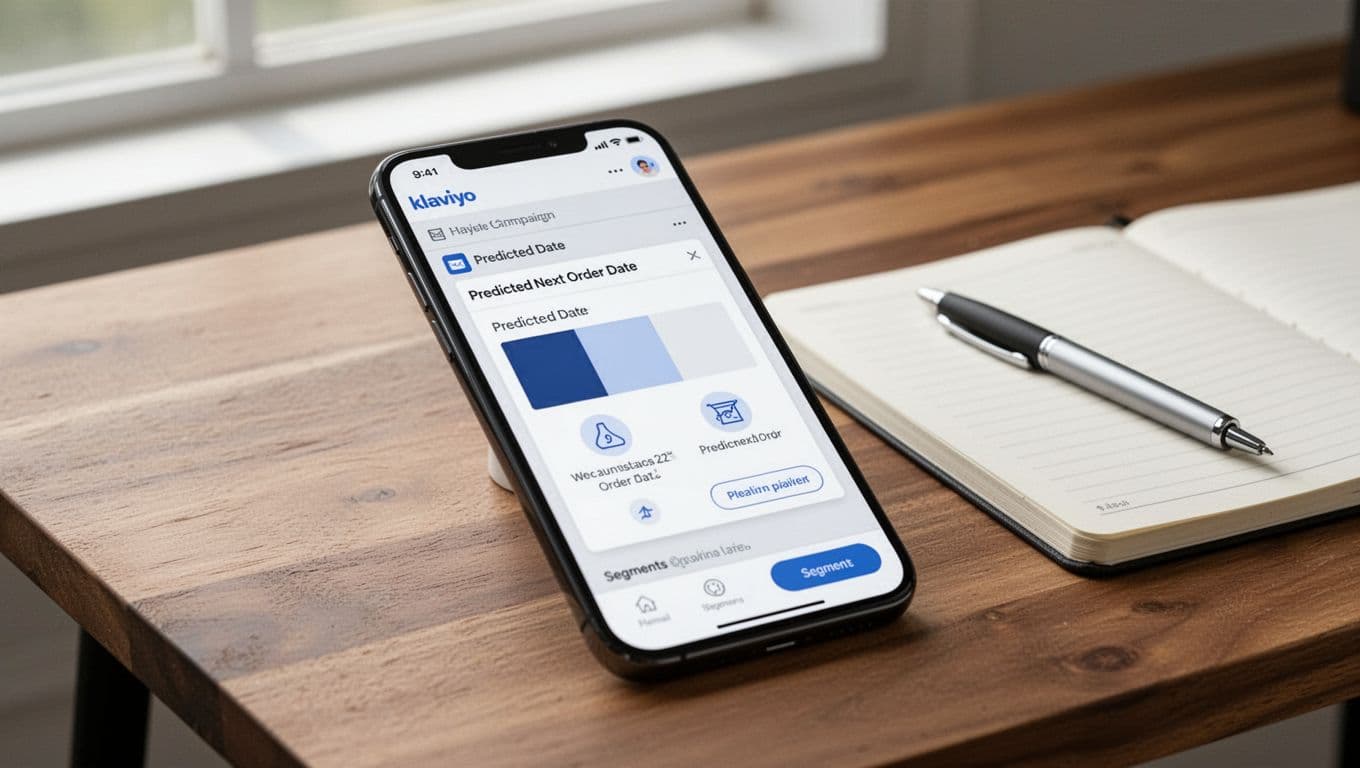
Using predicted timing to build smarter segments for campaigns and flows.
This is where predictive analytics stops being “interesting” and starts paying rent. Pick one use case, ship it, then improve it.
Build a VIP lane using predicted CLV (and protect it with churn risk)
Start simple: create a segment that captures your top predicted value customers (for example, top 10 percent by predicted CLV). Then add a guardrail if your goal is launch revenue: exclude people with high churn risk.
A practical example threshold many teams test first is “high predicted CLV” plus “churn risk under 20 percent.” Your numbers may differ, but the idea stays the same: reward loyal buyers who are most likely to respond.
Campaign ideas that fit this lane include early access, bundles, subscription offers, and loyalty perks. You’re not bribing them, you’re treating them like regulars at the counter.
Catch churn before it happens with a save flow
A churn-risk save flow works best when it feels calm, not desperate. Trigger when churn risk rises, then send a short sequence:
First, a helpful nudge (restock reminder, best-sellers, new arrivals). Next, add social proof or a product education angle. Finally, test a gentle offer if needed.
Guardrails matter. Don’t over-discount high-value customers by default. Also exclude recent buyers, because a win-back email right after a purchase feels tone-deaf.
For additional real-world context on how teams use these predictions across retention programs, this Klaviyo predictive analytics guide does a good job mapping the concepts to common workflows.
Time replenishment messages around the predicted next order date
Timing beats frequency. Send the first message a few days before the predicted window, then follow up if they don’t purchase.
This works best for consumables and repeat-buy items: skincare, coffee, supplements, pet supplies, and cleaning products. Keep the message tight. Use a reorder button, a “running low?” reminder, and a quick tip that reduces friction.
Make campaigns feel personal with product picks based on behavior
You don’t need complex rules to sound like you know your customer. Use what’s already there: past categories, typical order size, and how often they buy.
If you use predicted gender (when available), treat it as a soft signal, not a label. Product suggestions should feel respectful and flexible, because nobody wants to be boxed in by a guess.
Common mistakes, quick tests, and how to know it’s working
Predictive analytics earns trust when you measure it like a marketer, not like a scientist.
Mistakes that make predictive segments look “wrong.”
A few patterns cause most headaches:
Using predictions before your account has enough order history is a common one. Tiny segments can also swing wildly week to week. Seasonality and big promos can distort “normal” buying cadence, so compare against similar periods. Another trap is treating churn risk as a fact rather than a signal. Finally, gift buyers can pollute repeat-buyer segments, so separate them when you can.
Also remember the refresh cycle. Predictions commonly update weekly, so don’t panic after one day.
If a segment looks off, audit your events first, then audit your exclusions. Most fixes happen there.
Two simple ways to measure lift without overthinking it
Set up one A/B test at a time, and keep it running long enough to capture a full reorder cycle.
| Test idea | Control group | Predictive group | What to watch |
|---|---|---|---|
| Win-back targeting | Repeat purchase rate, revenue per recipient, and offer cost | High churn risk segment | “Last purchased 60 days ago.” |
| Replenishment timing | Monthly reorder blast | Predicted next order date window | Repeat purchase rate, revenue per recipient, offer cost |
If predictive targeting raises revenue per recipient without spiking unsubscribes, you’re on the right track.
Conclusion
If you’re staring at last month’s orders and guessing what to do next, take one small step: check eligibility, pick one predictive metric, and build one segment. Then launch one flow and let it run for a few weeks.
The payoff of predictive analytics, Klaviyo, is simple: better timing and better focus, without sending more messages. After the predictions refresh a few cycles, tighten your thresholds and keep what’s working. What would change in your store if your emails arrived right before customers were ready to buy?