Modern data centers face unprecedented cooling challenges as computing power demands continue to escalate, making advanced thermal management solutions essential for operational efficiency and equipment longevity. EcoStruxure™ IT Design CFD represents a revolutionary approach to data center cooling analysis, leveraging computational fluid dynamics (CFD) technology to predict, visualize, and optimize airflow patterns within data center whitespace environments.
Understanding EcoStruxure™ IT Design CFD
EcoStruxure™ IT Design CFD is Schneider Electric’s cloud-based computational fluid dynamics software specifically engineered for data center design and optimization. This sophisticated platform enables data center professionals to create virtual equipment layouts and specifications that are optimized for cooling performance and energy efficiency. By utilizing advanced CFD modeling techniques, the software predicts and visualizes complex airflow patterns within data center environments before physical implementation.apc+1
The platform stands out for its browser-based accessibility and cloud-GPU architecture, which delivers computational power that traditional CFD software cannot match. Unlike conventional CFD tools that may require hours or days of computing time, EcoStruxure™ IT Design CFD completes most simulations in less than a minute, fundamentally changing how data center cooling analysis is conducted
The Science Behind CFD in Data Center Cooling
Computational Fluid Dynamics forms the mathematical foundation of modern data center thermal management. CFD utilizes sophisticated algorithms to simulate thermo-fluid behavior in complex systems, including air movement, temperature distribution, and heat transfer patterns. In data center applications, CFD modeling enables engineers to analyze how cooling air moves through the facility and how heat dissipates from IT equipment.therma+1
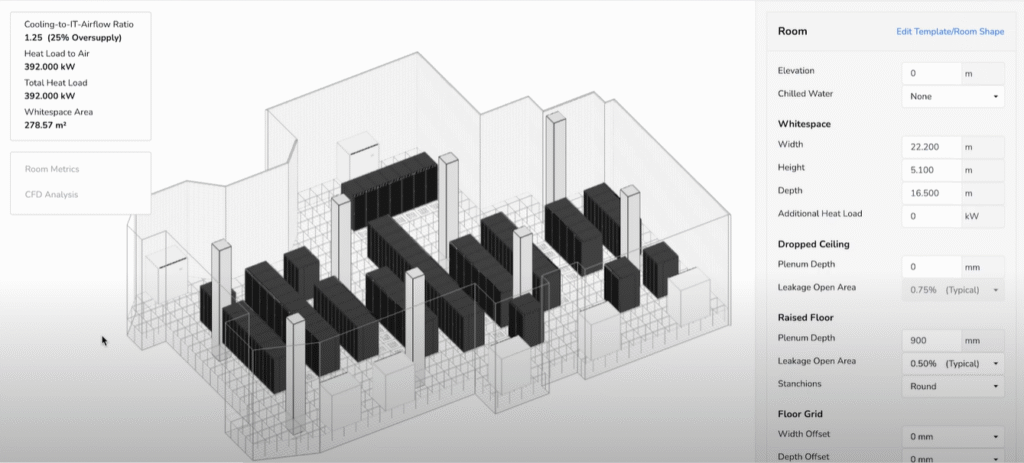
The CFD simulation process consists of three critical phases: pre-processing (where geometry is defined and divided into computational elements), solver operations (where fluid properties and boundary conditions are processed), and post-processing (where results are analyzed and visualized for decision-making). This comprehensive approach allows data center designers to understand complex thermal dynamics that would be impossible to predict through traditional methods.
Core Capabilities and Features
Drag-and-Drop Design Interface
EcoStruxure™ IT Design CFD features an intuitive design interface that allows users to drag and drop equipment directly into the whitespace for analysis. This user-friendly approach eliminates the complexity typically associated with CFD software, making advanced thermal analysis accessible to professionals across various expertise levels.se+2
Advanced Temperature Visualization
The software provides accurate, data-rich visuals that display temperatures, velocity patterns, pressure distributions, and airflow characteristics throughout the entire data center. Users can visualize temperature planes, analyze airflow vectors, and identify thermal patterns that impact cooling efficiency.
Temperature visualization capabilities include:
- Three-dimensional heat mapping for comprehensive thermal analysis
- Slice-based analysis allows detailed examination of specific data center sections
- Real-time temperature monitoring with color-coded visual indicators
- Hot spot identification through advanced thermal imaging techniques
Cloud-Based GPU Processing
The platform’s cloud-GPU architecture represents a significant technological advancement in CFD computing. By leveraging high-performance graphics processing units in cloud environments, EcoStruxure™ IT Design CFD delivers computational speeds that are orders of magnitude faster than traditional CFD software.se+3
This cloud-based approach offers several advantages:
- Near real-time analysis capabilities for rapid design iteration
- Scalable computing resources that adapt to project complexity
- Reduced hardware requirements for end users
- Automatic software updates and maintenance
Running a Comprehensive Cooling Analysis
Initial Setup and Model Configuration
Beginning a cooling analysis with EcoStruxure™ IT Design CFD involves creating a digital twin of the data center environment. Users input physical layout parameters including room dimensions, equipment locations, and infrastructure specifications. The software’s intelligent modeling system incorporates pre-built models for common data center equipment, ensuring accurate representation of real-world thermal characteristics.
The initial setup process includes:
- Geometric modeling of the data center whitespace
- Equipment placement using the drag-and-drop interface
- Boundary condition definition for air supply and return systems
- Thermal load specification based on actual IT equipment power consumption
Airflow Pattern Analysis
Once the model is configured, EcoStruxure™ IT Design CFD analyzes complex airflow patterns throughout the facility. The software solves fundamental fluid dynamics equations (Navier-Stokes equations) to predict how air moves through the data center, including interactions with raised floors, dropped ceilings, and equipment installations.
Key airflow analysis features include:
- Velocity vector visualization showing air movement direction and speed
- Pressure distribution mapping, identifying areas of flow restriction
- Recirculation pattern identification, highlighting inefficient air mixing zones
- Plenum analysis for raised floor and dropped ceiling environments
Temperature Distribution Assessment
The software provides detailed temperature distribution analysis across the entire data center environment. This analysis identifies areas where cooling may be inadequate or excessive, enabling targeted optimization strategies. The platform’s Cooling Check function provides immediate visual feedback on cooling performance, with graphical indications displayed on each equipment rack.se+2
Temperature analysis capabilities encompass:
- Inlet temperature monitoring for critical IT equipment
- Thermal gradient analysis across different data center zones
- Hot spot detection with precise location identification
- Ambient temperature tracking throughout the facility
Optimization Strategies and Benefits
Energy Efficiency Improvements
EcoStruxure™ IT Design CFD enables significant energy efficiency improvements through precise cooling optimization. Well-executed CFD projects typically achieve 20-30% reductions in cooling energy consumption by optimizing airflow routing and eliminating scenarios of overcooling. The software allows operators to test different supply temperatures and cooling configurations virtually before implementation.
Energy optimization strategies include:
- Supply temperature optimization to reduce cooling system energy consumption
- Airflow balancing to eliminate overcooling in certain areas
- Equipment placement optimization for improved thermal efficiency
- Cooling capacity right-sizing based on actual thermal loads
Hot Spot Elimination
One of the most critical applications of CFD analysis is hot spot identification and elimination. EcoStruxure™ IT Design CFD can predict where thermal problems will occur before they impact equipment operation. The software’s advanced visualization capabilities allow users to see exactly where hot air accumulates and how to redirect cooling airflow for optimal temperature control.nicecae+2
Hot spot mitigation techniques include:
- Strategic airflow redirection to eliminate thermal dead zones
- Equipment repositioning to improve thermal distribution
- Cooling unit placement optimization for maximum coverage
- Containment strategy implementation for improved air management
Predictive Failure Analysis
The platform enables predictive failure analysis by simulating various equipment failure scenarios. Users can model the impact of cooling unit failures, power outages, or equipment malfunctions to understand how these events would affect data center thermal conditions. This capability allows for proactive planning and resilience improvement.stulz+1
Advanced Features and Applications
Containment Strategy Analysis
EcoStruxure™ IT Design CFD supports analysis of various containment strategies including hot aisle and cold aisle containment systems. The software can model how these containment approaches affect airflow patterns and cooling efficiency, enabling designers to choose the most suitable strategy for their specific facility requirements.
Containment analysis features include:
- Hot aisle containment modeling for exhaust air management
- Cold aisle containment simulation for supply air optimization
- Containment effectiveness measurement through thermal performance metrics
- Energy impact assessment of different containment approaches
Integration with Building Management Systems
The software can integrate with existing Building Management Systems (BMS) for comprehensive facility control. This integration enables real-time optimization of cooling systems based on actual operating conditions and thermal sensor data throughout the facility.
Sustainability Metrics and Reporting
EcoStruxure™ IT Design CFD contributes to sustainability reporting by providing detailed energy consumption analysis and Power Usage Effectiveness (PUE) calculations. The software helps organizations meet regulatory requirements and sustainability goals by quantifying the environmental impact of cooling system operations.se+1
Industry Applications and Case Studies
Real-World Implementation Results
Organizations implementing CFD-guided cooling optimization have achieved remarkable results. Industry case studies demonstrate enhanced energy efficiency, improved cooling system performance, and minimized downtime through strategic CFD application. Companies have reported significant improvements in operational reliability and substantial cost savings from reduced energy consumption.
Compliance and Standards Adherence
EcoStruxure™ IT Design CFD follows ASHRAE Research Project RP-1675 guidelines and incorporates industry best practices for data center CFD modeling. The software ensures compliance with established standards while delivering accurate, reliable results for thermal analysis and optimization
Future Developments and Technology Evolution
Real-Time CFD Capabilities
Advances in GPU technology are bringing real-time CFD analysis closer to reality. These developments will enable CFD simulations with minimal latency, allowing operations teams to study and respond to live physical systems in real-time. EcoStruxure™ IT Design CFD is positioned to leverage these technological advances as they become available.
Machine Learning Integration
The integration of machine learning and artificial intelligence with CFD technology represents the next frontier in data center cooling optimization. These technologies will enable predictive modeling that goes beyond traditional CFD analysis, incorporating historical data patterns and operational trends for more accurate thermal management.
Implementation Best Practices
Model Accuracy and Validation
Successful CFD analysis depends on accurate input data and proper model validation. Users should ensure that geometric models accurately represent the physical facility and that equipment thermal characteristics match manufacturer specifications. Regular validation against measured data improves model reliability and confidence in results.
Iterative Design Approach
EcoStruxure™ IT Design CFD’s fast processing capabilities enable an iterative design approach where multiple scenarios can be tested rapidly. This methodology allows designers to explore various cooling strategies and optimize performance through systematic analysis and refinement.se
Professional Training and Expertise
While EcoStruxure™ IT Design CFD is designed for ease of use, proper training and understanding of CFD principles enhance analysis quality. Organizations should invest in training programs to ensure users can effectively interpret results and make informed decisions based on CFD analysis outcomes.
Economic Impact and Return on Investment
The implementation of CFD-guided cooling optimization delivers substantial economic benefits through reduced energy consumption, improved equipment reliability, and extended hardware lifecycles. Organizations typically see immediate energy savings and long-term cost reductions from optimized cooling operations.
Cost benefits include:
- Reduced electricity consumption from optimized cooling systems
- Extended equipment lifespan through improved thermal management
- Decreased maintenance costs from reduced thermal stress
- Improved operational efficiency through predictive analysis
EcoStruxure™ IT Design CFD represents a transformative technology for data center cooling analysis and optimization. By combining advanced computational fluid dynamics with cloud-based processing power, the platform enables data center professionals to achieve unprecedented levels of thermal management efficiency. The software’s intuitive interface, rapid processing capabilities, and comprehensive analysis features make sophisticated CFD analysis accessible to organizations of all sizes.se+1
As data centers continue to face increasing thermal challenges from higher power densities and evolving computing requirements, CFD-guided cooling optimization becomes essential for sustainable operations. EcoStruxure™ IT Design CFD provides the tools and capabilities necessary to meet these challenges while maximizing energy efficiency and ensuring reliable equipment operation.
The future of data center thermal management lies in the intelligent application of CFD technology, predictive analytics, and real-time optimization strategies. Organizations that adopt these advanced tools today will be better positioned to manage the cooling challenges of tomorrow while achieving their sustainability and operational efficiency goals.