Substations are being asked to do more than ever, often with the same staffing levels and tighter risk limits. The push for decarbonization, the rapid pace of digitization, and the growing need for cyber resilience are forcing utilities and industrial power teams to rethink how they control and monitor critical assets.
Schneider Electric’s PowerLogic T500 is positioned for that exact moment. It’s a substation controller built for demanding applications, with a modular hardware approach, strong cybersecurity alignment (IEC 62443), and the communications depth needed to sit between field devices and higher-level systems.
“Industries are facing significant challenges” is a simple line, but it matches what operators see daily: more data, more interfaces, and more ways for failures (or attacks) to propagate.
Why are substation teams under pressure right now
Decarbonization changes power flow. Renewables and distributed energy resources can shift load patterns, fault levels, and switching operations. Even when generation changes happen upstream, substations still feel the impact through more dynamic operating conditions and new monitoring requirements.
Digitization adds another layer. Teams want more visibility, faster troubleshooting, and better reporting. That usually means more networked devices, more protocols, and more integration work. At the same time, many sites carry legacy equipment that can’t simply be replaced in one outage window.
Cyber resilience has moved from “nice to have” to baseline engineering. Substations sit at the intersection of operational technology (OT) and enterprise systems, so security gaps can become safety issues or service interruptions. Research and standards work keep highlighting the risks in cyber-physical environments, including substations and smart grid systems, for example in work like resiliency-driven cyber-physical risk assessment for substations.
A few practical pain points show up across industries:
- Change happens faster than typical asset life cycles, so architectures need room to grow.
- Connectivity increases exposure, so security controls must be planned, not bolted on.
- Integration effort expands, because more data sources need to reach SCADA and enterprise tools without turning the system into a patchwork.
The hard part isn’t adding one more device, it’s keeping the overall architecture maintainable as the device count grows.
What the PowerLogic T500 is designed to do in a substation architecture
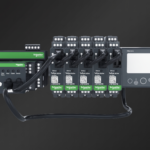
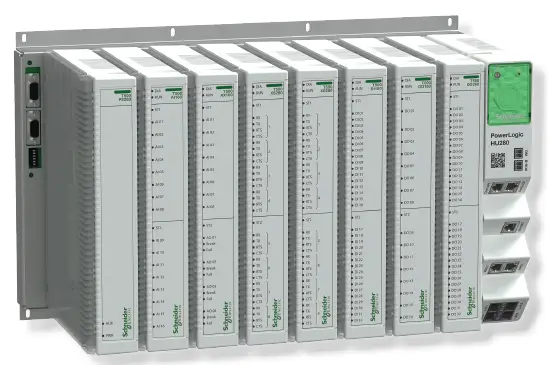
The PowerLogic T500 is a substation controller engineered for high-demand applications. In a typical automation stack, that means it can serve as a central coordination point between intelligent electronic devices (IEDs), station-level networks, and SCADA or other supervisory systems.
Schneider Electric describes the platform as modular, open, flexible, and easy to set up, with alignment to both operational and IT standards for connection to networks and enterprise systems. For the product family context, see PowerLogic T500 Substation Controller (Schneider Electric USA).
The controller as the “backbone” layer
In plain terms, “backbone” is about reducing fragile point-to-point designs. Instead of every IED needing a custom path to every upstream consumer of data, the controller can provide a structured, engineered hub for communications and system logic.
That matters in two common scenarios:
First, new builds often start with a target architecture (protocols, security zones, naming conventions, engineering workflow). A controller that supports modern substation standards helps keep the build consistent from day one.
Second, retrofits usually have constraints. You might need to integrate new digital devices next to older equipment while keeping outage time short. A controller platform that’s designed to adapt helps teams add capability without a full rip-and-replace approach.
IT/OT integration and IEC 62443 cybersecurity alignment
Substation automation sits between two worlds. OT focuses on deterministic operation, safety, and uptime. IT focuses on identity, access control, logging, and managed change. The weak point is usually the boundary where data crosses between them.
The PowerLogic T500 is presented as supporting IT/OT integration with IEC 62443 cybersecurity compliance (as highlighted in the video). That matters because IEC 62443 is a widely recognized set of requirements for industrial automation and control system security, including concepts like security levels, secure product development practices, and technical controls.
Rather than treating security as a separate appliance, the goal is to have security expectations built into how the controller fits in the network and how it gets engineered and maintained.
To make the relationship between today’s pressures and controller capabilities easier to scan, this table summarizes the “why” and the “what” at a high level:
| Substation pressure | What you need from a controller | T500 capability called out |
|---|---|---|
| More connected systems | Controlled, engineered data paths | IT/OT integration focus |
| Higher cyber risk | Security requirements that map to standards | IEC 62443 compliance |
| Longer asset life cycles | Upgrade path without redesign | Modular platform, hot-swappable modules |
The takeaway is simple: alignment to IEC 62443 helps set a baseline for security expectations, while IT/OT integration helps keep data movement intentional instead of accidental.
Modular hardware and hot-swappable modules for change without drama
Substation equipment often lives through multiple generations of communications and software practices. That’s why the T500’s flexible hardware platform and hot-swappable modules are not just convenience features, they are operational tools.
Hot-swappable design aims to reduce the friction of upgrades and maintenance. In environments where outage windows are narrow, even small tasks can become scheduling problems. A modular approach can also help with staged expansions, where you add capability as the project grows.
What “hot-swappable” means in real maintenance terms
Think of it like replacing a network interface card in a server designed for serviceability. The point is to avoid turning every change into a full shutdown event. In substation terms, that can support:
- Faster hardware refresh cycles, when communications needs change.
- Simpler spares strategy, because modules can be stocked and replaced.
- Lower upgrade risk, because changes can be more incremental.
The video also emphasizes “easy to upgrade and adapt to future needs.” That’s a useful framing for teams who are trying to keep architectures stable while requirements move.
Engineering and daily operation: Engineering Suite plus embedded web UI
A controller can have strong hardware and strong comms, yet still fail the usability test. If configuration and maintenance are painful, technicians avoid updates, documentation drifts, and troubleshooting time rises.
Schneider Electric positions two interface layers around the T500:
PowerLogic Engineering Suite for configuration and maintenance
The video calls out PowerLogic Engineering Suite as the way to make device configuration, engineering, and maintenance simpler. In practice, that kind of tool support matters most when multiple people touch the system over time. Standard workflows help teams avoid one-off settings and reduce dependence on tribal knowledge.
Embedded web UI for fast access
The T500 also includes an intuitive embedded web-based user interface (webUI). A built-in UI can be valuable for on-site checks and commissioning tasks, especially when you need quick confirmation of status, communications, or configuration without setting up a heavyweight engineering session.
The description also mentions advanced analytics for operational efficiency. Analytics only help when data collection and context are consistent, so the engineering workflow and the communications model matter just as much as the analytics functions themselves.
Tools don’t replace engineering discipline, but they can make disciplined work easier to repeat and audit.
Communications depth: IED and SCADA compatibility, plus IEC 61850 support
A substation controller earns its place by speaking the right languages, reliably. The video highlights comprehensive communication capabilities, plus compatibility with a wide range of IEDs and SCADA systems. The description adds IEC 61850 native compliance, which is a key detail for modern digital substations.
IEC 61850 matters because it standardizes data models and services for substation automation, which can reduce vendor lock-in and simplify integration across mixed fleets. If you want a practical view of how this shows up during integration work, see IEC 61850 communication for MiCOM relays.
SCADA integration is where many projects either stabilize or spiral. Tag quality, event reporting, time sync assumptions, and protocol mapping all show up here. For a SCADA-focused view of substation control and monitoring considerations, real-time substation monitoring with SCADA is a useful reference.
Finally, interoperability isn’t just a design claim, it’s a test effort. When teams validate behavior across devices and networks, they reduce surprises during commissioning. For teams working in IEC 61850 environments, testing IEDs in IEC 61850 substations outlines why verification work matters and what it typically covers.
Environmental profile and Green Premium certification
Decarbonization goals don’t stop at generation sources. Procurement and engineering teams also face sustainability requirements for the equipment they specify, including environmental declarations and lifecycle considerations.
The video highlights an enhanced environmental profile, and the description calls out Green Premium certification. While sustainability claims should always be checked against product documentation for the exact configuration you’re buying, the key point is that environmental attributes are being treated as part of the product story, not an afterthought.
For those who want to go deeper into official documentation, Schneider Electric provides platform documentation such as the PowerLogic T500 Platform User Manual. That type of document is also where you typically confirm details needed for engineering reviews and operational planning.
Conclusion: where the PowerLogic T500 fits best
The PowerLogic T500 targets substations that need a controller built for demanding environments, with IEC 62443 cybersecurity alignment, IEC 61850 support, modular hardware, and practical engineering and web UI tools. Those features map directly to the pressures utilities and industrial sites face as they modernize.
For product-level details and configuration options, start with the PowerLogic T500 Substation Controller (Schneider Electric USA) page, then validate engineering assumptions against the documentation. The best next step is to match the controller’s communications, security, and modular expansion options to your site’s architecture and upgrade plan, so future upgrades don’t become emergency projects.
#PowerLogicT500 #SubstationController #SmartGrid #Cybersecurity #EnergyEfficiency #SchneiderElectric