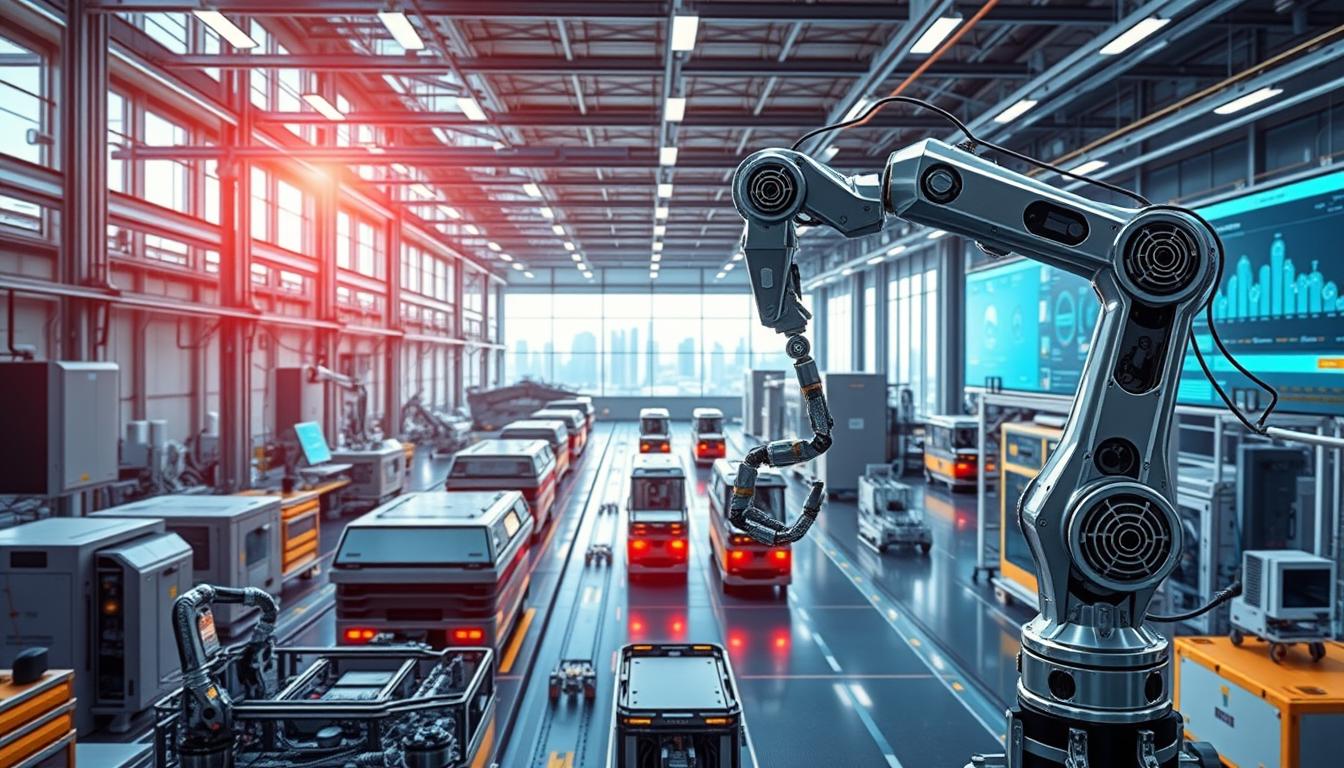
As we get closer to 2025, the world of industrial automation is changing a lot. This change comes from new tech like AI and robotics. These are making big changes in how industries work.
The use of smart manufacturing is making things more efficient and productive in many areas. This article will give you a deep look into the important changes happening in industrial automation.
Key Takeaways
- The future of industrial automation is heavily influenced by AI and robotics.
- Smart manufacturing is becoming increasingly important for industrial efficiency.
- Technological advancements are driving significant changes in the industrial automation landscape.
- Industries are adopting new technologies to enhance productivity and efficiency.
- The industrial automation sector is expected to undergo substantial growth and transformation by 2025.
The Current State of Industrial Automation
Industrial automation is changing fast, thanks to AI and robotics. More companies are using automated systems. This makes work more efficient and productive.
Key Statistics and Market Overview
The global industrial automation market is experiencing rapid growth. Recent numbers show a big jump in adoption. A report says the market will keep growing as companies invest in new tech.
Global Adoption Rates by Region
Regions are adopting automation at different speeds. Asia-Pacific is leading, with countries like China and India investing a lot. They want to improve their manufacturing.
Economic Impact Assessment
Automation has a big impact on the economy. It might lead to job losses in some areas. But it also creates new jobs in AI and robotics. A study shows automation could make work 40% more productive by 2025.
“Automation is not just about replacing human labor; it’s about augmenting it to achieve greater efficiency and precision.”
Major Players Shaping the Industry
The automation world is shaped by many players. Tech companies and implementers are key. Siemens and Rockwell Automation are leading with new solutions.
Technology Providers vs. Implementers
Technology providers create new automation tech. Implementers put these solutions into place. Their work together is key for automation success.
Industrial Automation 2025: AI, Robotics and Smart Manufacturing Trends
As we near 2025, AI, robotics, and smart manufacturing are changing the game. They’re making factories more efficient and productive. This is thanks to the mix of physical and digital systems.
Convergence of Physical and Digital Systems
The blend of physical and digital systems is a big deal. It lets us monitor things in real-time and predict when machines need fixing. It also makes production smoother.
Industry 4.0 Evolution to Industry 5.0
We’re moving from Industry 4.0 to Industry 5.0. This change brings more personalized and green manufacturing. Industry 5.0 is all about humans and machines working together better.
A report says the future of making things is all about mixing physical and digital. This makes factories more flexible and quick to respond.
“The factories of the future will be characterized by their ability to adapt quickly to changing market demands, leveraging advanced technologies such as AI and robotics.”
Projected Growth and Investment Patterns
The world of industrial automation is set to grow a lot. We’ll see more money going into AI for maintenance, robots that work together, and digital twins.
Sector-Specific Adoption Forecasts
Not all industries will adopt new tech at the same pace. Cars and electronics will lead the way. But, industries like drugs and food will catch up soon.
| Sector | Adoption Rate | Key Technologies |
|---|---|---|
| Automotive | High | AI, Robotics, Digital Twins |
| Electronics | High | AI, Machine Learning, Collaborative Robots |
| Pharmaceuticals | Medium | Digital Twins, Predictive Maintenance, Quality Control |
AI-Powered Predictive Maintenance Revolution
Predictive maintenance, powered by AI, is changing the game in industrial automation. It offers real-time monitoring and failure prediction. This shift means industries can move from scheduled maintenance to a proactive approach. It reduces downtime and boosts productivity.
Real-Time Monitoring Systems
The core of AI-powered predictive maintenance is real-time monitoring systems. These systems use sensor technology to watch equipment closely. They spot potential failures before they happen.
Sensor Technology Advancements
New sensor tech has made real-time monitoring systems more accurate and reliable. Modern sensors can catch even small changes in equipment. This gives AI algorithms the data they need to analyze.
“The use of advanced sensors and AI in predictive maintenance is revolutionizing the way industries approach equipment maintenance, reducing unplanned downtime and increasing overall efficiency.”
Machine Learning Algorithms for Failure Prediction
Machine learning algorithms are key in analyzing data from monitoring systems. They predict equipment failures by spotting patterns and anomalies. These are often missed by humans.
Case Study: Downtime Reduction in Automotive Manufacturing
A top car maker used AI for predictive maintenance. It cut downtime by a lot. By using machine learning to analyze sensor data, they avoided equipment failures. This boosted production efficiency by 15%.
The success of AI in predictive maintenance shows its huge potential. As more industries use it, we’ll see better productivity and lower costs.
Collaborative Robots (Cobots) Reshaping Production Lines
The rise of cobots is changing production lines. They bring flexible and adaptable automation. This change is needed for more efficient and responsive manufacturing.
Human-Robot Collaboration Models
Cobots work alongside humans, boosting productivity and efficiency. Human-robot collaboration models include:
- Shared workspace collaboration
- Sequential task allocation
- Simultaneous human-robot interaction
Task Allocation Optimization
It’s key to optimize task allocation between humans and cobots. This means looking at tasks based on complexity, precision, and human judgment needs.
| Task Characteristics | Human Strengths | Cobot Strengths |
|---|---|---|
| Precision and Repetition | Low | High |
| Complex Decision-Making | High | Low |
Safety Innovations in Cobot Technology
Safety is a top priority with cobots. New safety innovations include advanced sensors and collision detection algorithms.
Regulatory Compliance and Standards
Following regulations is key for cobot adoption. Manufacturers must meet international safety standards and guidelines.
By adding cobots to production lines, manufacturers can make their processes more flexible and efficient. They use the best of both human and robotic systems.
Digital Twins: Virtual Replicas Driving Real-World Decisions
Digital twins are changing how smart factories make decisions. They are virtual models of real systems. This lets companies test different scenarios, spot potential problems, and improve how they make things.
Implementation Strategies for Digital Twin Technology
Starting with digital twins needs a good plan. First, pick the assets to copy. Then, collect the right data. Data collection is key for a good digital twin.
Data Requirements and Integration Challenges
The quality and amount of data matter for digital twins. Real-time data from sensors and IoT is vital. But, mixing this data with old systems can be tough.
| Data Type | Source | Usage |
|---|---|---|
| Real-time sensor data | IoT devices | Monitoring and simulation |
| Historical performance data | Database records | Predictive analytics |
| Maintenance records | Maintenance logs | Predictive maintenance |
Case Studies of Successful Digital Twin Applications
Many companies have made digital twins work. For example, a big maker boosted their line’s efficiency by 20% thanks to digital twins.
“Digital twins have changed how we plan and run production. We’ve seen big boosts in productivity and less downtime.” –
ROI Metrics and Performance Indicators
Figuring out the ROI of digital twins means looking at things like how efficient production is, how much downtime there is, and maintenance costs. Companies often see a big return on investment in the first year.
Edge Computing Transforming Factory Floor Operations
Edge computing is changing how factories work. It brings processing power closer to where data is made. This makes factories work better and faster.
Decentralized Data Processing Benefits
Edge computing helps with decentralized data processing. It lets factories work without needing big data centers. This makes systems more reliable and efficient.
Latency Reduction in Critical Applications
Edge computing cuts down on latency in key areas. This means factories can act fast when things change. It’s key for things like fixing machines before they break and checking product quality.
Edge-to-Cloud Integration Solutions
Factories are using edge-to-cloud integration solutions to get the most out of edge computing. These solutions make it easy to move data between edge devices and the cloud. This gives a clear view of factory operations and helps make better decisions.
Hybrid Architectures for Optimal Performance
Hybrid architectures that mix edge and cloud computing are getting popular. They let factories do their best work by processing important data at the edge. But they also use the cloud for tasks that aren’t as urgent.
5G and Industrial IoT: The Connectivity Backbone
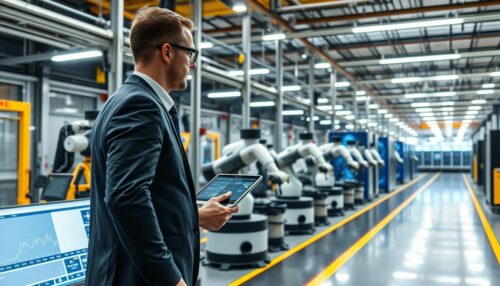
The arrival of 5G technology is changing industrial IoT by giving it a strong connection base. This is key for smart manufacturing’s future. It makes data transfer quicker and connections more reliable.
Ultra-Reliable Low-Latency Communication (URLLC)
URLLC is a major part of 5G networks, offering latency as low as 1 ms. This is vital for mission-critical applications in industries.
Mission-Critical Applications
These include real-time monitoring and control systems. Any delay could cause big losses or safety risks. With URLLC, industries can send data on time, boosting efficiency and safety.
Massive Machine Type Communications (mMTC)
Another big part of 5G in industrial IoT is mMTC. It supports a huge number of devices. This is crucial for big IoT projects.
Scaling Challenges and Solutions
As more IoT devices are added, scaling becomes harder. Solutions include better network management and optimization. These help keep connections smooth and data handling efficient.
In summary, combining 5G and industrial IoT is set to change industrial automation. It promises better reliability, efficiency, and scalability.
Autonomous Mobile Robots (AMRs) Revolutionizing Factory Logistics
Autonomous Mobile Robots (AMRs) are changing factory logistics. They make material handling more efficient and flexible. As companies move towards Industry 4.0, AMRs help streamline operations and boost productivity.
Navigation and Obstacle Avoidance Technologies
AMRs have advanced navigation and obstacle avoidance. These features let them move safely and efficiently in complex factory settings.
SLAM Algorithms and Environmental Mapping
Simultaneous Localization and Mapping (SLAM) algorithms are key for AMRs. They create and update maps of their surroundings. This helps AMRs know where they are and navigate through changing factory floors.
“The use of SLAM algorithms has changed how AMRs work,” says an expert. “They can now adjust to changing environments in real-time.”
Fleet Management Systems for AMRs
With more AMRs in factories, managing them becomes essential. New fleet management systems are being developed. They help AMRs work together smoothly and avoid conflicts.
Traffic Optimization in Mixed Human-Robot Environments
Managing traffic in places where humans and robots work together is tough. New algorithms and data analytics are being used. They help manage traffic flow, reducing congestion and improving efficiency.
Effective traffic management is key to getting the most out of AMRs.
By using these technologies, manufacturers can improve their logistics. They can achieve better productivity and flexibility. As the technology gets better, we’ll see even more advanced AMR systems changing factory logistics.
Computer Vision and AI Quality Control Systems
AI-driven computer vision systems are changing quality control. They offer real-time inspection and feedback. This makes defect detection in manufacturing more accurate and efficient.
Defect Detection Accuracy Improvements
Deep learning models for visual inspection have changed defect detection. These models learn from huge image datasets. They can spot even the smallest defects with great precision.
Deep Learning Models for Visual Inspection
Deep learning models, like convolutional neural networks (CNNs), excel in visual tasks. They can recognize complex patterns and anomalies. This leads to accurate defect detection.
“The use of AI in quality control has reduced our defect rate by over 30%. It’s a game-changer for our manufacturing process.”
Integration with Production Lines
Computer vision systems are being added to production lines. They provide real-time feedback and correction. This means defects can be fixed right away, reducing waste and improving product quality.
Real-Time Feedback and Correction Mechanisms
Real-time feedback lets for quick fixes. This keeps production running smoothly. It’s key for maintaining quality and cutting costs.
| Feature | Traditional Quality Control | AI-Driven Computer Vision |
|---|---|---|
| Defect Detection Method | Manual Inspection | Automated Visual Inspection |
| Accuracy | Variable, Human Error | High, Consistent |
| Speed | Slow, Labor-Intensive | Fast, Real-Time |
Augmented Reality for Maintenance and Worker Empowerment
As industries move towards Industry 4.0, augmented reality is becoming key for maintenance and worker empowerment. AR is changing how maintenance tasks are done, making them more efficient and cutting downtime.
AR Headsets and Wearable Technology
AR headsets and wearable tech are leading this change. They give workers real-time, interactive guidance. This helps them do complex maintenance tasks more accurately.
User Experience and Adoption Challenges
But, there are hurdles to using AR, especially in how easy it is to use. Making AR systems intuitive and user-friendly is key for it to be widely accepted.
Remote Expert Assistance Applications
AR’s big plus in maintenance is remote expert assistance. Experts can guide technicians through tough procedures in real-time. This cuts down the need for on-site visits.
Knowledge Transfer and Documentation
AR also helps with knowledge transfer and documentation. It captures and stores maintenance procedures and insights. This builds a valuable knowledge base for future technicians.
| AR Application | Benefits | Challenges |
|---|---|---|
| Maintenance Guidance | Real-time instructions, improved accuracy | User adoption, hardware costs |
| Remote Expert Assistance | Reduced on-site visits, faster issue resolution | Connectivity requirements, latency issues |
| Knowledge Transfer | Captured procedures, training insights | Data management, access controls |
Using augmented reality in maintenance boosts worker empowerment and makes industrial operations more efficient. As AR tech gets better, its role in industrial automation will grow even more.
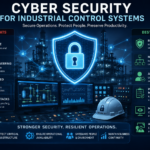
Cybersecurity Frameworks for Smart Factories
The use of AI and IoT in manufacturing has made cybersecurity very important. Smart factories are now more connected and use complex systems. This makes them more vulnerable to cyber threats.
Threat Landscape for Industrial Systems
Industrial control systems (ICS) and operational technology (OT) are being targeted by advanced cyber-attacks. The mix of OT and IT systems has opened up new risks. Manufacturers must update their cybersecurity plans.
OT/IT Convergence Security Challenges
The blend of OT and IT systems brings several security issues, including:
- More devices to attack, increasing the risk
- Difficulty in managing different security rules
- Risk of big failures in connected systems
Zero-Trust Architecture Implementation
Using a zero-trust architecture is now a top choice for protecting smart factories. This method assumes threats can come from anywhere. It requires strict checks on who gets to access the network.
Security by Design Principles
Applying security by design means making cybersecurity a part of every step in making things. It’s about being ready for threats from the start. This way, risks are lowered, and factories stay safe.
By choosing strong cybersecurity plans, like zero-trust and security by design, smart factories can keep their operations safe. They also keep the trust of their customers and partners.
Sustainable Manufacturing Through Smart Automation
Smart automation and sustainable practices are changing the way we make things. Industries are working hard to be kinder to the planet. Smart automation is key in making this happen.
Energy Optimization Algorithms
Smart automation uses special algorithms to cut down energy use. These algorithms look at production data in real-time. They find where things can be better and fix them.
Carbon Footprint Reduction Metrics
We measure how well we’re doing by looking at carbon footprint. These metrics show how much less CO2 we’re making thanks to smart tech.
Waste Reduction Through Precision Manufacturing
Smart automation makes production more precise. This means less waste and better products. It’s good for the planet and for quality.
Circular Economy Integration
Smart manufacturing also helps the circular economy. It makes it easier to reuse and recycle materials. This cuts down waste and supports sustainable growth.
| Strategy | Benefits | Environmental Impact |
|---|---|---|
| Energy Optimization Algorithms | Reduced Energy Consumption | Lower CO2 Emissions |
| Precision Manufacturing | Improved Product Quality | Minimized Waste |
| Circular Economy Integration | Enhanced Resource Efficiency | Promotes Recycling and Reuse |
Using smart automation, makers can make things better for the planet. They use less energy and make less waste. This is good for the environment and helps save money too.
Workforce Transformation in the Age of Automation
The rise of automation is changing the workforce a lot. It’s creating a need for new skills and roles. As more industries use automated systems, workers must learn new things to keep up.
Emerging Roles in Automated Environments
New jobs are popping up in automated settings. These jobs need special skills to handle and keep up complex systems. One such role is that of Human-Machine Interface Specialists.
Human-Machine Interface Specialists
These specialists are key in making interfaces that let humans and machines work well together. They make sure automated systems are easy to use and work well.
Reskilling Programs and Educational Initiatives
Companies are starting programs to help workers learn new skills. These programs aim to prepare workers for an automated world.
Industry-Academia Partnerships
Partnerships between industries and schools are growing. These partnerships help create new educational programs. They make sure these programs meet the needs of industries using automation.
Key parts of these partnerships include:
- Creating curricula that fit industry needs
- Working together on research to improve automation
- Offering internships and apprenticeships for real-world experience
By focusing on changing the workforce and providing the right training, industries can smoothly move to more automated operations.
Regulatory Developments Shaping Industrial Automation
Regulatory changes are reshaping the world of industrial automation. New rules are coming in to make things safer, more secure, and efficient.
International Standards Evolution
The world of international standards is changing fast. Groups are working hard to make sure rules are the same everywhere.
Harmonization Efforts Across Regions
There’s a push to make things easier for companies that work all over the world. They’re working on making safety, cybersecurity, and data protection rules the same everywhere.
Data Privacy and Ownership Frameworks
Data privacy and ownership are getting more attention in industrial automation. New rules are being made to keep important information safe.
Compliance Requirements for Global Operations
Companies that work all over the world have to follow many rules. They need to follow data privacy laws and industry standards.
Key regulatory developments include:
- Enhanced data protection regulations
- Stricter cybersecurity standards
- Harmonized safety protocols across regions
As a leading industry expert said,
“The regulatory landscape for industrial automation is becoming increasingly complex, requiring companies to stay informed and adaptable.”
Investment Landscape and Market Opportunities
The investment landscape for industrial automation is changing fast. It’s growing thanks to AI, robotics, and smart manufacturing. These advancements are making factories more efficient and cost-effective.
Venture Capital Focus Areas
Venture capital is now more into startups that bring new ideas to the table. They focus on predictive maintenance, collaborative robots, and digital twins. These innovations are changing how we make things, making it better and cheaper.
Emerging Startups and Innovation Hubs
New startups are key in pushing the limits of industrial automation. Places like Silicon Valley and Singapore are hotspots for new tech and business ideas. They help create the next big things in automation.
Government Incentives and Programs
Worldwide, governments are offering help to invest in automation. They want to make factories more competitive and boost the economy. These efforts are aimed at helping businesses grow.
Public-Private Partnership Models
There’s a new way of working together: public-private partnerships. Governments, companies, and research groups are teaming up. This teamwork is helping bring advanced automation to the market.
Conclusion: Navigating the Future of Industrial Automation
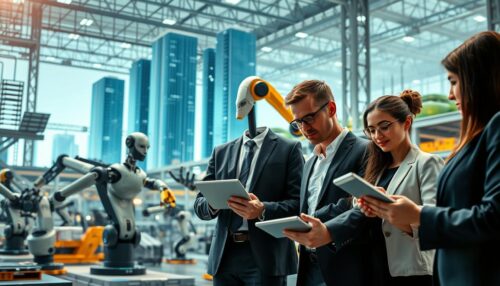
The future of industrial automation is changing fast. Advances in AI, robotics, and smart manufacturing are leading the way. These technologies are making production better, more efficient, and cheaper for companies.
AI and machine learning are changing how we do maintenance, check quality, and plan production. Robots and cobots are working better with people. Digital twins and edge computing help make quick decisions.
As automation grows, companies face new challenges and opportunities. Smart manufacturing means better productivity, less waste, and more green practices. But, they must also worry about keeping data safe, changing workforces, and following rules.
To lead in the future, companies need to invest in new tech, form partnerships, and encourage creativity. This way, they can find new chances, grow, and stay ahead in a fast-changing world.